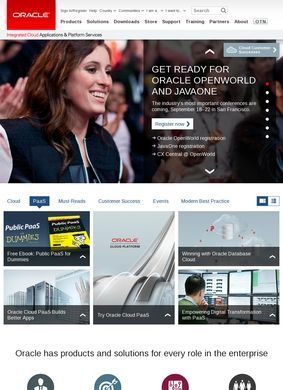
Oracle is an American multinational technology corporation, founded in 1977 and known first of all as the maker of the relational database that carries its name. The company has grown from that single product into one of the largest enterprise software and cloud vendors anywhere, and oracle.com is where the whole catalogue sits: databases, cloud infrastructure, packaged business applications, engineered hardware, and the developer tooling that stitches them together.
Breadth is the point. A finance controller weighing a new ledger, a database administrator comparing storage options, a developer hunting for open-source documentation, and a CIO deciding whether to move an entire estate off its own servers can all begin from the same domain. That is a rare thing for one vendor to pull off.
The material here is dense and unapologetically aimed at people who build and run large systems. It is not a shop window for casual browsing, and it does not pretend to be. Oracle assumes its visitor already speaks the language of enterprise IT, and the writing rarely stops to explain a term.
From a single database to a full cloud stack
The founding product still anchors everything. Oracle Database remains the software the company is measured by, and the site treats it as a family: the flagship engine, the technology that surrounds it, and the cloud services built to run it at scale. Decades of banks, airlines, and government systems have been built on that engine, which is why so much of the surrounding catalogue reads as an answer to the question of where all that data should live next.
The pitch across the site is a full stack. Where a customer once bought a database licence and ran it on their own metal, Oracle now wants to supply the metal, the operating layer, the database, and the applications on top, all as services. Whether that consolidation is a strength or a lock-in is a fair debate, and the depth of technical detail on the site at least gives a reader enough to argue it honestly.
That shift also explains the shape of the catalogue. Much of what Oracle publishes now reads as a bridge from the on-premises world it dominated to the cloud world it is chasing, and the pages tend to acknowledge both ends of that bridge instead of pretending the old estate does not exist. For a reader trying to place the company against a pure cloud-born rival, that dual identity is the single most important thing to grasp.
Oracle Cloud Infrastructure and engineered systems
Oracle Cloud Infrastructure, usually shortened to OCI, is the company's answer to the hyperscalers. It is presented as high-performing cloud services covering compute, storage, and networking, positioned squarely against the more established names in that market. The site pairs it with the older idea of engineered systems: hardware and software designed and tuned as a single unit so that the database runs faster on Oracle's own boxes than on a generic server. That hardware lineage is unusual for a company most people think of as a software house, and it is a genuine differentiator worth understanding before any comparison.
For an organisation already deep in these databases, OCI carries an obvious gravitational pull, since running the workload on the vendor's own infrastructure removes a layer of friction. A team starting fresh will want to read the technical pages closely and weigh them against competitors, because the marketing claims are strong and the real test is the workload in front of you. Oracle has spent heavily to make this part of the story credible, and the site does not shy away from performance numbers.
Fusion Cloud Applications and the ERP line
On top of the infrastructure sits a very large applications business. Oracle Fusion Cloud Applications is the current, cloud-native line, and Oracle Cloud ERP within it handles enterprise resource and finance management, pitched around resilience and agility for the office of the CFO. The catalogue extends into industry-specific SaaS suites, more than two dozen of them by the company's own count, covering banking, healthcare, and the public sector among others, each with AI, machine learning, and analytics built in rather than added on later.
The older systems have not vanished, and that honesty is useful. Oracle E-Business Suite and JD Edwards EnterpriseOne, both long-running on-premises platforms, still appear in the picture, since a huge number of live installations sit on exactly those products. A buyer researching a migration path can see both the destination and the legacy starting point in one place, and that continuity is one of the more practical reasons to consult the site.
The applications span finance, HR, and supply chain, the core functions most large organisations run on. For anyone evaluating a suite at that scale, seeing the whole range laid out with its AI and analytics claims spelled out is a reasonable place to begin the due diligence. Oracle competes hard here against the other giant of business applications, and the site is plainly written with that rivalry in mind.
Who the platform is built to serve
The audience is broad but specific. Oracle serves enterprises, government organisations, OEM and ISV partners, and individual developers, and the site is organised around those very different needs. A government body running a national payroll and a solo developer testing a database driver are both catered to, which is a wide gap to bridge on a single domain.
That range shapes how the site reads. Parts of it are executive-facing, framed around business outcomes and total cost. Other parts drop straight into configuration detail, driver downloads, and reference material. The site does not smooth those two registers into one, and a reader gets more out of it by knowing which of the two they came for.
The partner angle deserves a mention too. Oracle sells to the organisations that run its software and, separately, to the OEMs and ISVs that build products on top of it, which is why chunks of the site read like a supplier catalogue for other technology companies. Individual developers sit at the far end of that same spectrum, and Oracle keeps a distinct set of pages and free tiers aimed squarely at them.
MySQL and the open-source side
One piece often surprises people who file the company purely under expensive enterprise software: it also owns and offers MySQL, one of the most widely used open-source databases in the world. MySQL powers an enormous share of web applications, and its presence here means the same corporation stands behind both a premium commercial engine and a free, community-rooted one. For a developer, that makes the site a legitimate first stop for MySQL documentation and downloads, quite apart from anything to do with the commercial products.
The community edition remains free to use, and the reference manual is thorough, which keeps the domain relevant to people who will never touch the paid catalogue at all.
Holding both a proprietary flagship and a leading open-source project under one roof creates an obvious tension, and the company has drawn scrutiny over how it stewards the open-source side. Even so, the practical value stands: the reference material is authoritative, and the two database worlds sit a click apart. A team can compare a lightweight open-source option against a heavyweight commercial one without leaving the domain, which is a genuinely useful thing to be able to do.
Taken together, the site works as the front door to a very large technology portfolio: the database that started the company, and the cloud, hardware, and applications it sells today. It rewards a visitor who arrives with a specific problem and knows roughly what they are looking for, and it can overwhelm anyone who does not. The value tracks pretty directly with how well that visitor already knows which layer of the stack they need before they start clicking through it.