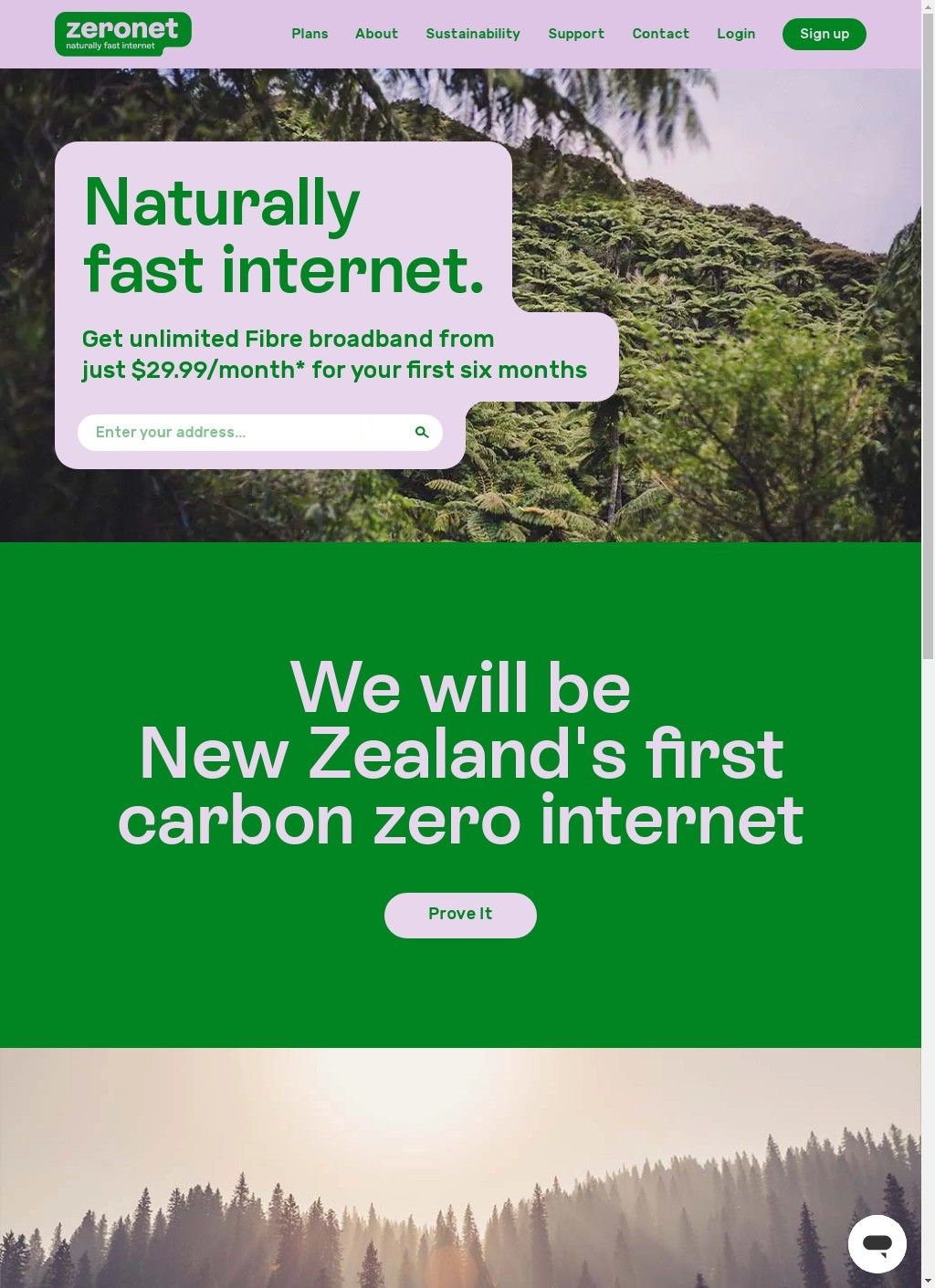
Pitching a broadband company as New Zealand's first sustainable internet and mobile provider is a line you do not hear often, and that is what Zeronet leads with. Whether the environmental angle changes anything technical about the fibre coming down the line is debatable, but it sits on top of a fairly conventional offering: Ultra-Fast Fibre delivered over the Chorus network, unlimited data on every plan, no asterisk hiding a cap somewhere.
Plan options from starter to hyperfibre
The plan ladder is where most readers will spend their attention. Zeronet's Fibre Starter sits at roughly $70 a month, with a six-month half-price hook bringing it down to $35 on a twelve-month term, which does real work in a price-sensitive market. From there the standard Fibre plans land somewhere between $58 and $70 monthly, Fibre Max climbs for heavier households, and at the top end sit two Hyperfibre tiers, 2000 and 4000, aimed at large families, businesses, gamers and content creators who genuinely saturate a normal connection. That spread is honest about who Zeronet serves. A single person streaming a couple of shows has no business on Hyperfibre 4000, and the site does not pretend otherwise.
Router rental and mobile integration
Hardware terms are refreshingly plain. A router runs from $1 a week to rent, or comes free on a monthly plan, which removes one of the small frictions people hit when switching providers. On the mobile side Zeronet runs SIM-only plans with 3G, 4G and 5G support, VoLTE, and eSIM on compatible handsets, and bundling a mobile plan with broadband knocks $5 off the monthly bill. None of this is exotic, but it is the modern baseline done without obvious gaps, and the $5 bundle saving is a quiet nudge toward keeping both services under one roof.
Speed claims get a citation, which is more than many providers bother with. Zeronet points to the Measuring Broadband New Zealand Report to back up its performance figures, an independent yardstick that lets a prospective customer check the boast against something other than the marketing page. That is a small thing, but it says something about a company comfortable being measured against external data.
From support documentation to external reviews
Where the experience gets less polished is finding a human. There is no phone number anywhere on the main site, and no physical address either. Support runs through live chat, Monday to Friday, 8am to 8pm, closed Sundays and public holidays, plus an email route at the care subdomain. The contact details are reachable, but they live one click away on a separate support portal at care.zeronet.co.nz, not front and centre on the homepage. For a customer who likes to call a provider before switching, the absence of a voice line will register. A missing email would not bother most people, since a chat window and an inbox cover the same ground, but no phone option at all is a fair thing to weigh.
Inside the support portal
That same support portal turns out to be one of Zeronet's stronger assets once you are inside it. It walks through account setup, billing questions, router troubleshooting, number porting, and the practical business of migrating away from other carriers, naming One NZ, Skinny, Compass and Rocket Mobile specifically. Switching providers is the moment most people abandon the idea, and a documented path does more to reassure a wavering customer than any tagline. The detail here suggests Zeronet has thought carefully about the part of the journey that usually goes undocumented.
The picture on external platforms is limited. Trustpilot carries only four reviews, too few to draw a firm line through, though the sentiment skews positive and one reviewer singled out competitive pricing and a professional sign-up process. Reddit threads in the New Zealand and Auckland communities run mixed to positive, with recurring praise around price and a handful of good first-hand experiences, set against a couple of users who flag that Zeronet does not yet have a long track record to point to. Geekzone discussion places Zeronet in the usual pricing comparisons against Skinny, and MoneyHub published an editorial take on its mobile offering. There is no Google, Yelp, Facebook or BBB footprint to lean on, so the reputation rests on a small, scattered set of voices.
That track-record gap is the honest tension in any look at Zeronet. The pricing is competitive, the plans are clearly tiered, the support documentation is unusually thorough, and the sustainability framing gives Zeronet a distinct identity in a category where most providers sound interchangeable. Against that, the company is newer and quieter than the established names, the review volume is too low to be statistically meaningful, and the deliberately phone-free support model will not suit everyone. Both of those things are true at once.
For the right customer the case is genuinely strong. Someone comfortable with chat and email support, drawn to the environmental positioning, and chasing unlimited data at a sharp price, especially with that six-month half-price Starter deal, will find little to complain about. The Hyperfibre tiers mean Zeronet scales with a household if its needs grow, so customers are not locking themselves into a ceiling. The migration guides take much of the dread out of leaving whoever you are with now.
Someone who wants a phone number to call, a longer public history to scrutinise, and a thick stack of independent reviews will find Zeronet harder to evaluate at this stage, and those are reasonable concerns. The offering itself is well-structured and clearly priced. The reputation is still forming, which is the ordinary condition of any provider building its name, and the published evidence available right now is enough to assess the product but not enough to fully assess the company behind it.
Business address
Zeronet
162 Grafton Road, Grafton,
Auckland 1010,
Auckland
1010
New Zealand