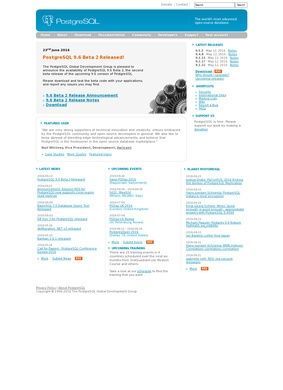
Someone has chosen PostgreSQL for a new application, or inherited a system running on it, and now needs the canonical source: the exact release to install, the documentation that matches that release, and a clear answer on how long the version they picked will keep getting fixes. PostgreSQL.org is the home of the open-source relational database itself, and it is the distribution point and reference desk for a piece of software that has been in active development for more than thirty-five years. No vendor sits between you and the project here; what you get is the project itself.
Download paths for every supported release
The first thing the site has to get right is the download path, and it does. Every supported release is published here, with the current list running 18.4, 17.10, 16.14, 15.18, and 14.23, plus a version 19 beta. That breadth is deliberate. A team running a database in production rarely jumps to the newest major version on day one, so being able to pull the precise minor release for whichever major line they committed to, and to read the release notes that go with it, is the difference between a clean patch and a guessing game. The beta is there too, openly, for anyone who wants to test their workload against what is coming before it lands in a stable release.
Versioned documentation by major line
Behind the binaries sits the documentation, which is the part most database administrators end up living in. It covers the SQL the engine accepts, the API references, configuration options, and the release notes that record exactly what changed between point releases. The docs are versioned to match each major line, so a person on PostgreSQL 15 reads the 15 manual and is not tripped up by a feature that only exists in 18. For a system this large, that discipline is more useful than any single tutorial would be, and it is one of the reasons PostgreSQL has the reputation it does among people who actually run it in production.
Core database capabilities
The software being documented is a full relational database. PostgreSQL speaks advanced SQL, holds to ACID guarantees, uses multiversion concurrency control so readers and writers do not block each other, and handles JSON, full-text search, and replication without requiring a separate product for each capability. The extensibility is the quiet headline: you can add data types, functions, and whole extensions, which is why the same engine turns up under a hobby project and under a company processing serious transaction volume. The audience the site serves reflects that range, from individual developers to database administrators to organizations that need a production-grade database they do not have to license.
Mailing lists and community infrastructure
Around the core software, the project keeps a real community apparatus, and the site is the front door to it. Mailing lists are hosted at the lists subdomain, and they are where genuine support and development discussion happen. There are user groups, developer resources for people who want to contribute, formal beta testing programs, a bug tracker, and security advisories published when they are needed. Someone who arrives expecting a vendor pitch will instead find the operating machinery of an open project laid out plainly. PostgreSQL has been governed this way since the early 1990s, and the infrastructure reflects that continuity.
Governance and feature matrix
The supporting sections fill in the parts that a long-lived database has to address. The About area explains how the project is governed and carries a feature matrix, which is genuinely handy when comparing what PostgreSQL 16 can do against PostgreSQL 14 before deciding on an upgrade path. The Community section lists conferences and events. Support documents the versioning scheme and, importantly, the end-of-life policy, so an administrator can see in advance when a given major line stops receiving fixes and plan the migration instead of being surprised by it.
Packaging across Linux, macOS, Windows
There is also a listing here that points to PostgreSQL.org, and the site itself gives that listing something real to point to: download packages for Linux, macOS, and Windows; installers and container images; source tarballs for anyone building from scratch; and platform-specific notes that go beyond a generic readme. The packaging work is not trivial, and having it consolidated in one place rather than scattered across mirrors makes it genuinely easier to provision PostgreSQL consistently across environments.
What you do not get here is hand-holding. PostgreSQL.org assumes a reader who already knows roughly what a relational database is and wants authoritative detail, not an introduction to the concept. The documentation is thorough and precise, and that precision is also what makes it dense; a newcomer landing on the manual cold may find it heavier going than the friendlier write-ups that third parties publish elsewhere. The site is the reference, and it reads like one. That is a fair trade for the depth on offer, but it is worth knowing before you go in expecting a tutorial.
The harder question is the one the project itself keeps in front of you through that end-of-life policy. Choosing PostgreSQL means choosing a version, and every version has a clock on it. The site is honest about that, which is fair, but staying current with five supported major lines and a beta in flight is a real maintenance commitment. The burden of tracking which release you are on and when it expires lands on whoever runs the database. For PostgreSQL specifically, that ongoing upgrade discipline is the actual long-term cost, and the project documentation makes sure you know it rather than glossing over it with reassurances about stability.