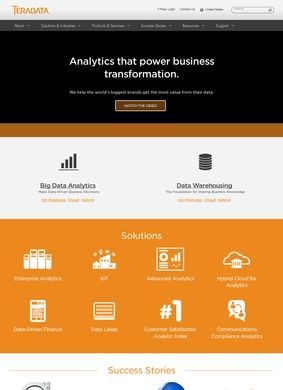
Teradata has been selling database technology since the mainframe era, and its current offer to cloud-age buyers centers on Vantage, a connected analytics platform built to run across AWS, Azure, and Google Cloud, on-premises, or in hybrid setups where some data stays in a private data center and some moves out. Teradata answers that with Vantage, a connected analytics platform built to run across AWS, Azure, and Google Cloud, on-premises, or in hybrid setups where some data stays in a private data center and some moves out. Vantage is designed to be the single analytics layer over all of that, so a bank or a retailer running petabyte-scale workloads does not have to pick one cloud and rebuild everything around it.
Vantage product range
The product range underneath that umbrella is more granular than a quick glance suggests. VantageCloud Enterprise is the traditional massively parallel deployment moved to the cloud, aimed at organisations that want the familiar high-concurrency engine without owning the hardware. VantageCloud Lake takes a different tack, built cloud-native on object storage so compute and storage scale independently, which tends to matter when workloads are spiky and paying for idle capacity is not appealing. Sitting on top is ClearScape Analytics, the in-database analytics and machine-learning function library that lets teams run models where the data already lives instead of shuttling it out to a separate tool. QueryGrid rounds it out as a data fabric for federated queries, reaching across heterogeneous sources so an analyst can join data that physically sits in different systems.
Target sectors and pricing model
That spread tells you who the audience is. This is not a free tier you spin up on a Friday afternoon. The named sectors are financial services, retail, manufacturing, healthcare, telecommunications, and government, the kind of environments where query concurrency, governance, and predictable performance at scale are the whole game. Pricing is available on request, which is standard for software sold to that buyer; deals are shaped around an organisation's footprint rather than a published rate card.
Multi-cloud deployment options
On the question of whether it fits modern data teams, the platform leans toward openness more than its legacy reputation would imply. It supports SQL, Python, and R, works with open-source frameworks, and integrates with the tools data engineers reach for day to day: dbt for transformation, Apache Spark for distributed processing, and the major BI platforms for the reporting layer. The inclusion of dbt and a dedicated developer portal stands out, because those are the things a practitioner checks first. Teradata also publishes detailed developer documentation alongside the portal, and that combination does more concrete work for an engineering team than any case study.
Developer tools and documentation
Beyond the engine itself, the site carries the apparatus you expect from a vendor selling to large IT organisations. There are solution pages organised by industry, a partner section, customer case studies, and a resource library stocked with white papers, analyst reports, and webinars. The blog handles the broader conversation. Teradata also runs professional services covering implementation, migration, and managed operations, which is the realistic part: moving an enterprise data warehouse onto a new platform is rarely a self-service exercise, and having the vendor's own people available for the migration is often what makes a project viable.
The education side is worth noting. Through Teradata University the company offers training and certification, which addresses a real constraint for adopters, namely finding staff who already know the system. Certification programmes also keep a platform sticky inside an organisation once in-house skills are built, and that cuts both ways for a buyer weighing long-term commitment against Teradata's ecosystem.
Across the whole proposition there is a coherence that is easy to miss on a first pass. The multi-cloud positioning, the federated query layer, the in-database analytics, and the migration services all point at the same buyer: a large enterprise that already has data scattered across systems and clouds and wants to analyse it without first consolidating everything into one place. For that buyer, the breadth here is a genuine strength. For a small team or a startup, the same breadth reads as overkill, and the request-only pricing confirms the platform was never built for them.
Set against Snowflake, which has become the default reference point for cloud analytics, the comparison gets interesting. Snowflake's appeal is the clean separation of compute and storage and a frictionless onboarding story, and VantageCloud Lake clearly answers in that direction. Where Teradata holds ground is the hybrid and on-premises reality, the deep professional-services bench, and decades of running the heaviest concurrent workloads in regulated industries. A team starting fresh on a blank slate may well prefer Snowflake's simplicity; an organisation with an existing Teradata estate, strict data-residency rules, or workloads that cannot all move to a single public cloud has a stronger case for what is documented and supported here. The platform suits that second group well and is an honest skip for the first.