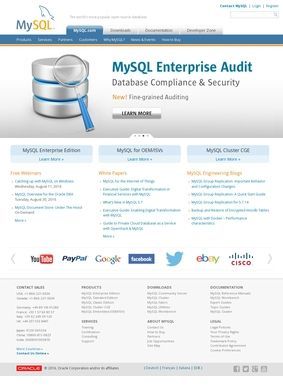
Where does a developer go for the genuine article, and what is waiting once they arrive? The answer is mysql.com, Oracle Corporation's official home for the database it bills as the world's most popular open source database, and the site hands over two things at once: the free software itself, and a ladder of paid editions and cloud services built on top of it. Both parts are on display from the front page, and telling them apart is most of what a first-time visitor needs to do.
The audience is broad by design. Individual developers pulling down a free copy sit at one end; large enterprises and government organizations sit at the other; and in between are the OEM and ISV partners the site says number more than two thousand, companies that embed the engine inside their own products. One codebase, several very different kinds of customer.
The banner claim, that this is the world's most popular open source database, is the sort of line a company writes about its own product, so it deserves a pinch of salt. What the site can point to underneath it is real breadth: a partner count in the thousands and an edition range that runs from a free download to carrier-grade deployments. MySQL has been a default pick for web applications for a long stretch, and the front page is arranged to keep it in that position.
What the official MySQL site puts on offer
The editions, from Community Server to Cluster
The core download is MySQL Community Server, the free and open source edition that made the name in the first place. For most developers, hobby projects and a large share of production websites running today, that is the whole story, and the site does not hide the download behind a paywall or a mandatory account.
Above it sits a commercial tier. Enterprise Edition adds advanced features and formal support for organizations that need a contract behind their data, and Cluster CGE is pitched at carrier-grade workloads where scalability and uptime are the deciding factors, the sort of deployment a telecom or a payment system runs. The progression is clear once you look: the same database, sold in heavier configurations as the stakes rise. A visitor should read the edition pages carefully, because the jump from the free server to the supported tiers is where the pricing conversation with Oracle begins.
What the ladder does not always make plain is how much stays free. The Community Server carries the open source license and the full core engine, so the gap a paying customer is really closing is support, a set of advanced features, and the assurance of a vendor at the other end of the line.
For a lot of projects that gap never needs closing at all. For a bank or a national agency, closing it is the entire reason to sign, and the site is candid enough about which capabilities live only in the paid editions that the decision can be made without guesswork.
HeatWave and the cloud turn
The newer part of the offering leans hard toward the cloud. MySQL HeatWave is presented as a cloud service that folds analytics and generative AI capabilities into the database, so that transactional data and analytical queries live in one place instead of being shuttled to a separate warehouse. There is also a MySQL AI line that brings machine learning and AI features into the platform directly.
The pitch behind MySQL HeatWave is consolidation. Run the transactions and the analytics against the same data, in the same place, without standing up a separate warehouse and copying rows between the two. For an organization already carrying that split, the appeal is obvious, and the generative AI features layered on top are the current version of that argument.
This is the direction Oracle is clearly pushing, and the marketing weight on the site reflects it. For a reader who came for a plain relational database, HeatWave and the AI line are worth understanding but easy to set aside. They answer a different need than a straightforward transactional store, and nothing forces a small project toward them.
Workbench, Shell and the daily tooling
Software alone is only half of what a database team touches day to day, and the site provides the surrounding tools. MySQL Workbench is the graphical client for design, administration and query work. MySQL Shell is the command-line and scripting interface for people who live in a terminal. MySQL Router handles connection routing in front of clustered or replicated setups.
Between them the three cover different working styles without forcing one on anyone. A newcomer can point and click through Workbench; a scripter automates from the Shell; an operations team leans on Router to keep traffic moving when a node drops out. None of these is walled off behind the paid tiers, which keeps the free download genuinely usable in production instead of crippled into an upsell.
Sitting behind all of it is the documentation, and this is arguably the strongest reason the site is worth opening at all. The MySQL reference manuals are thorough, versioned per release, and treated as a primary resource, which is what a developer chasing a specific function signature or a configuration flag actually needs. The versioning is not a small detail, because behaviour shifts between releases and a manual pinned to the wrong one costs an afternoon. A great deal of real-world troubleshooting ends on these pages.
Training, certification and support
For teams that want more than documents, the site lists training and certification programs, tiered technical support, and consulting. Certification gives a database administrator a credential to point at when hiring managers are weighing candidates, and the support tiers matter to any organization that cannot afford to be alone with a production outage at two in the morning. The consulting arm is aimed at groups planning a migration onto MySQL, or tuning a deployment that has outgrown the shape it was first built in.
The site also maintains community channels on Facebook, X, LinkedIn and YouTube, where releases and technical material get circulated. These extend the official material outward, and for a technology with this large a user base, an active stream of updates is genuinely useful to follow. The YouTube presence in particular tends to carry conference talks and feature walkthroughs, which fill the gap between a dense manual and a live person explaining how a feature is meant to be used.
One thing worth keeping in view across all of these services is the ownership. Everything here routes back to Oracle, and the free database and the paid stack are branches of the same tree. That is neither hidden nor sinister; it simply shapes what the site is trying to do at every turn.
So the qualified verdict is this. As the canonical source of the software and, above all, of the reference documentation, mysql.com is close to indispensable, and there is no better first stop for the actual downloads and manuals. The site is well organized for a project of this size, and the separation between the free engine and the paid stack is stated plainly enough that nobody has to be tricked into either.
The caveat is the commercial gravity of the place. A fair chunk of the surface is a sales funnel steering serious users toward Enterprise Edition, HeatWave and the cloud, and a plain developer who came for the free MySQL server and the docs will spend a little time stepping around the pitch to reach them. Useful and authoritative, then, with a commercial current running under most of the pages, which is exactly what an official vendor site owned by Oracle was always going to be.