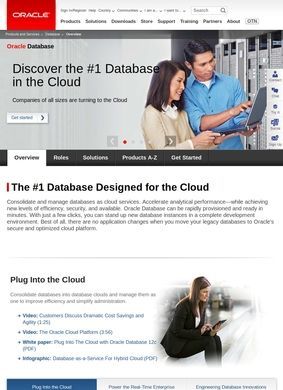
Headline product on this page is the Autonomous AI Database, the edition of Oracle Database pitched as self-driving, self-securing, and self-repairing, running serverless so nobody has to babysit patching or tuning. That positioning tells you a lot about who this page is written for: shops that already run heavy workloads and want fewer hands on the wheel. Oracle Database has been the relational engine behind a large slice of enterprise finance and government systems for decades, and the site treats that history as a given, spending its space instead on what the current line can do.
Product family and deployment options
The product family is wider than a single download. The core relational engine sits at the center, now branded as the AI Database, and around it sit Exadata, the engineered hardware-and-software stack built for the kind of throughput a stock exchange needs, and the Base Database Service, which is the cloud VM deployment with lifecycle automation and pricing meant to flex with usage. There is also Oracle NoSQL for non-relational needs, and MySQL gets folded in under the same database technologies banner, which is worth knowing if you arrived expecting only the proprietary flagship of Oracle Database. Someone comparing options will appreciate that the deployment story is laid out honestly across three modes: on-premises, Oracle Cloud Infrastructure, and a hybrid of the two. You are not locked into the cloud to get the newer capabilities.
Multi-model data storage capabilities
What I found genuinely useful on the technology pages is the multi-model angle, because it is explained in concrete terms instead of slogans. One data store handles relational SQL, JSON documents, graph, and spatial data, and you reach all of it through open-standard SQL, REST, JavaScript, and an Apache Iceberg interface. For teams that have been juggling a separate document database and a separate graph database alongside their relational one, that consolidation is a real practical pitch, not a marketing flourish. It means fewer systems to license, secure, and keep in sync. Whether it beats a best-of-breed setup depends entirely on the workload, and the site does not pretend otherwise, which is more honest than you get from most vendor documentation at this tier.
Operational features for database administrators
On the operational side the feature list reads like what a database administrator would work through during a proper evaluation. ACID-compliant transactions are spelled out, along with automated backup and recovery, high availability and replication through GoldenGate, encryption, auditing, and scaling for large datasets. None of this is novel for an enterprise database in this tier, but it is documented clearly enough that an evaluator can map it against requirements without guessing. GoldenGate in particular has a long track record for replication and data integration, so its presence here is a meaningful checkmark for anyone planning active-active setups or zero-downtime migrations.
Lowering barriers for new developers
More surprising, given how heavyweight Oracle Database's reputation is, is how much attention goes to lowering the barrier to entry. There are low-code development tools aimed at business analysts who are not full-time developers, and a lightweight Docker container that lets a developer spin up an instance quickly to try things out. Oracle Database has historically carried a reputation for being hard to get started with, and a quick container path is a sensible answer to that complaint: the first hour with a platform often decides whether developers adopt it from the ground up or wait for it to be handed down from above.
Target sectors and workload profiles
The customer profile the site describes is consistent with everything else: enterprises in finance, government and defense, scientific research, and healthcare. These are sectors with strict uptime, audit, and compliance demands, and the Oracle Database feature set is clearly tuned to them. If you run a small application with modest data, almost none of this is aimed at you, and the documentation makes no real effort to court that audience. That is a fair scoping decision, though it does mean a smaller team should read the technology overview carefully before assuming the platform fits, because the gravity of the product is squarely on large, regulated workloads.
Pricing flexibility without published rates
One honest limitation worth flagging: pricing is described as flexible but is not published. For the Base Database Service the page talks about flexible pricing without putting numbers on the screen, so any real cost picture requires a direct conversation. That is standard for enterprise database licensing, where the final figure depends on cores, editions, support tiers, and deployment, but it does mean you cannot self-serve a budget estimate from this site the way you can with some cloud-native competitors. Plan on that being a negotiation rather than a checkout.
Navigation across the public pages is straightforward. There is a products A-to-Z listing, a technology overview, a features page, and a dedicated Base Database Service features page, all reachable without hunting. The structure mirrors how a serious evaluator actually moves: start at the overview, drill into the specific edition, then check the feature matrix against a requirements list. For a sprawling product line, keeping those entry points clean is harder than it looks, and the site manages it.
The clearest use for this resource is evaluating whether to consolidate multiple data engines onto one platform, or to modernize an existing Oracle Database estate toward the autonomous or cloud editions. Start with the technology overview to confirm the multi-model claims against your actual data shapes, then pull the Docker container to get hands-on with the core engine before any sales discussion. When pricing comes up, go in with a specific question about Base Database Service costs for your core count and deployment mode, because that is the one figure these pages will not hand you up front. MySQL sits under the same umbrella and is the more proportionate starting point for lighter workloads; the full Oracle Database stack is built for a different weight class entirely.
Business address
Oracle Database
365 N Scottsdale Road, SkySong 3 Building, Suite 340,
Scottsdale,
AZ
85257
United States
Contact details
Phone: +1-602-824-6299
Fax: +1-602-824-6291