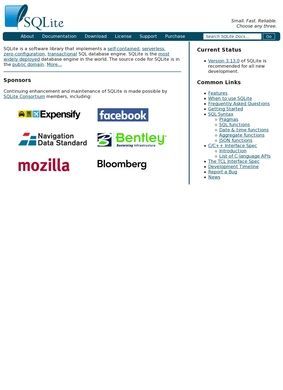
Developers need to store structured data in an app, reach for a database, and immediately hit the wall: install a server, configure a port, manage a daemon, set credentials, keep the thing running. For a phone app, a desktop tool, or an embedded gadget, that overhead is absurd. The official SQLite site answers exactly this, and it answers it with a piece of software you have almost certainly used today without knowing it. SQLite is a C library that puts a complete SQL database engine inside your program, with the whole database living in one ordinary file on disk and no server process anywhere in sight.
What SQLite is
The pitch on the home page is blunt about reach: this is described as the most widely deployed database engine in the world, built into every mobile phone and most computers. That is not marketing bravado once you trace where the engine truly runs. Browsers use it. Operating systems use it. Embedded devices, desktop applications, and the small data stores tucked inside countless mobile apps all sit on top of it. The site frames SQLite as serverless, self-contained, zero-configuration, and transactional, and each of those words maps to something a working programmer can verify instead of just nodding along to.
Serverless database engine
Self-contained means the engine has no external dependencies to chase down. Serverless means there is no separate process to start, monitor, or secure. Zero-configuration means you do not edit a config file before the first query runs. Transactional means writes are atomic and durable even if the power cuts mid-operation, which is the property that lets people trust it for real data rather than scratch storage. The single-file design carries a practical bonus the documentation leans on: that file is cross-platform, so a database written on Linux opens unchanged on Windows or macOS. Copying a database becomes copying a file.
Source code and downloads
The site works as the distribution point as much as the reference shelf. The SQLite source code is in the public domain, with no license fees and no contracts to sign, which is a genuinely unusual posture in a field full of dual-licensing traps. For people who do not want to compile anything, there are precompiled binaries for Windows, macOS, and Linux ready to download. The latest release listed is version 3.53.2, and the full release history sits alongside it, so you can see how the project has moved over the years and pin to whatever version a build needs. Public-domain code for software running on billions of devices is a rare thing, and the project states it plainly without burying it under terms.
Public domain license
The documentation is the part that earns repeat visits. There is a complete SQL language reference covering syntax, pragmas, and the function catalog: core functions, date and time handling, aggregates, window functions, math, and JSON. The C and C++ interface specification is documented in detail, and so is the TCL binding, which tells you something about the project's long lineage.
Documentation and references
A quick-start guide gets newcomers moving, while a FAQ and a frankly useful quirks-and-gotchas section catch the places where SQLite behaves differently from a client-server database. That honesty about its own edge cases is worth more than a glossy feature tour, because it saves you the afternoon you would otherwise spend confused by flexible typing or some other deliberate design choice. The reference does not assume you already know the engine; it explains the choices it made and why, which is the difference between documentation that answers questions and documentation that only describes.
SQL language reference
There is also a browser-based environment called SQLite Fiddle, hosted on the site, where you can write and run SQL live without installing a thing. For testing a query, showing behavior to a colleague, or just confirming how a SQLite function works before you wire it into code, that is a fast loop with nothing to set up. A bug-tracking system is published too, so the project's known issues sit out in the open instead of being hidden behind a support wall. You will not find SQLite listed inside any business directory with user ratings. That fits what it is: infrastructure code, not a service people shop for.
Browser sandbox for testing
One thing the site is careful to set straight, and the documentation does this well, is the boundary of where SQLite fits. It does not pretend to be a high-concurrency network database for thousands of simultaneous writers, and the docs say as much in plain language.
Scope and limitations
SQLite is the engine for the local case: the app, the device, the file format, the cache, the place where one process owns the data and wants SQL without the operational weight of a server. Read with that scope in mind, this listing represents one of the clearest examples of a tool built for a specific job and built honestly around it. A team that respects the documented limits rarely gets surprised; a team that ignores them and tries to run SQLite as a busy shared write server learns the hard way that the design never promised that.
For commercial users who need more than community documentation, there is a paid professional support option offering guaranteed response times. That sits as a deliberate counterweight to the public-domain core: the software costs nothing, but if your business depends on it and you need a contact with an obligation behind it, that path exists. It is a sensible model for software this deeply embedded in other people's products.
Outside the official site, public discussion is spread across Stack Overflow (where questions on the engine number in the tens of thousands) and the sqlite-users mailing list, searchable through the project's own archive. There are no aggregated star ratings to report; the software is not the kind of product people score on review platforms. That gap says nothing negative about reliability, given that the code ships inside Chrome, Firefox, Android, and iOS by default.
What makes the reference genuinely good is density without clutter. The pages are plain, fast, and text-heavy, with cross-linking that lets you start at a pragma and end up understanding why a query planner made a decision. No popups, no slow-loading framework standing between a question and its answer. The structure rewards repeat visits: you can land deep in a single page from a search engine, get exactly what you came for, and close the tab without ever touching a navigation menu.
If you are evaluating SQLite for a project, the material here gives you what you need to decide without guesswork: design constraints stated up front, interfaces documented to the call, limitations admitted, and the code and binaries one click away. A permissive public-domain license, exhaustive documentation, a live query sandbox, and an optional commercial support tier together cover the range from a hobbyist's weekend script to a shipping product with millions of installs. The decision comes down to whether your data lives in one place that one process owns, or whether you genuinely need a server, and the site gives you enough honest information to answer that.