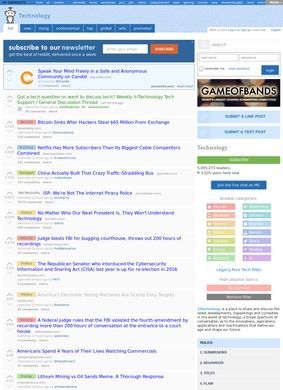
Reddit is a social news and discussion platform, and r/technology is the slice of it that gathers tech news and argument in one place. Posts are links, text threads, images, and short videos, and the crowd decides what rises through up and down votes. That voting mechanic is the whole point: what you see near the top of the feed reflects what tens of millions of subscribers cared about enough to push there, not what an editor chose. It is one of the larger technology communities on Reddit, and the volume shows in how fast a breaking story spills into hundreds of comments.
Topic range and voting mechanics
The subject range is wide and stays close to what people in tech follow day to day. Software and hardware releases, internet culture, cybersecurity incidents, artificial intelligence, consumer electronics, and the business side of the industry all surface here. A typical front page mixes a product launch, a layoff or earnings story, a policy fight over privacy or regulation, and an open question thread where people just talk through something they noticed. Net neutrality, mergers, corporate moves: the heavier debates land alongside the lighter link posts, and the same voting rules sort both.
Comment threads
Comments are where r/technology either pays off or disappoints, depending on the thread. Discussion runs as branching trees, so a single submission can hold several parallel conversations, some technical and careful, others sarcastic pile-ons. Volunteer moderators set and enforce subreddit rules, posts carry flair tags that signal topic or source, and accounts accumulate karma based on how their contributions get voted. None of this guarantees the comment under a hot story is informed. It guarantees only that it was popular, and the gap between those two things is the recurring frustration anyone who reads the place closely will recognize.
Platform infrastructure
Mechanically, the experience is consistent because r/technology inherits Reddit's wider platform instead of running its own software. The same account works across every community, the same voting and threading apply, and the same paid layers sit on top: Reddit Premium removes ads, awards and coins let users flag standout posts, and the advertising products serve businesses trying to reach these audiences. A user moving from r/technology to a gaming or science subreddit keeps the same login, the same comment history, and the same karma total, so the experience feels continuous even when the topic changes completely.
Access and public ownership
Access is through any web browser or the official iOS and Android apps, and the mobile apps push notifications for replies and mentions so a thread can keep pulling someone back through the day. Reddit, Inc. went public on the NYSE in March 2024 under the ticker RDDT, which put the company under the usual public-market pressure to grow revenue from a product built on unpaid contributions and unpaid moderation.
Community versus shareholder pressure
That tension is worth sitting with, because it shapes what r/technology is becoming. The content is generated and curated by the community, yet the platform around it is now answerable to shareholders. Decisions about API access, third-party clients, and how aggressively to monetize attention have already drawn loud objections from the same users who supply the posts and comments. A technology community is unusually sensitive to those moves, since its members tend to understand exactly what is being changed and why.
For someone trying to keep a finger on tech news, r/technology offers reach that few single outlets match. Stories arrive fast, often before mainstream coverage settles, and the comment threads occasionally surface a primary source, a correction, or a working engineer's perspective that adds something a headline cannot. The format rewards speed and consensus, though, and those are not the same as accuracy. Vote counts measure agreement, and on contested topics the loudest reading of a story can drown out the more careful one. Treating the feed as a starting point and verifying elsewhere will get more out of it than taking the top comment as settled.
What stays unresolved is whether the qualities that made r/technology useful can survive the platform it depends on. The volunteer moderation that keeps threads on topic is unpaid and overstretched, the voting system that ranks content also rewards outrage, and the company steering all of it now has investors to satisfy. Reddit has not yet shown how it reconciles a community that values open, sometimes adversarial discussion with a business model that needs predictable, advertiser-friendly engagement. The same friction has played out across other large Reddit communities, which is why r/technology watchers tend to read each policy change as a preview of what comes next. The conversations here are worth reading for now, but the structural pressures pulling at the platform run deep enough that the current character of the place cannot be taken for granted.