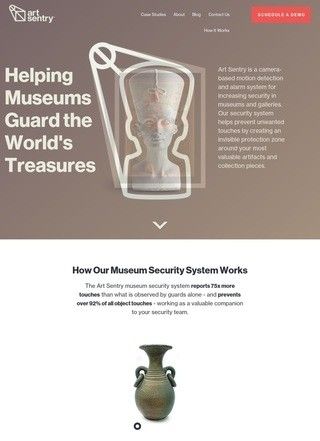
Art Sentry draws a polygon around a painting and watches that exact shape, so the protected zone hugs the artwork instead of a crude rectangle that either guards too much empty wall or leaves the edges of a frame exposed. The product comes out of Cleveland, Ohio, and Art Sentry addresses a narrow problem that big museums quietly wrestle with: visitors lean in, point, sometimes reach out, and a guard cannot watch every object every second. When someone crosses one of those custom zones, the Art Sentry system sounds an audible alert and pings security staff, and it is built to do that without a confrontation. That last detail says something about who designed it. They understood that a museum gallery is not a bank vault, and that scaring a visitor is its own kind of failure.
How the motion detection system works
The camera-based motion detection sits at the center of everything else. Around it, Art Sentry layers components that turn a tripwire into a working tool. There is a mobile app on the Apple App Store that gives staff remote live video and real-time readouts, which is useful for a security director covering several rooms or several buildings.
There is also a module the company calls Sentry Intelligence, an AI layer meant to distinguish an accidental brush from a deliberate touch and to handle common line-of-sight compliance rules. Anyone who has watched a motion sensor cry wolf at a passing sleeve will see the point of that. False alarms train staff to ignore the alarm, and a system that learns the difference between a stray elbow and a hand reaching for the canvas is worth more than one that simply triggers on movement.
Performance claims and what they mean
The claims attached to all this are specific, and specificity is the right thing to scrutinize. Art Sentry says the system catches seventy-five times more object touches than guard observation alone, and that it prevents over ninety-two percent of object contacts. It also cites a sixty percent drop in serious-damage incidents and, further down the chain of consequences, reduced insurance premiums. These are the kinds of figures a vendor controls the methodology behind, so a buyer should ask how a touch is counted and over what baseline. That said, the shape of the argument tracks with how the product works: more eyes, recording continuously, will register contacts a human roving guard never sees, and the touch-frequency and visitor analytics the platform generates give a museum data it almost certainly did not have before.
Verified museum clients
What lends the pitch credibility is the client list, because these are verifiable names and serious ones. The Toledo Museum of Art, the Detroit Institute of Art, the Butler Institute of American Art, and the National Museum of Funeral History all appear as documented users. Art Sentry goes further and states it protects more than a quarter of the top US art museums. That is a strong claim, but it is one a competitor or a curious director could test by asking around the field, and institutions of that calibre do not adopt a security system on a whim. They run procurement, they trial it, they talk to peers. A footprint like that is the closest thing to a reference check a prospective buyer gets, and it tells a more honest story than testimonials could.
Sales approach and contact options
The site found in this business directory listing is narrow in its scope and knows it. Art Sentry speaks to museum executives, security directors, and the collections and exhibition teams who decide what gets installed in a gallery. This is not consumer software and it does not pretend to be. The homepage funnels toward a single action, a "Schedule a Demo" call that routes to a contact page, which fits a product sold through conversations and walkthroughs rather than a checkout button. For a system priced and configured per institution, a demo-first path is the honest one.
The homepage holds some contact information back. There is no phone number or email on the front page; you have to click through to find a way in. For a niche enterprise vendor that is a defensible choice, since the people who need Art Sentry are a small, motivated group who will happily fill out a form, and a public phone line invites cold calls from the wrong audience. A director who wants to gauge responsiveness has to take it on faith until they submit the form. A direct line or a posted address on the homepage would cost nothing and would reassure someone who likes to know where a vendor is based.
Third-party ratings and online presence
Outside validation for Art Sentry is sparse, and it deserves a plain word. A search turns up one listing on botw.org with no rating attached, an Apple App Store app with too few reviews to show a score, and a Museum Marketplace entry that lists Art Sentry without any review count or rating. No Google, Trustpilot, Yelp, or BBB presence surfaced. The LinkedIn company page shows 243 followers, modest but consistent with a firm selling to a few hundred institutions and not the general public. The absence of star ratings is less damning here than it would be for a restaurant.
Security directors do not leave Yelp reviews about their alarm vendors, and a museum protecting eight-figure collections is not going to advertise the specifics of how it guards them. The named client institutions tell a more useful story than any rating site would in this category.
Educational content on art security
Art Sentry also publishes a library of educational content around art preservation and museum security, which is worth noting because it shows the company has enough domain depth to write substantively about the problem it is selling against. That kind of material is harder to produce convincingly than a product page, and it gives a procurement officer something to read before the sales conversation starts. Whether the content translates to product quality is a separate question, but it is more informative than a product page that stops at feature lists.
Taken together, Art Sentry reads as a company solving a defined problem for a defined buyer, with a product architecture that makes sense and a roster of institutions that backs the pitch. The polygon-zone approach is technically coherent, the Sentry Intelligence layer addresses a real operational problem, and the touch-frequency analytics give museums data they would otherwise have no way to collect. The friction is in transparency at first contact and in the limited independent third-party record, both of which a serious buyer can resolve with a single demo and a couple of phone calls to existing clients. There is enough on the site to justify booking that conversation.
Business address
Art Sentry
26404 Center Ridge Road Building B-1,
Cleveland,
OH
44145
United States
Contact details
Phone: 8884269151