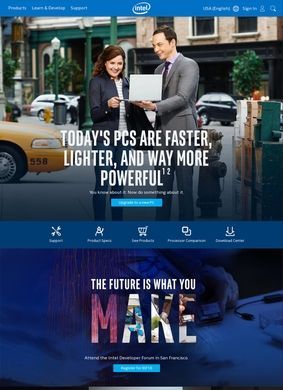
Semiconductor companies rarely make for interesting reading, but Intel Corporation has put together a site that rewards the effort of actually clicking through it. The catalogue starts with the Core processor families that show up on laptop and desktop spec sheets: Core i3, i5, i7 and i9, alongside the newer Core Ultra parts that fold a neural processing unit onto the die for on-device AI work. From there the range widens fast. Xeon chips handle servers and data centres, Atom and Celeron cover low-power and embedded jobs, and the Arc line brings discrete graphics into the picture for both consumer and workstation use. Intel Corporation has been a fixture of personal computing for decades, and the site assumes that recognition without leaning on it for padding.
Processor families for laptops, desktops, servers
A good portion of the site is built for engineers and developers, not casual shoppers. There are driver and software downloads, product documentation, support forums, and developer resources that go well past marketing summaries. The software side is heavier than a casual visitor might expect. oneAPI sits at the centre of it, a programming model that targets CPUs, GPUs and FPGAs through a single toolchain so that code does not have to be rewritten for each piece of hardware. Around it are tools like the VTune Profiler for performance analysis and the OpenVINO toolkit, aimed at optimising AI inference and distributed through the company's own packaged build. These are real downloads with real documentation behind them, and they tell you Intel Corporation treats its software as part of the product rather than a bolt-on afterthought.
Software tools for developers
The server and cloud material is organised under the Intel Data Center and AI division, and it reads as the part of the business where the heaviest engineering decisions get made. Xeon anchors it, but the pages also cover network and storage ASICs and the Gaudi AI accelerators, which target large-scale training and inference instead of the single-machine workloads that Core parts address. Optane memory shows up here too, now discontinued, and Intel Corporation carries that history honestly instead of quietly scrubbing it. That candour runs through several corners of the catalogue and makes the technical pages easier to trust.
Data center and AI infrastructure
The customer list this section implies is what gives it its particular weight. Intel Corporation sells into the cloud hyperscalers, AWS, Azure and Google Cloud among them, as well as enterprise data centres and network infrastructure providers. That breadth shapes how the documentation is pitched: dense, technical, and assuming the reader already knows what a process node is and why it matters. A consumer looking for a gaming chip and an engineer specifying a rack of servers are both served here, but they are reading very different pages. The material does not pretend to flatten that gap, and the depth on the data center side is where Intel Corporation looks least like a consumer brand and most like an infrastructure supplier.
Foundry services for contract manufacturing
The newest strategic thread is Intel Foundry, the contract manufacturing arm. This is Intel Corporation opening its fabs to outside customers who want chips built on its advanced process nodes, Intel 3 and Intel 18A among them. For most of its history Intel Corporation made its own designs on its own lines, so a section devoted to building other companies' silicon is a genuine shift, and the site treats it as a distinct division with its own footing rather than a footnote. The named process nodes give the section something concrete, which is more than most corporate roadmap pages deliver.
Direct sales to consumers
For consumers there is a more familiar shopfront. The online store sells boxed processors and NUC mini PCs directly, which keeps a tangible retail thread running through what is otherwise a deeply technical operation. It is a small slice of the overall picture, but it gives an ordinary buyer a clear place to land without wading through foundry roadmaps or accelerator benchmarks. A boxed processor and a NUC mini PC are concrete things a person can put in a cart, and that gives the broader catalogue a tangible anchor.
Taken together, the site spans an unusually wide range of audiences for one company. OEM laptop and desktop makers, embedded and IoT device builders, cloud operators, enterprise IT teams, AI researchers, and individual buyers all have material aimed at them. That can make the site feel sprawling, and navigating from a consumer Core page to a Foundry process node does take some deliberate clicking. The trade-off is depth. Very little here is surface-level, and the documentation generally answers the next question instead of stopping at a headline. Intel Corporation has clearly chosen completeness over a tidy, narrow homepage, and for the people who use these pages to specify hardware, that priority makes sense. The support forums add another layer, giving users somewhere to compare notes when the official documentation runs out.
What is worth noting is how openly Intel Corporation carries its own transitions. The discontinued Optane line is still documented. The pivot toward AI acceleration through Core Ultra and Gaudi sits alongside the long-running Xeon and Core families instead of replacing them in the messaging. The Foundry push is presented as a live, evolving business with specific named process nodes attached to it. The picture that emerges is of a company in motion, designing chips, writing the software that runs on them, and now manufacturing for others. The documentation stays deep enough that a developer or buyer can usually verify a claim against the spec sheet a click or two away, and Intel Corporation mostly does not leave the obvious gaps unaddressed.
Business address
Intel Corporation
2200 Mission College Blvd.,
Santa Clara,
CA
95054
United States
Contact details
Phone: +1-408-765-8080