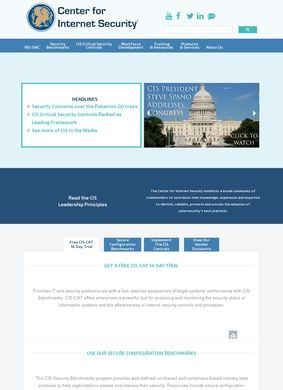
What does an organization do when the question is not whether security matters but how to put a precise number on what good security looks like? The Center Of Internet Security answers that by turning vague intentions into concrete, testable configuration. It is an independent nonprofit, and its work shows up in the form of standards that other people can pick up, apply, and check against. The two pillars most practitioners will recognize are the CIS Critical Security Controls, a prioritized set of defensive actions, and the CIS Benchmarks, more than a hundred vendor-neutral configuration guides covering operating systems, cloud platforms, and common software.
Controls and Benchmarks for security configuration
The Controls are worth dwelling on because they answer a real problem: where to start. Most teams know they should do something, but the list of possible somethings is enormous. The Critical Security Controls put those actions in order of impact, so a small IT shop and a large enterprise can both reason about what to tackle first and what can wait. The Benchmarks then take that further down to the level of individual settings. Each one reads less like advice and more like a checklist an auditor could run line by line, which is precisely why regulators and auditors lean on them as compliance references. When a benchmark says a particular service should be disabled or a permission set a certain way, there is a documented rationale behind it.
Prioritizing defensive actions across organizations
For people who do not want to translate a benchmark by hand, the Center Of Internet Security offers CIS Hardened Images. These are pre-configured virtual machine images, already locked down to a benchmark, ready to drop into a cloud deployment. That removes a tedious and error-prone step, since hardening a fresh image manually is the kind of work where one missed setting undoes the rest. The assessment side is covered too. CIS-CAT Pro Assessor scans a system automatically and reports how far its configuration drifts from a chosen benchmark, CIS CSAT measures how fully the Controls have been implemented, and CIS RAM supplies a risk assessment methodology for organizations that need to justify their choices in terms of risk rather than a flat checklist. For members, CIS SecureSuite bundles the benchmarks, tools, and supporting resources into one integrated package.
Hardened images and assessment tools
A large part of the organization's reach comes through its work with United States government bodies, specifically State, Local, Tribal, and Territorial entities, often shortened to SLTT. For that audience the Center Of Internet Security runs the MS-ISAC, the Multi-State Information Sharing and Analysis Center, alongside the EI-ISAC focused on elections infrastructure. These are not abstract memberships. They come with operational services: Albert Network Monitoring deploys intrusion detection sensors that watch traffic for known threats, CIS Managed Detection and Response provides a staffed watch over an organization's environment, and the Malicious Domain Blocking and Reporting service quietly stops devices from reaching domains tied to malware and phishing. Threat intelligence flows between members, so a problem spotted in one jurisdiction can warn the rest.
Automated scanning against configuration standards
That government focus is significant because a county clerk's office or a small school district rarely has the budget or the staff of a Fortune 500 security team, yet faces many of the same attacks. By pooling resources and sharing intelligence across thousands of such bodies, the model gives a small public agency access to detection and response capability it could never build alone. The CIS CyberMarket extends the same logic to procurement, offering SLTT members vetted discounts on security products, which addresses the budget side of the problem as directly as the ISAC addresses the staffing side.
Government services through MS-ISAC
One quality that gives the Center Of Internet Security unusual weight is openness. The benchmark documents and a good deal of cybersecurity guidance are published free and open-access. Anyone can read a benchmark for a given operating system, understand the reasoning, and apply it without paying a fee, even if the automated tooling and member services sit behind SecureSuite. That open-access posture is part of why the standards have spread so widely. A guide that costs nothing to read and is written to be vendor-neutral tends to get adopted across very different environments, and adoption is what makes a standard a standard.
Threat intelligence sharing across jurisdictions
The vendor-neutral point deserves emphasis. Because the Center Of Internet Security does not sell the operating systems or cloud platforms it writes benchmarks for, its recommendations carry no commercial slant toward any one product. A benchmark for a given cloud provider is written to harden that provider's service, not to nudge a reader toward a competing one. That independence is hard for a vendor-published hardening guide to match, and it is a meaningful reason auditors treat the documents as a neutral baseline.
Free benchmarks with vendor neutrality
Who is the Center Of Internet Security work for? The honest answer spans a wide range. A solo systems administrator can download a single benchmark and apply it that afternoon. A government CISO can build an entire program around the Controls and the ISAC services. A cloud engineer can pull a hardened image and skip a day of manual lockdown. An auditor can use the same documents to measure someone else's environment against a recognized yardstick. The Center Of Internet Security manages to serve all of them from one coherent body of work, which is rarer than it sounds, since most security material is pitched at exactly one of those audiences and ignores the others.
Adoption across audits and regulatory frameworks
Outside reputation is not the issue here. No third-party review aggregator captures a nonprofit standards body the way it would a commercial vendor, so the absence of a star rating says nothing useful. What does speak clearly is citation frequency: the CIS Controls and Benchmarks show up in regulatory frameworks, government procurement requirements, and audit checklists in a way few independent organizations achieve. The Center Of Internet Security has built its reputation through adoption, not advertising. A search for the organization's name turns up references from NIST, CISA, and state-level security programs instead of review platforms, and the depth of that adoption is visible in how frequently the documents are referenced by people who had no part in writing them.
The breadth here is genuine: a free PDF a single admin reads on a Tuesday afternoon and a managed detection service watching a state network around the clock are both products of the same organization. The standards are prioritized, the tooling is concrete, and the open documents are cited because they have proven accurate in practice. That track record is the clearest measure of what the Center Of Internet Security has built, and few independent organizations in this space can point to comparable evidence of adoption.