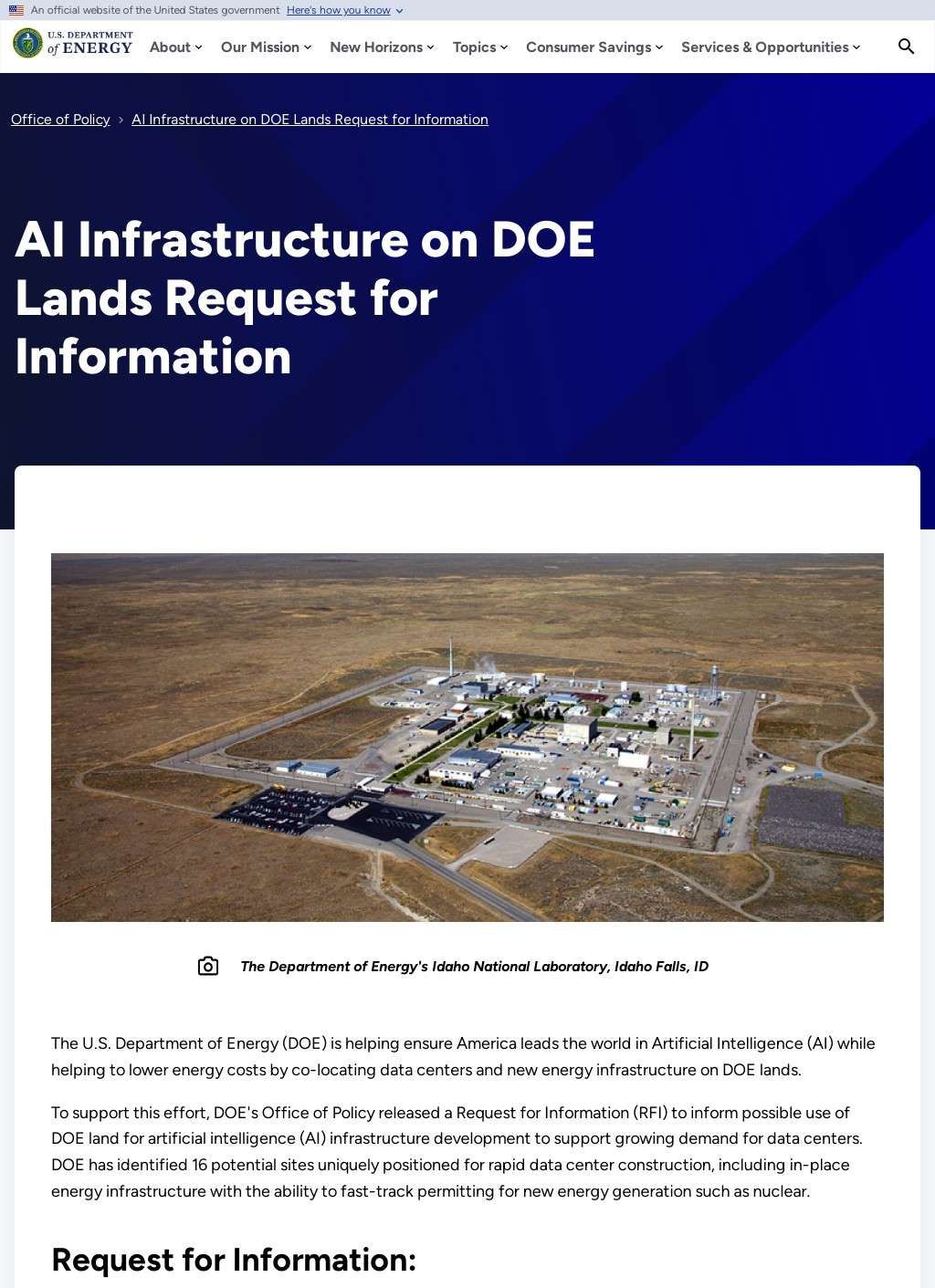
Developers trying to stand up a large data center keep hitting the same wall: power, and where to put the thing close to it. Grid interconnection queues run for years, and a serious AI compute cluster needs hundreds of megawatts available on day one, not after a decade of permitting. That is the bottleneck the U.S. Department of Energy AI Infrastructure on DOE Lands Initiative is built around. Rather than asking industry to find suitable ground and then beg for power, the Office of Policy turned the question on its head and asked who wants to build on federal land that already has the energy backbone in place.
Sixteen candidate sites with existing energy infrastructure
The mechanism here is a Request for Information, published through the Federal Register on April 7, 2025. An RFI is not a contract or a solicitation for bids. It is the government collecting structured input before it commits to an approach, and the page reviewed is the public landing point that ties the pieces together: the full RFI text, the submission instructions, and the appendix materials. Reading it, a respondent can see fairly quickly what DOE is and is not promising at this stage.
The substance that gives the U.S. Department of Energy AI Infrastructure on DOE Lands Initiative its weight is the list of locations. DOE identified sixteen potential sites on its own lands, each picked because existing in-place energy infrastructure makes rapid data center construction plausible. That is the practical hook. A site with transmission, generation, or both already standing skips the part of the timeline that usually kills projects of this scale.
How the Request for Information process works
The page itself keeps the high-level pitch short and pushes the detail where it belongs, into appendices to the full RFI document, downloadable as a PDF. Location, acreage, available energy capacity, and the relevant physical characteristics of each candidate site live there. Anyone evaluating whether a parcel could actually host their workload has to open that PDF, which is the honest place for engineering specifics to sit. The landing page is a directory and an index, not a spec sheet, and it does not pretend otherwise.
National laboratory partnerships as development assets
Several of the candidate sites sit alongside DOE national laboratory research facilities, and the RFI explicitly invites respondents to consider partnering with or drawing on that co-located research. For a developer, proximity to a national lab is an unusual variable to weigh, and it is worth noting that the U.S. Department of Energy AI Infrastructure on DOE Lands Initiative treats it as an asset on the table, not a footnote.
Four open questions shaping the initiative
The questions DOE poses fall into four buckets, and they map what the agency has not yet decided. First, development approaches and technology solutions: how would a builder actually construct and power compute at these sites. Second, operational and ownership models, which is the genuinely open one, since whether these become privately owned facilities, public-private arrangements, or something else is not settled. Third, economic considerations and cost structures, the part that determines whether any of this pencils out. Fourth, the lab partnership angle described above.
The useful thing about that framing is its candor. The U.S. Department of Energy AI Infrastructure on DOE Lands Initiative does not arrive with a fixed business model and dress it up as consultation. It is asking utilities, energy developers, data center builders, and the general public to help shape the model itself, which is a different and more credible posture than a foregone conclusion wearing a comment period.
The stated policy context behind the U.S. Department of Energy AI Infrastructure on DOE Lands Initiative is twofold: advancing U.S. leadership in artificial intelligence while managing the energy costs that come with it. Those two goals can pull against each other, since more compute means more demand, and the RFI does not hide that tension. The target it sets is concrete enough to judge against, with operations meant to commence at selected sites by the end of 2027. For an effort this large touching federal land, that is an aggressive clock, and the emphasis on sites with existing energy infrastructure is the only reason such a date is even arguable.
One thing a reader should keep in mind is what reaching this page does and does not get them. It is a gateway, not a decision. Following the links from the U.S. Department of Energy AI Infrastructure on DOE Lands Initiative leads to the formal RFI and the designated Federal Register process where comments are actually submitted. The U.S. Department of Energy AI Infrastructure on DOE Lands Initiative routes responses through that channel, so input enters the record as a docketed federal comment, with the timing and instructions governed by the notice and not by the webpage.
Intended audiences and their interests
Who is this page genuinely for? Three audiences, roughly. Energy and data center developers sizing up whether a federal parcel beats the open market on speed and cost. Utilities thinking about how a new multi-hundred-megawatt customer reshapes their planning. And the broader public, including anyone tracking how federal land policy and the AI buildout intersect, since the U.S. Department of Energy AI Infrastructure on DOE Lands Initiative is one of the clearer artifacts of that intersection currently on the record.
For a researcher or a journalist, the value runs a little differently. The page documents an agency's thinking at a specific moment, before commitments harden, and the appendix data gives a rare itemized look at which federal sites the government considers ready for this kind of build. That is primary-source material, not commentary about it, which is the main reason to go to the primary source instead of a secondary summary.
What the RFI does and does not guarantee
The limits are worth stating plainly so expectations stay calibrated. This is an information-gathering step, and an RFI obligates the government to nothing. Sites named as candidates may never be developed; the 2027 target is an intention, not a guarantee; and the ownership and cost questions being asked are precisely the ones without answers yet. None of that is a flaw in the page. It is the nature of the stage the U.S. Department of Energy AI Infrastructure on DOE Lands Initiative occupies, and the material is upfront about it.
Assessing federal land against market alternatives
That openness is either the strength of the U.S. Department of Energy AI Infrastructure on DOE Lands Initiative or its central risk, depending on whether the market finds the offered terms workable. The published record cannot settle the question; it shows an agency willing to put sixteen federal sites on the table and solicit industry's terms instead of dictating its own. What DOE learns from those submissions will determine whether the 2027 target remains anything more than a date on a policy document.