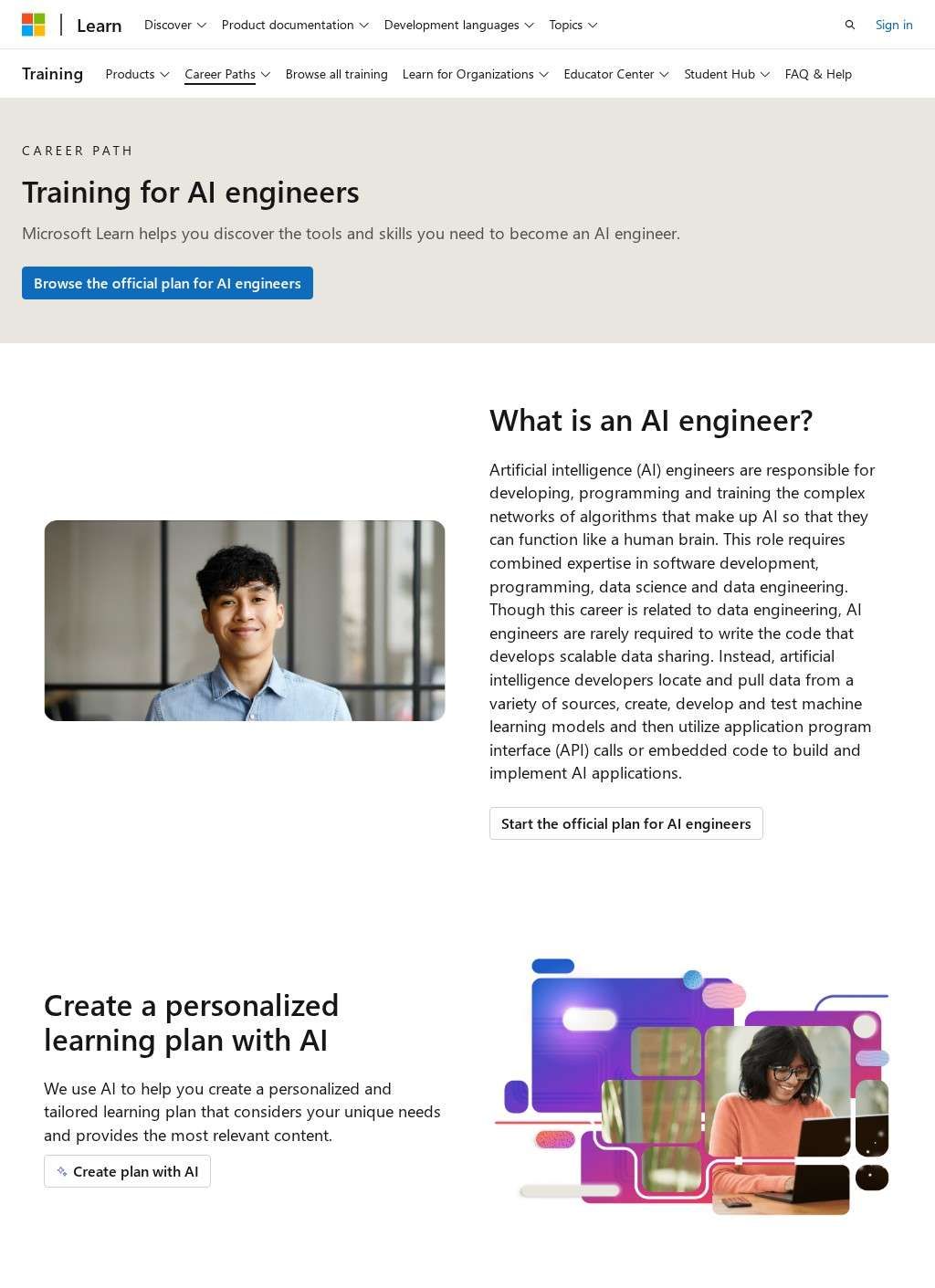
What does it take to move from "I write code" to "I build and train AI systems for a living"? Microsoft Learn - Training for AI Engineers opens with that question and answers it directly: the role rests on four competencies at once, software development, programming, data science, and data engineering, and the work itself involves developing, programming, and training networks of AI algorithms. Setting out the role definition before listing a single course is more useful than it first appears, because it lets a reader gauge how far they already are from the target rather than diving into content that may or may not apply to them.
Two study tracks for different learning styles
The training on Microsoft Learn - Training for AI Engineers splits into two tracks. Self-paced study runs through online guided learning paths and modules that build toward the skills a credential expects, pulled together under an official plan reachable at a short Microsoft link. The instructor-led option keeps the classroom format, scheduled with some flexibility for people who want a teacher and a fixed cadence instead of working alone. Neither track is presented as the default, which suits a field where some people learn fastest by reading and tinkering and others need the structure of a live cohort.
Skills aligned with employer demand
Where the page gets genuinely practical is its skills section. It surfaces the abilities employers searched for over the previous year, and each one links straight to a recommended learning path. That ties study to hiring demand instead of an abstract syllabus, and it gives a learner a defensible reason to spend time on one path before another. It is the part of the page that would change what someone does next, going beyond what they already know about the role.
Working toward the AI-102 certification
It does, and the destination is named. After the training, learners are pointed to a practice assessment for the AI-102 exam, which leads to the Azure AI Engineer Associate certification. A concrete exam turns a loose collection of modules into something with a finish line and a credential an employer can verify. A reader can work backward from AI-102 to figure out exactly which paths to prioritise.
Hands-on labs and community support
The wider platform behind Microsoft Learn - Training for AI Engineers is where the real depth sits. Beyond this one career page, the platform carries modules, learning paths, certifications, and sandboxed hands-on labs spanning Azure AI services, Azure OpenAI, Cognitive Services, and the surrounding Microsoft tooling. Those sandboxes are worth singling out: they let someone run real exercises against Azure services without standing up and paying for their own environment, which removes a common reason people stall partway through self-study.
There is also a community thread. Microsoft Learn - Training for AI Engineers links out to the Microsoft Tech Community so AI engineers can network with peers, ask questions, and trade notes. It is a sensible addition, though it points away from the structured material into a more open forum, and how much value a learner gets there depends entirely on how active they choose to be.
Maintaining current content through GitHub
One detail that quietly raises confidence: the content is sourced from a public GitHub repository and carries a recent update stamp. That openness means the material is maintained out in the open and corrected when it drifts, which is reassuring for a subject that changes as fast as applied AI does. A page about AI tooling that went stale would be close to useless, so the visible maintenance trail counts for something.
The honest limitation is what Microsoft Learn - Training for AI Engineers deliberately does not do. It maps the route and hands over the resources, but the load stays on the learner. The page tells you the AI engineer role demands software development, programming, data science, and data engineering all together, then largely assumes you arrive with the foundations in software and data already in hand. The guided paths organise the journey rather than teaching the prerequisites from scratch.
Who benefits most from this training?
So the value of Microsoft Learn - Training for AI Engineers tracks closely with who shows up to it. For a working developer aiming at the Azure AI stack and the AI-102 credential, the structure is hard to argue with: clear role definition, two study modes, demand-ranked skills, real labs, a named exam at the end. For someone newer to programming or data work, the page risks reading as a map drawn for terrain they have not yet crossed. That is the part it leaves open, and the part none of the well-organised paths in Microsoft Learn - Training for AI Engineers can fill in automatically.