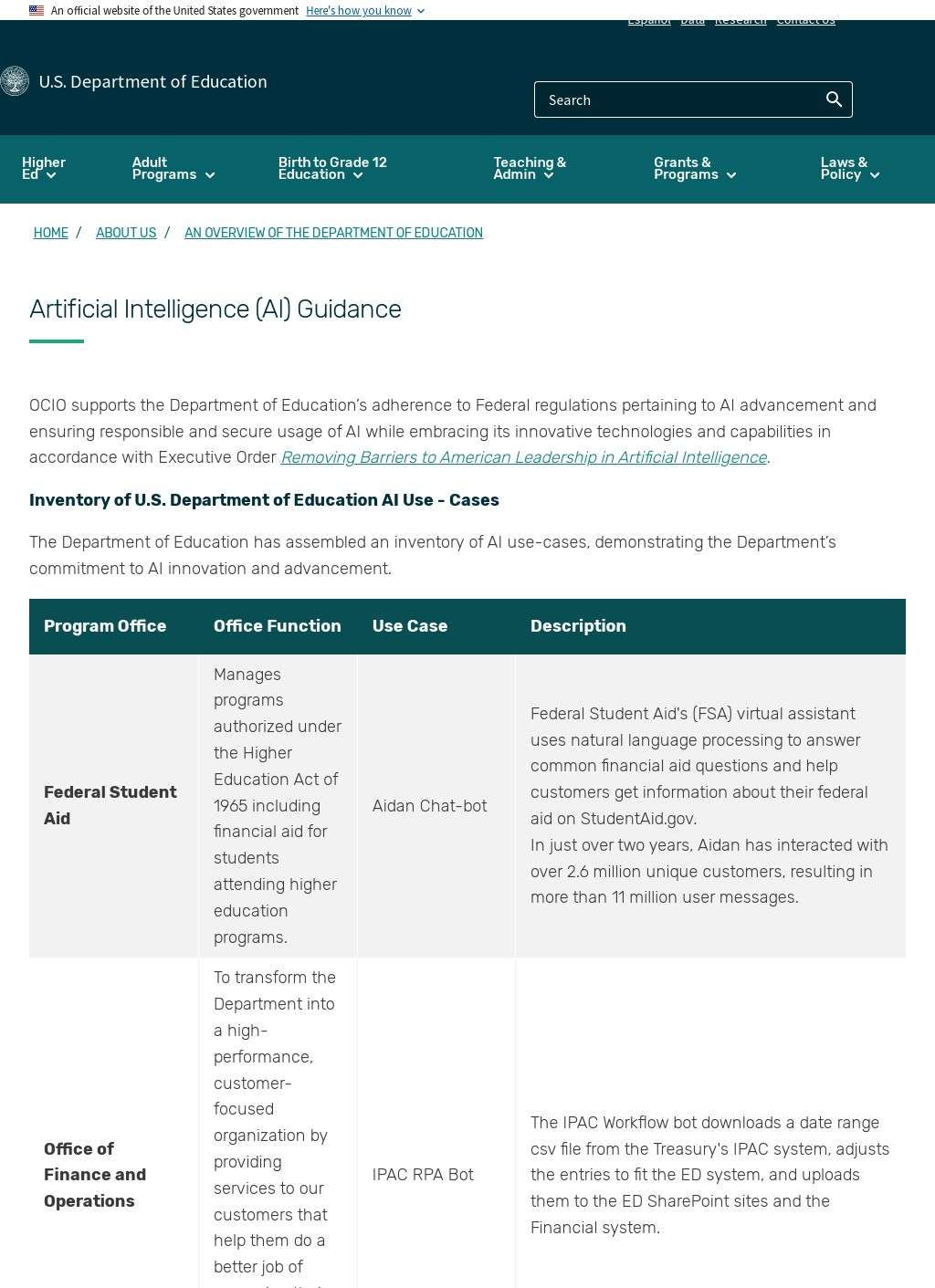
Sixty-plus AI deployments is the number the U.S. Department of Education - Artificial Intelligence (AI) Guidance page leads with, and it is the most useful fact on it, because it immediately raises the question that the page itself cannot fully answer: how many of those sixty-plus tools are genuinely consequential versus routine back-office automation padded out to satisfy a disclosure requirement? The honest answer is that the inventory does not tell you, and that structural silence is worth sitting with before treating this resource as authoritative.
Inventory structure and documented deployments
The U.S. Department of Education - Artificial Intelligence (AI) Guidance page documents each AI application with a named program office, a use-case label, and a brief written description. The Aidan Chatbot, operated by Federal Student Aid, has processed over eleven million messages from roughly 2.6 million unique customers. The IPAC RPA Bot handles automated data transfers between Treasury and Department systems. CAISY provides predictive analytics and intelligent automation for Finance and Operations. A Grammarly AI Writing Assistant is embedded inside Migrant Education programs. Microsoft Copilot has been deployed agency-wide across more than fifteen functions, including document creation and code generation. The page records all of them whether they look impressive or not, which is the only genuinely good thing about its design.
Downloadable data format for custom analysis
The U.S. Department of Education - Artificial Intelligence (AI) Guidance page also offers a downloadable Excel file of the full inventory, which is more useful than the web view for anyone who needs to map deployments by office, count use cases by category, or track rollout pace. Publishing raw data for direct filtering is a reasonable choice for a disclosure document.
Regulatory mandate with built-in credibility limits
The page exists because an Executive Order, specifically the one titled "Removing Barriers to American Leadership in Artificial Intelligence," requires it, along with related federal AI regulations. Compliance documents have a built-in credibility problem: they are as complete as the agency's internal reporting requires them to be, and the Department sets both the reporting standard and the submission. There is no independent audit of whether the sixty-plus entries represent the full set of deployed tools or a curated selection of what the agency is comfortable disclosing publicly. The U.S. Department of Education - Artificial Intelligence (AI) Guidance page is a self-reported inventory, and that is what it remains regardless of how structured its format is.
Update frequency and timestamp visibility gaps
Update frequency is a separate problem. Because the U.S. Department of Education - Artificial Intelligence (AI) Guidance page follows regulatory timelines, a tool deployed last month may not yet appear. For anyone tracking the current federal AI footprint in education, it is already stale by some unknown interval. No last-updated timestamp appears in a prominent location, so a reader cannot know how stale. That is an obvious design failure for a resource whose core purpose is currency.
Entry length constraints on outcome evaluation
The entries themselves are short. Forty words describing what a chatbot does and who runs it is enough to establish that a tool exists. It is not enough to evaluate whether the tool is working, whether it has produced measurable outcomes, or whether it has caused problems the agency has not disclosed. The Aidan Chatbot figure of eleven million messages sounds large, but the U.S. Department of Education - Artificial Intelligence (AI) Guidance page does not say what share of those messages were resolved satisfactorily, what the failure rate is, or whether the volume has grown or declined. A number without a denominator is not evidence of success.
Audience scope versus specific user needs
The stated audiences for the U.S. Department of Education - Artificial Intelligence (AI) Guidance page span Federal Student Aid customers, Department employees, higher education institutions, K-12 schools, researchers, journalists, and vendors. A resource that serves everyone with equal granularity usually serves no single group particularly well. A journalist trying to understand how AI has affected student loan processing will find the Aidan entry too spare. A vendor assessing federal procurement patterns will find the descriptions too vague to act on. A researcher wanting to evaluate outcomes will find the page ends exactly where the interesting questions begin.
Primary source value with unsigned descriptions
For a federal primary source, the U.S. Department of Education - Artificial Intelligence (AI) Guidance page is worth knowing about. It is the enumerated list, not a secondhand summary: it gives you the agency's own framing of each deployment instead of a journalist's paraphrase. But the framing is produced by the same agency being disclosed, descriptions are unsigned, and there is no mechanism for a reader to challenge an entry's accuracy.
How to use this inventory responsibly?
If the purpose is to understand how AI is genuinely operating inside federal education programs, the U.S. Department of Education - Artificial Intelligence (AI) Guidance page is a starting point at best, and a misleading one at worst, because its structured format lends an air of comprehensiveness that the underlying entries do not support. Download the Excel file, cross-reference the named offices against independent reporting, and treat the descriptions as the floor of what each tool does rather than the ceiling.