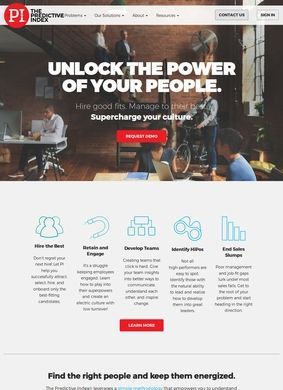
How much can a short online questionnaire really tell an employer about who to hire, promote, or hold onto? That is the question the Leadership Training listing sets out to answer, and the tool behind it, The Predictive Index, stakes its entire business on the reply. The platform uses behavioral science to help organizations with hiring, leadership development, and employee engagement: a brief assessment becomes practical guidance on how a person works and where they are likely to fit.
The entry is filed under training, but Leadership Training here is shorthand for something much broader than a course catalog. Its foundation is a pair of assessments: a behavioral one that maps how someone tends to operate at work, and a cognitive one that gauges how quickly they take on new or complex problems. Everything else in the platform grows out of those two readings.
Talent optimization, from assessment to career pathing
Assessments are only the front door. What Leadership Training points to is a connected suite that follows an employee across the full arc of a job, from the interview through to the exit conversation, all resting on the same behavioral profile taken once at the start.
That single-profile idea is the design decision worth understanding, because it is what turns a hiring test into a management tool.
Behavioral and cognitive assessments
The two assessments do the heavy lifting. The behavioral one reads workplace tendencies, drives, and communication style; the cognitive one measures problem solving speed and the capacity to absorb complexity under pressure. The company says it has administered more than 37.5 million assessments and that over 10,000 organizations use the platform. Self reported as those figures are, they at least point to real scale, well beyond a pilot with a handful of clients.
For a manager weighing two similar candidates, a structured read on how each one thinks and works is the sort of input Leadership Training is built to supply, and the sort that gut feel alone rarely delivers reliably. A behavioral profile does not replace judgement, but it gives judgement something concrete to push against. The distinction between the two tests is worth grasping, since one describes how a person behaves at work and the other describes raw processing capacity, and a strong result on one says little about the other.
From hiring to career pathing
Around the assessments sits the software. Leadership Training, through The Predictive Index, offers candidate evaluation tools for hiring, leadership development and team management features, employee engagement and pulse survey solutions, performance management systems, and onboarding and career pathing tools. The through line is continuity. One behavioral profile follows a person from the interview into the role and onward, so the same data that shaped a hiring decision later informs how to manage, develop, and keep that hire.
That continuity is the real pitch of Leadership Training, and it is a sound one, because most companies collect this information in fragments and then lose it between departments.
The platform serves executive leaders, HR professionals, line managers, and even job seekers, across industries as different as manufacturing, construction, software and tech, healthcare, and financial services, which suggests the framework is broad enough to travel well between very unlike workplaces. Career pathing in particular is the piece many hiring tools skip, and folding it into the same system signals a product designed for retention as much as recruitment.
The research claim and what users report
A platform selling insight into people has to answer for its own credibility, and Leadership Training makes some ambitious claims on that front.
The methodology, the company says, rests on 70 years of scientific research, and the corporate record supports a long history: Gartner Peer Insights lists it as a privately held firm headquartered in Westwood, Massachusetts, with a headcount in the 201 to 500 range. The marketing also leans on outcomes clients have reported, a 12 percent EBITDA growth in one case, 180,000 dollars in annual attrition savings in another, a 20 percent drop in attrition within key departments elsewhere.
Those are customers' figures, not independently audited results, and the fair way to read them is as illustrative examples rather than as a promise Leadership Training makes to the next buyer who signs up. Impressive numbers from a self selected group of happy clients are worth noting, and worth discounting a little too. A buyer with any experience reads case-study statistics through that lens automatically: evidence the tool can work, not proof that it will. A figure like a 20 percent attrition drop is the sort of result any vendor would put on a slide.
Independent reviews are real, though a touch scattered across platforms. On G2, users rate the tool on concrete features, and the most reviewed among them are ease of use, goal setting, team collaboration, general helpfulness, and efficiency, an unusually practical breakdown even though a single headline star score was not on display.
Gartner Peer Insights also hosts user reviews for the platform behind Leadership Training. Comparably splits its scores in a telling way: roughly 3.8 out of 5 for company culture as rated by employees, and a separate 3.7 out of 5 on value for money from the customer side, a middling but far from damning grade on return for the spend.
Indeed adds its own employee reviews, and SelectSoftwareReviews folds Leadership Training into a wider comparison of recruiting software, which reads as an editorial nod rather than a numeric verdict.
Taken together, the outside picture is consistent: users find the software usable and useful, the workplace culture rates decently, and nobody is claiming miracles on price. That is a healthier profile than either glowing uniformity or a wall of complaints would be. Consistency across independent sources is the signal a careful buyer trusts, precisely because no single marketing team controls all of it.
Reaching the team behind Leadership Training is straightforward. The platform lists a sales line and a support line directly, and a demo request page invites a hands on look before any commitment is made. In a category where some vendors hide behind a single contact form and a promise to call back, having named phone numbers sitting on the page is a genuine point in its favour, and the demo route means a buyer can test the fit before spending anything. Few enterprise-software vendors make that first conversation so painless.
An HR leader or people manager at a growing, mid sized company, the kind fighting turnover and unsure whether a strong individual contributor will hold up once handed a team, is the natural fit for what Leadership Training offers. The behavioral data pays off most where headcount is scaling and a bad hire or a mispromotion gets expensive quickly. Leadership Training has been at this long enough to have refined the methodology, and the pairing of a long history with current, feature-level reviews is a reassuring combination in a category crowded with newer, unproven names.
A very small shop that hires once a year will draw less from a full talent optimization platform than from a careful interview and a reference call. For the right buyer, the concrete next step is straightforward: a demo, followed by a hard look at the cognitive assessment and the value-for-money question that Comparably's 3.7 raises, weighed against a company's own turnover numbers well before any contract is on the table.