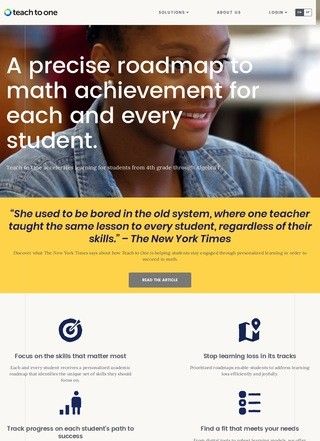
A teacher with twenty-eight kids in one room, half of them two grade levels behind in math and a few already bored, has a problem no single worksheet solves. That gap is exactly what Teach to One sets out to address. The site presents a nonprofit math platform built around the idea that students move along their own path through skills, and that the software keeps track of where each one is so a teacher does not have to reconstruct it by hand. The pitch is not about replacing tutors; it is about keeping a mixed-ability room from leaving anyone stranded.
Roadmaps personalized math program
The product doing most of the work here is called Roadmaps, a personalized K-12 math program. The pitch is competency-based: a student is assessed on what they can do, gets a route through the skills they still need, and progress is tracked in something close to real time. Resources are tiered so a child who is ahead and a child who is behind are not handed the same task.
Tools for teachers and administrators
That is a clear, specific claim, and it is the part of the offering that feels genuinely thought through. For teachers there are tools for putting the curriculum into practice and watching how a class is moving; for administrators there is program management and outcomes data. The platform itself lives on a separate subdomain, a practical choice that keeps the public site as the front door and the actual work behind a login.
Does accessibility match the promise?
Accessibility gets a partial treatment. Content is available in Spanish, and there are options aimed at visual accessibility, which matters for a tool meant to reach a wide spread of districts. There is no read-aloud feature, and for a math product serving students who may also be early or struggling readers, that absence is worth naming. Common Sense Education, which looked at the Roadmaps tool, flagged limited teacher guidance, and that lines up with a platform that leans on its data dashboards more than on hand-holding the adults running it. Teach to One clearly expects its teacher users to be comfortable reading those dashboards.
Published outcomes from independent studies
The organization sits under New Classrooms, a 501(c)(3), and it does not hide behind vague language about results. There is an Impact section publishing outcomes data, and the site points to independent studies behind what it describes as an outcomes guarantee. Tying a guarantee to outside research is a stronger move than a lot of edtech sites attempt, and it gives a district evaluating Teach to One something to check instead of a marketing line to trust. Onboarding materials sit under a Get Started area, support documents are available, and there is a newsletter for people who want to follow along without committing. A social presence runs across X, Facebook, LinkedIn, and YouTube.
Behind the favorable coverage
The reputation record is where the assessment gets harder, because it does not all point one way. Coverage in The 74 Million was positive about Teach to One and leaned on a Bill Gates endorsement from the 2016 ASU GSV Summit, the kind of name that opens doors with funders and superintendents. Against that, there is critical reporting from Open Culture and a NYC public school parents blog covering 2017 to 2019.
Pilot school dropout rates
One Mountain View, California, parent survey cited there found 61 percent felt the program did not match their children's needs, and 54 percent of the New York City pilot schools dropped out. Those are not soft complaints. A drop-out rate above half among pilot schools is the sort of number that should make any administrator ask hard questions, and the public record offers no later figures to say whether that pattern held or improved.
I find the contrast between the polished outcomes story and that pilot attrition the most telling thing in the whole record. Teach to One can publish strong aggregate data and still be the wrong fit for individual classrooms, and both can be true at once. The deployments are not hypothetical: districts in New York City and New Jersey have run Teach to One, so this is not a concept looking for its first customer. But scale of deployment and satisfaction inside those deployments are different measurements, and the public material weighs heavily toward the first.
On reaching Teach to One directly, the homepage keeps its distance. There is no phone number and no physical address shown up front. What is offered is a demo scheduling form, an email newsletter signup, and a login portal for existing users. A demo form is a reasonable primary channel for a B2B sale into school districts, where procurement runs through meetings rather than a quick call, so the missing phone number reads less like evasion and more like a choice about who the site is built for. Still, a district administrator who wants to talk to a human before booking a scripted demo has to dig, and contact details do not surface without navigating past the front page.
There is also a quieter gap in the public proof. No ratings turned up on Google, Trustpilot, Yelp, or the BBB, which is common for a nonprofit selling to institutions rather than to walk-in consumers, so the absence is not damning on its own. It does mean the available outside picture is split between favorable press built on a high-profile endorsement and a cluster of critical parent and district reporting, with little neutral middle ground to settle the question.
What Teach to One offers is coherent and, on paper, more rigorous than a lot of math software: a real assessment loop, tiered content, dashboards for three different audiences, and a willingness to stake an outcomes claim on cited studies. Few competitors in this space put that much on the record. Whether the classroom experience lives up to that framework is the part the site cannot answer for itself, and the one survey showing most NYC pilot schools walked away is the doubt that keeps surfacing no matter how clean the Impact page looks.