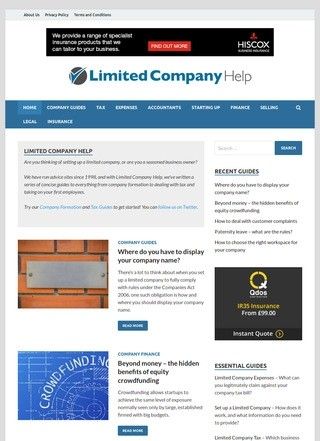
Limited Company Help is a UK resource site for people who run, or are about to set up, a limited company. It is published by Contract Eye Limited, and the footer copyright dates from 2011, which puts more than a decade of active publishing behind it. That age shows in the breadth of what the site covers. A director landing here is looking for plain answers on tax, pay, expenses, and the paperwork that Companies House demands, and Limited Company Help is built squarely around those needs.
Tax guidance and director salary optimization
The core of the site is guidance. There are sections on tax and accounting, on setting up a company and staying compliant, on business expenses, and on finance and banking. One of the more practical threads is director salary optimisation, where Limited Company Help lays out tax-efficient ways to draw money from a company through a mix of salary and dividends. That is the sort of question that sends a new director hunting for an accountant, and the site tries to answer it before the meter starts running. There is also a company information lookup tool and a set of calculators and financial planning tools, which push Limited Company Help past a pile of articles into something a visitor can use to work out their own numbers.
Accountant services with transparent pricing
Choosing an accountant gets its own section, and this is where the site is most clearly trying to be useful in a transactional way. A dedicated accountants area lists fixed-fee services, with pricing starting from 75 pounds plus VAT a month. Quoting a real figure, avoiding the usual "request a quote" fog, is worth something, because it gives a director an anchor before they start ringing around. Whether that price fits a one-person consultancy or a company with payroll and VAT to handle is left to the reader, but at least the starting point is on the table.
Insurance product guides for contractors
Beyond accountancy, Limited Company Help carries a fairly wide run of insurance product guides aimed at contractors and small company owners. The list is specific: professional indemnity, private medical insurance, relevant life insurance, income protection, public and employers liability, tax investigation cover, and critical illness cover. That is a sensible spread for someone working through their own limited company, where there is no employer quietly arranging any of this. Relevant life cover and tax investigation cover are products contractors often do not know exist until someone explains them, so grouping them in one place has obvious practical value.
Current editorial coverage of filing reform
The editorial side is kept current, which is what separates a living site from an abandoned one. There is coverage of the Companies House filing changes pencilled in for 2028, alongside ongoing pieces on tax-efficient salary strategies. Reading about filing reform years before it lands is the sort of thing a careful director wants, because it gives time to adjust. The presence of forward-looking content, alongside the older evergreen guides, shows the team behind Limited Company Help is still actively writing rather than coasting on a back catalogue.
Referral income and editorial independence
One honest caveat about the insurance and accountant sections: a site that curates products and lists service providers usually earns referral income from those arrangements, and a reader should keep that in mind while treating the guides as a starting point rather than impartial gospel. That is normal for this kind of publisher and not a mark against it, but it is fair to name. The guidance still reads as genuinely informative, and the breadth of topics means most contractor questions land somewhere on Limited Company Help.
Who is this for, concretely? Freelancers and contractors operating through a limited company, first-time directors trying to understand what they have signed up for, and established owners checking a specific point on dividends, expenses, or a particular insurance type. Limited Company Help is narrow in the right way: it does not try to be a general portal, it stays inside the world of the UK limited company and goes reasonably deep there. Someone running a sole trader business or a non-UK entity will find less that applies.
Limited contact details and transparency
The weak spot is contact and transparency. On the homepage and in the footer there is no phone number, no email, and no postal address. The footer offers only an About page, a Privacy Policy, and Terms and Conditions, with no direct way to reach the people behind the writing. For a pure information site that is less damaging than it would be for a service business, since most visitors come to read and leave, not to call anyone. Still, it is a real gap.
Knowing there is a person or a desk you could query lends credibility to financial guidance, and a director acting on advice about their own tax position would reasonably want to see who stands behind it. The About page presumably names the operator, Contract Eye Limited, but a visible route to ask a question would strengthen the whole proposition of Limited Company Help.
A search did not surface notable third-party reviews or ratings for Limited Company Help, so there is no independent verdict from users to draw on here. That is not unusual for a content publisher, which tends to be judged by whether its articles rank and read well, not by star counts, but it does mean a first-time visitor has to form their own view from the material in front of them.
So where does that leave it? Limited Company Help is a substantial, long-running resource for UK limited company directors, strongest on the practical questions of pay, tax, and the right insurance, and useful enough that it is easy to see why it has stayed online since 2011. The fixed-fee accountant pricing and the calculators give it a practical edge over sites that only publish theory. Set against that are the missing contact details and the absence of any outside reputation data, neither fatal for a reading-and-research site, both worth weighing before treating any single page as the final word. As a place to get oriented and compare options, Limited Company Help does the job; the caution is that no named adviser is reachable from the page if a question goes beyond what the articles cover.