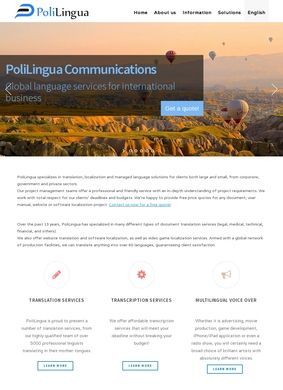
What does a translation firm that has run since 2002 put on offer? For PoliLingua, the list reaches well past plain document translation, into transcription, voice-over, subtitling, interpreting, desktop publishing, and typesetting. PoliLingua describes its core as translation, localization, and managed language solutions for clients large and small, drawn from corporate, government, and private-sector work.
Translation, localization, and managed language solutions
Localization is the part worth pausing on, since it separates a firm that swaps words from one that adapts a message to a market. PoliLingua sells it as a managed service, which points to project handling and coordination sitting on top of the raw translation. The transcription and subtitling lines lean toward media and video clients; interpreting leans toward live events or meetings; desktop publishing and typesetting mean the finished files come back formatted and ready to use, with the layout rebuilt in the new language rather than dumped as loose text.
Breadth is the selling point. A business that needs a contract translated, a training video subtitled, and a company brochure re-typeset in a second language can hand all three to one vendor and keep a single point of contact. Whether PoliLingua does each of those equally well is a separate question, and the reviews below split on it.
A managed-solutions pitch also implies someone is coordinating deadlines and formats across a whole project, which is the quiet value a lone freelancer usually cannot provide. For a company juggling several languages on one deadline, that coordination is often what separates a finished job from a pile of files that still need assembling.
Economy, Professional, and Premium tiers
Pricing at PoliLingua, as reported by a review site, climbs in three steps: Economy around nine cents a word, Professional around fifteen, and Premium around twenty-one. A separate AI-assisted option with light human editing sits in the lineup below those, aimed at buyers who want speed and a lower bill and can live with a machine doing the first pass. Clutch pegs real project engagements between roughly $150 and $6,100, with hourly rates in the $25 to $49 band, so the actual spend swings hard on volume and tier.
That structure is honest in one sense, since it tells a buyer up front that better output costs more, but it also means the headline price and the price of usable work can be two different numbers. The AI-assisted tier is the clearest example, since it trades human polish for a lower rate, and a buyer has to decide up front how much editing they are willing to do themselves afterward.
A keyword-localization case study
One engagement listed on PoliLingua's Clutch profile stands out because it is concrete: an SEO and keyword-localization job covering 1,200 keywords across four markets. That is the sort of work where localization proves its worth, since a keyword that converts in one language can fall flat translated literally into another, and search intent shifts from country to country. It also tells you PoliLingua takes on marketing and search work alongside static documents.
The client base PoliLingua names across its listings is corporate, government, and private sector, a wide net, and I would read that as a shop comfortable with both a one-off private order and a larger institutional contract. Government work in particular tends to demand consistency and confidentiality, so its presence on the roster says something about how the firm handles sensitive material.
Corporate, government, and private clients
That mix shapes what PoliLingua has to be good at: confidentiality and consistency for corporate and government files, responsiveness and price for smaller private jobs. The engagement range on Clutch, from a few hundred dollars to several thousand, fits PoliLingua taking both.
FeaturedCustomers adds eleven testimonials, though those are self-published, so they warrant the skepticism due any quote a company picks about itself. The useful signal is less any single praise line and more that the same name turns up across a business directory, employee-review sites, and translation-specific review hubs at once.
How the work lands with reviewers
Outside opinion is broadly positive but uneven. On Trustpilot, PoliLingua holds a four-star rating from around 130 reviews, with praise landing on responsive support and reliable delivery, and at least one sour note over a disputed transcription payment. Glassdoor gives a separate, employee-side reading: 4.0 out of 5 across 23 reviews, with 78 percent saying they would recommend the place to a friend. Clutch adds 17 client reviews and a profile summary calling out competitive pricing and good value.
PickWriters, a review aggregator, lands mostly positive, citing round-the-clock support and on-time delivery, while noting that reviews of PoliLingua are relatively scarce online. Hold onto that scarcity. A four-star average from 130 voices is decent, but it is well short of the mountain of feedback a household-name vendor carries, and a payment dispute inside that small a sample is worth reading before you commit a large job. Spread across Trustpilot, Glassdoor, Clutch, and the translation-review sites, the total body of feedback on PoliLingua is respectable for a firm of this size, even if no single platform carries a decisive number.
The pricing and quality complaints
The critical reviews are pointed and consistent enough to matter. Translationreport.com flags pricing it reads as high or not fully transparent, and isaccurate.com echoes the pricing concern while adding that quality on the AI-light-edit tier can be inconsistent. Set that beside the tier chart and it lines up: the cheap machine-assisted option is where a buyer is most likely to be let down, and the premium human tier is where the good reviews cluster. PoliLingua, on this evidence, rewards paying up, and a buyer tempted by the lowest number should understand exactly what that number buys.
The site itself turned away a direct visit during this review, returning a forbidden response to an automated fetch, so the on-page contact routes could not be checked firsthand. What can be checked is the shape of the feedback: the champions and the critics do not argue about the range of services PoliLingua offers, they argue about the price and, on the lowest tier, the polish.