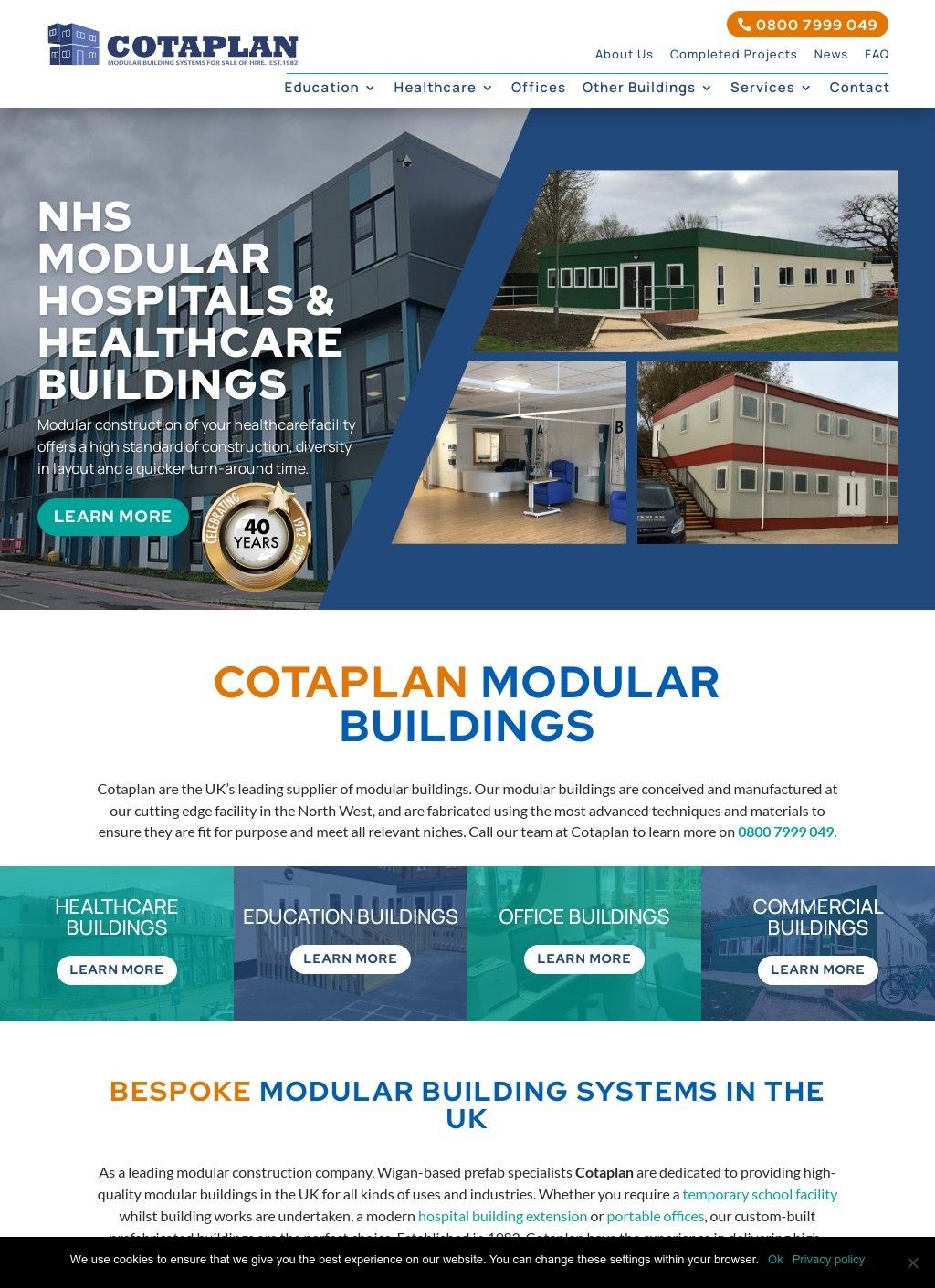
Modular Buildings is the listing name for Cotaplan, a UK manufacturer and supplier of prefabricated modular structures that has been trading since 1982 and works out of its own facility in the North West. That length of history is worth pausing on: a firm making off-site units for four decades has watched the market shift from cheap temporary huts to permanent, warrantied construction, and the site reads like it has moved with it. The work splits into two clear tracks. One is design and build of new units to a client's own spec. The other is buying and hiring second-hand stock, which is the route for anyone watching a budget who does not need something bespoke.
Education, healthcare, business sectors
The sector breakdown is where the offering gets concrete. Education is a big part of it, with temporary school facilities and modular classrooms that schools tend to need at short notice when pupil numbers jump or a permanent block goes out of action. Healthcare is the second pillar: hospital extensions, clinic space, and medical facilities, where the appeal of an off-site build is getting a working room commissioned without a year of on-site disruption.
The third is straightforward business use, modular offices for firms that want floor space added quickly. Dedicated pages sit behind each of these, including a specific one for modular clinic buildings, so a visitor from any of the three groups lands somewhere relevant instead of a single catch-all pitch. Across all three, the pitch stays practical: the point of Modular Buildings here is that the same off-site process serves a temporary classroom, a permanent clinic wing, and an office block with only the specification changing.
Quality management and warranties
Cotaplan puts real weight on quality documentation, and for a construction supplier that is the part I read most closely. It cites a UKAS-accredited ISO 9001:2015 quality management system, which is an externally audited standard and not a self-declared badge, along with structural warranties and product guarantees. A separate "Quality and Guarantees" page collects this together, and it is the clearest sign that Modular Buildings treats compliance as part of the product rather than an afterthought. For a buyer signing off a classroom that children will sit in, or a clinic room that has to meet health standards, that paperwork is the difference between a serious contractor and a shed vendor, and it is good to see Modular Buildings give it its own space instead of a footer line.
Speed of prefabricated installation
The headline selling point on the build side is speed. Because the units are prefabricated off-site, the site claims on-site installation can run up to 50 percent faster than traditional construction. That figure squares with how modular work is priced and sold across the trade, so it is a fair claim to lead with. There is also a blog that goes past marketing into topics like sustainable modular construction and where public-sector Modular Buildings are heading, which reads like the people behind it think about the field beyond the next order. It is a small thing, but a supplier writing about its own sector tends to know it well, and it positions Modular Buildings as something more considered than a bulk cabin outlet.
Trade listings and customer feedback
On reputation, there is not much to go on. No star-rated reviews with counts turned up, no Trustpilot or Google score attached to the company name. Modular Buildings appears across several trade profiles instead: FreeIndex, Barbour Product Search, Betterbuild, and a couple of aggregator pages, one of which repeats vague customer praise about service and build quality without a number behind it. That absence is not a red flag for a business-to-business supplier, where deals close over quotes and site visits rather than public star ratings, but a first-time buyer has little independent feedback to lean on and would want to ask for project references directly.
Contact routes and quote responsiveness
From the outside, contact visibility is harder to judge. The site blocked automated fetching, so I could not confirm the landing-page layout, and search results did not surface a phone number or a dedicated enquiry page. A supplier of this type almost certainly runs an enquiry route, since the whole model depends on quotes, but I would rate that as expected, not confirmed. A prospective client should plan to make first contact by phone or form and gauge responsiveness then, because that early exchange tells you more about a modular contractor than any web page will. How quickly a quote comes back, and how specific it is, is a useful early read on how the rest of a project will run.
Position against national competitors
Weighed against a national name like Portakabin, which dominates the hire-and-buy market with deep stock and heavy brand recognition, Modular Buildings reads as the smaller, manufacturer-direct alternative: the client deals with the firm that actually builds the unit, backed by the ISO accreditation and a long trading record, with second-hand stock keeping it competitive on price. Schools, healthcare trusts, and companies needing office space put up quickly all fit the same brief here, and this entry points to a credible outfit with decades behind it in that line of work. What is missing is independent verification: references checked, guarantees confirmed in writing, and lead times tested against what the site claims. Nothing here rules that out, but nothing published settles it either.
Business address
Cotaplan
Unit 1, Ashton Grange Industrial Estate, Bryn Road,
Ashton-in-Makerfield,
Greater Manchester
WN4 8BX
United Kingdom
Contact details
Phone: 0800 7999 049