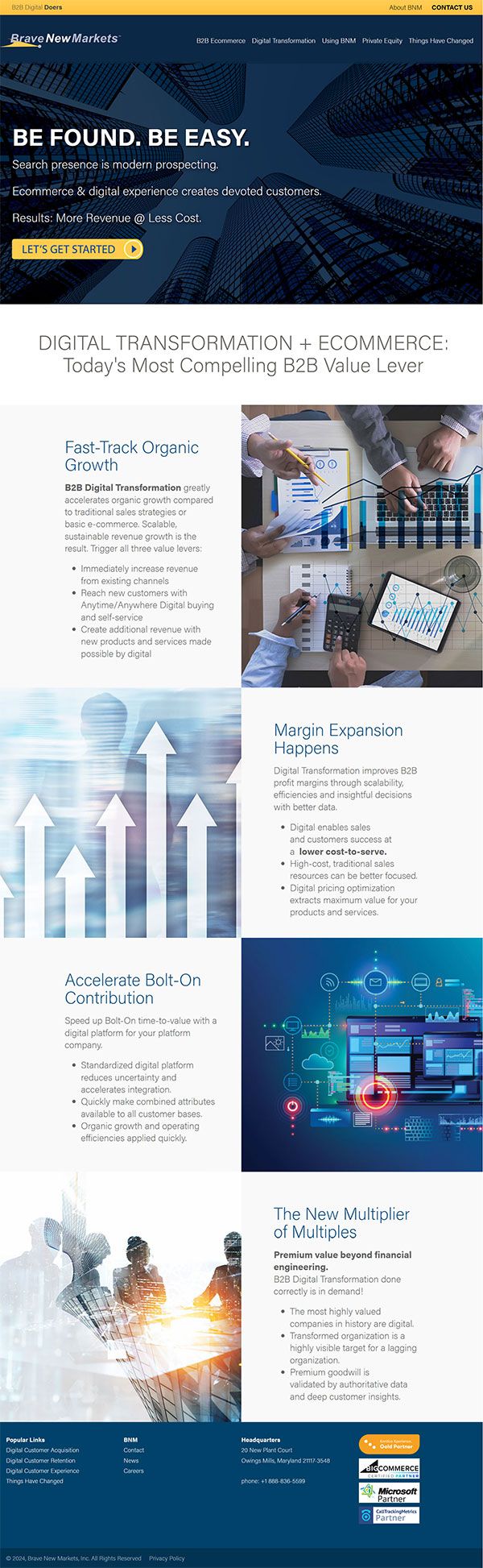
Mid-size B2B companies with a tired website and a sales process built for phone calls and fax-era catalogs hit a wall when buyers start expecting to research, configure, and order on their own. That is the gap B2B Digital Enablement, the consultancy operating as Brave New Markets out of Owings Mills, Maryland, sets out to close. B2B Digital Enablement works specifically with established business-to-business sellers that have momentum and revenue but are running on digital infrastructure that has fallen behind how their customers now want to buy.
Five service lines for digital business transformation
The experience claim here is concrete: more than 25 years implementing digital business solutions. That is not a startup pitching its first engagement, and the service map at B2B Digital Enablement reflects a firm that has seen the same problems repeat across many clients. Five service lines carry the work. Customer Acquisition covers the front door of demand generation, with B2B web applications, search optimization, and lead generation grouped together. Data and Analytics handles the back end, building decision-support tools and turning operational data into something a sales or product team can act on. Sales Modernization is the most plainly named of the set and arguably the most honest about what these projects usually involve, which is dragging legacy B2B sales processes onto digital channels without breaking the relationships that already drive revenue.
E-commerce work built for B2B complexity
The line that gives B2B Digital Enablement a distinct point of view is its e-commerce work, filed under Customer-Led Growth and branded B2B Ecommerce 3.0. The framing is worth pausing on. B2B commerce is not retail with a different logo, and self-service digital commerce for business buyers means handling contract pricing, account hierarchies, reorder flows, and approval chains that a consumer cart never touches. Naming it as a distinct discipline shows the people behind B2B Digital Enablement understand that distance. Whether the "3.0" label is substance or shorthand is something a prospect would want to press on in a first call, but the underlying focus reads as legitimate.
Private equity advisory for portfolio companies
One service line stands apart from the rest. Private Equity Consulting offers digital enablement advisory aimed at PE-backed portfolio companies, and that is a deliberate audience to court. Private equity owners want measurable value creation on a fixed timeline, and a portfolio company that has neglected its digital sales channel is a familiar target for that kind of intervention. B2B Digital Enablement positioning itself to speak to sponsors as well as operators tells you something about the size and seriousness of the engagements it pursues. This is consulting pitched at people who expect a return, not a redesign.
Content demonstrating B2B commerce expertise
Beyond the services, B2B Digital Enablement keeps a content section called Things Have Changed, which covers buyer-behavior shifts, branding, and commerce topics in the B2B space. A blog like this earns its keep in two ways. It gives B2B Digital Enablement a place to demonstrate that it thinks about these problems rather than only billing for them, and it gives a cautious buyer a way to judge the quality of that thinking before any money changes hands. The title itself doubles as the firm's thesis: business buyers have changed how they purchase, and sellers who have not adapted are the intended clients.
Geographic targeting across multiple states
The site also runs state-level landing pages for several U.S. states, Vermont and Rhode Island among them, which points to deliberate geographic targeting across the country. For a consultancy this is a search-visibility play more than a sign of physical offices in each location, and it is worth reading it that way. It does mean B2B Digital Enablement is actively trying to be found by businesses outside its Maryland base, which fits the profile of an operation that wants national reach from a single headquarters.
Direct contact information on the homepage
On the practical question of reaching them, B2B Digital Enablement makes it straightforward. A phone number and a physical street address sit on the homepage, and a contact page lives in the main navigation. For a B2B consultancy, where the first real step is almost always a conversation, that openness counts. A buyer evaluating a firm that will touch their sales infrastructure wants to know there is a named place and a phone line behind the marketing, and B2B Digital Enablement supplies both without making anyone hunt.
The site also lists B2B Digital Enablement in a business directory search context, which is how many buyers first encounter smaller consultancies outside the major analyst-tracked markets. Finding the firm through that path and then landing on a coherent, specific service offering is a better experience than the vague "digital transformation" language most competitors default to.
Limited third-party verification available
The weaker spot is independent corroboration. A search for outside reviews turns up nothing on the platforms a prospect would normally check, no Google reviews, no Trustpilot, no BBB or Clutch profile. What comes back is the firm's own pages and its location-targeted subpages and little else. That absence is not proof of anything bad. Plenty of B2B consultancies run their entire pipeline through referrals and direct relationships, and those engagements rarely generate the kind of public ratings a restaurant or a SaaS tool collects. Still, a buyer doing diligence has the experience claim, the named services, and the visible contact details to work from, but no third-party voice confirming the results. For a firm asking clients to trust it with revenue-critical systems, that is a gap a prospect can only close by asking for client references directly.
What the site does well is project seriousness rather than splash. The service lines are specific, the e-commerce positioning shows B2B Digital Enablement knows B2B is its own animal, the private-equity angle reveals the caliber of engagement it pursues, and the contact information is exactly where it should be. The clarity of the offering is the strongest argument in its favor. B2B Digital Enablement reads as a focused consultancy that knows precisely which problem it solves and which kind of company it solves it for. The proposition holds together, and there is enough published detail here to make the case for a first conversation without needing a leap of faith.