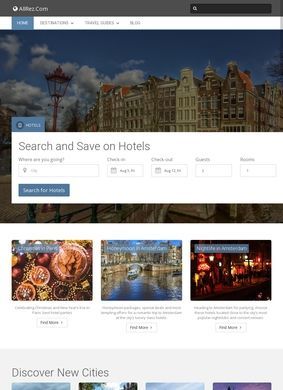
Type Amsterdam into the search box on AllReZ and one of the first properties that comes back is the Lloyd Hotel and Cultural Embassy, a place that mixes one-star and five-star rooms under the same roof. That choice of feature property says something about how the site wants to position itself: it is a hotel reservation platform aimed at leisure travelers, and it leans on a handful of recognisable, character-heavy hotels to set the tone. Alongside the Lloyd you get the Four Seasons George V in Paris and the Regina Baglioni in Rome, both well-known addresses that show AllReZ is comfortable listing the upper end of the market as well as everything below it.
Search and booking across worldwide properties
The core of the offering is a search-and-book tool. You pick a destination, set check-in and check-out dates, tell it how many guests and rooms you need, and it returns properties with prices you can compare side by side. That comparison angle is the pitch AllReZ repeats most often, and it is the right thing to compete on when a traveler is choosing between five hotels in the same neighbourhood and the only real difference is the nightly rate and what is included. The catalogue is meant to stretch well beyond the cities it puts on the front page, since AllReZ frames itself as a worldwide reservation service.
Featured European cities with travel guides
Those front-page cities are worth naming because they shape first impressions. The featured destination pages cover Amsterdam, Paris, Rome, London, and Madrid, which is a sensible spread of European city-break staples. Each city carries its own guide content, so AllReZ is trying to be useful before the booking step, building in context at the inspiration stage rather than arriving only at the point of payment. Whether the coverage runs as deep outside these five cities is the open question, because the headline pages are clearly the ones that get the most editorial attention.
Around the booking engine, there is more going on than a bare search form would suggest. A blog ranges across Christmas trips, honeymoon destinations, and nightlife, aimed at catching travelers early, when they are still deciding where to go. Individual hotel listings carry user reviews, so a visitor can read what previous guests said about a specific property without jumping out to a separate review platform mid-booking. City travel guides sit alongside the blog and fill in practical detail the search box alone cannot provide.
AllReZ also has routes aimed at people with purposes beyond booking a single room. There is a newsletter signup for travelers who want to hear about deals, an affiliate program for anyone who wants to earn by sending bookings its way, and a separate registration portal for hoteliers who want their property listed. That hotelier-facing side is consequential: a booking platform is only as good as the inventory behind it, and giving property owners a direct way in is how a site of this kind grows its catalogue without relying entirely on third-party feeds. A help and security section rounds things out, which is reassuring on a site that handles dates, guest details, and payment intent.
On contact, the picture is mixed. A feedback and contact page is linked from the footer, so there is a clear route to reach the people behind AllReZ, and for a booking platform a contact form is often the channel that gets answered. What is missing from the landing page is a phone number and a physical address, with no email address put out in plain view. For a service asking travelers to enter dates and reserve rooms, a visible phone line would provide considerably more confidence, because the moment something goes wrong with a reservation is exactly when a customer wants to call rather than fill in a form and wait. The contact route exists; it is just more form-dependent than a cautious traveler might want.
Building trust without external reviews
The reputation side is where the evidence runs out. A search for outside coverage of allrez.com did not turn up notable third-party reviews or ratings on the usual platforms. There is a trap to flag here, too: a casual search throws up plenty of reviews for Allurez, a jewelry retailer whose name looks almost identical at a glance, and none of that has anything to do with this hotel booking site. So AllReZ does not carry a visible body of independent reviews to draw on. That is not the same as a bad reputation, but it does mean a first-time visitor has little outside signal to go on and has to judge the platform on what the site itself shows, plus the guest reviews attached to individual hotels.
That gap in external track record is the main thing holding back a confident verdict. The booking tool is competent and the surrounding content, guides, blog, on-page hotel reviews, gives the site more substance than a bare search form would. The featured properties are real and recognisable, which lends some credibility. But a traveler about to put a credit card behind a reservation tends to want either a strong brand they already trust or a thick layer of independent reviews confirming that bookings go through cleanly and refunds get handled. AllReZ supplies neither in obvious quantity, and the quiet contact details do not fill that gap.
Comparing AllReZ to established booking platforms
Set against something like Booking.com, which offers the same date-and-guest search and the same price-comparison promise but with millions of verified guest reviews, a phone support line, and a name most travelers already know, AllReZ is competing in a long shadow. On price comparison alone it may well surface deals worth checking, especially across the five European cities it highlights and through the guest reviews tied to specific properties. Run a search here, weigh the result against a known platform, and read the booking terms carefully, because the independent reassurance the bigger names provide is not yet in evidence here.