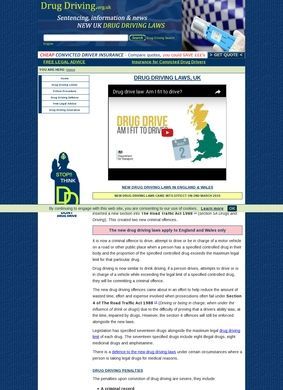
Running under the trading name Drug Driving, this information and legal-referral website covers the law on driving while impaired by drugs in England and Wales, built around section 5A of the Road Traffic Act 1988. It is operated by DFT Media Limited, a company registered in England and Wales (number 07976649) and also registered with the Financial Conduct Authority. That FCA registration is worth noting early, because it places the site closer to the insurance and referral side of this subject than to a pure legal-textbook approach, and that colours a good deal of what follows.
Section 5A offence explained
The core of the site is an explanation of how the offence works. It walks through the seventeen specified controlled drugs and the statutory limits set for each, which is the part most drivers genuinely do not understand. The point of section 5A is that there are fixed limits, similar in principle to the alcohol limit, so a driver can be over the line for a particular drug without being obviously impaired. Drug Driving spells that out clearly. There is a breakdown separating illegal drugs from the prescription medicines that also fall under the regime, which is the distinction that trips people up most often. Someone taking a legitimately prescribed medication can still commit the offence if they exceed the threshold and do not have a defence in place, and the site does not bury that point.
Penalties for drug driving
From there Drug Driving lays out penalties without softening them. A conviction carries a minimum twelve-month driving ban, an unlimited fine, up to six months in prison, and a criminal record that follows a person around for years. Those are not figures the average driver carries in their head, and seeing them stated plainly is one of the more useful things the site does. The criminal record alone has knock-on effects on employment and travel that many people only discover after the fact. The pages on police procedure are similarly practical: they describe the preliminary roadside oral fluid swab devices that officers use and what tends to happen after a positive reading. A reader who has just been stopped, or who knows someone who has, gets a reasonably honest picture of the sequence of events instead of vague reassurance.
Legal defences and referral service
Where Drug Driving turns from explanation to service, it offers a free legal-advice referral connecting users with solicitors, and it covers the legal defences that may be open to an accused driver. More visible detail on which defences apply in which circumstances would have been welcome, since a referral is only as useful as a person's ability to judge whether their case has any merit before picking up the phone. The defence content is present, but it reads as a gateway to the referral more than a standalone guide a worried driver could study independently. That is a defensible commercial choice, and it does shape how much a visitor can absorb without engaging the service. The legal information orients you; the referral is where the actual help is meant to happen.
Insurance after conviction
The other distinctive strand is insurance, and this is the part that sets Drug Driving apart from a generic explainer. It addresses what a conviction does to a person's premiums and cover, and it offers comparison aimed specifically at convicted drivers carrying a DG10 endorsement. This is a genuine niche. Mainstream insurers often refuse cover or load the premium heavily once that conviction code is on a licence, and finding any policy at all becomes a real problem.
A resource pointed at exactly that situation has obvious practical worth. Tying the legal explanation to the financial aftermath of a conviction is a sensible way to organise the whole subject, and it gives the site a reason to exist beyond repeating what is already published on government pages. The endorsement, the licence consequences and the cost of insurance afterwards are connected problems, and treating them as one journey is the smartest thing about the structure.
Scope limited to England and Wales
Drug Driving keeps its scope honest in one respect that deserves credit: it states that the material applies to England and Wales, and it flags that Scotland operates under separate provisions. Plenty of UK legal-information sites blur that line and leave Scottish readers with guidance that simply does not apply to them. Naming the limit of your own coverage is a small thing, but it shows that the people behind the writing know the territory and are not simply recycling general content to fill a page.
Reputation is where the picture gets sparse. A search for this domain turns up the site's own pages and the familiar authoritative voices on the topic, RoSPA, GOV.UK and Brake, but none of that is a review or endorsement of Drug Driving itself. There are no Trustpilot, Google or Facebook ratings attached to the Drug Driving domain that I could find, and no independent commentary vouching for the referral service or the insurance comparison. For a site that asks visitors to describe their situation and be matched with a solicitor, the absence of any outside feedback is a real shortfall. It does not prove the service is poor. It does mean a careful person has nothing external to lean on when weighing up whether to trust the operation with something as serious as a pending prosecution.
Contact page returns errors
Contact transparency reinforces that caution. There is no phone number and no email on the homepage. A footer link on Drug Driving points to an About or Contact page, which is exactly what a visitor would want, except that the /about/ and /contact/ paths return 404 errors. A broken contact route on a site whose entire purpose is to get worried people to reach out is the kind of fault that erodes confidence fast. Someone facing a court date wants a clear, working way to reach a human being, and right now the most prominent route to do that does not resolve. The referral itself may well function through its own forms, but a standard contact page failing outright is a poor look and an easy fix that has not been made.
Substance versus trust
So the assessment splits cleanly. On substance, Drug Driving is a competent and well-targeted resource. The explanation of section 5A, the seventeen drugs and their limits, the penalties, the roadside testing process and especially the DG10 insurance angle add up to something more useful than the average page on this subject. It understands its anxious, specific audience and gives them what they need to grasp their exposure. The information is accurate to the law as described and it avoids overpromising on the defence side, which is more discipline than many sites in this space manage.
On trust, Drug Driving is weaker than its content deserves. The commercial nature is disclosed through the company and FCA registration, which counts in its favour, but a referral and insurance operation carrying no independent reviews and a broken contact page is asking visitors to extend more faith than the page earns. Take the legal material as a solid starting point, then verify anything that bears on a real case directly with a solicitor. Drug Driving gets the substance right; the infrastructure around it needs work.