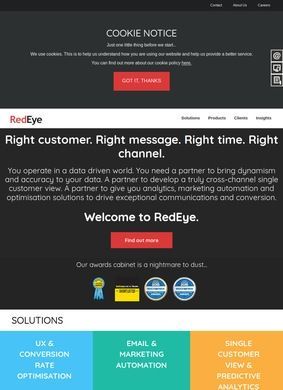
RedEye's drag-and-drop campaign builder is where the platform's ambitions become obvious. You set up a multi-step, multi-channel workflow visually, then push the same audience across email, SMS, web push, mobile app push, social and search retargeting, display ads, website personalization, and physical direct mail. That last channel is worth flagging, because plenty of marketing automation tools stop at digital and treat postal mail as someone else's problem. With RedEye it sits in the same builder as the rest.
Multi-channel campaign builder
Underneath the channels is a customer data platform doing the unglamorous work of stitching records together. RedEye calls the result a Single Customer View, the standard CDP promise: pull behavioral and transactional data from several sources, resolve it to one person, and stop treating the same shopper as three different anonymous sessions. Whether that works depends entirely on the quality of a client's source data, and no vendor page can prove that. What the feature list does show is that the segmentation is dynamic and behavior-driven, so audiences shift as people act rather than sitting frozen in a static list.
Customer data platform capabilities
The analytics side leans harder on AI than comparable platforms tend to admit. RedEye ships eight pre-built predictive models, with churn prediction and prospect conversion scoring named specifically. Pre-built is the operative word. Users are not asked to train anything from scratch, which suits a marketing team that wants a churn score without hiring a data scientist, and frustrates anyone who wanted to define the model themselves. The reporting dashboards add a natural language search layer, so a user can ask a question in plain English instead of building a query. Useful if it works smoothly, and a gimmick if it only handles three phrasings, though the published materials give no way to test which.
Predictive models built in
Industry targeting is broad. Ecommerce and retail are the obvious fit, and the native Shopify integration backs that up, but the list also reaches into travel, hotels and transportation, sports clubs, automotive, nonprofits and charities, museums and attractions, and education. A spread that wide can mean a genuinely configurable engine or a sales team that says yes to everyone. The presence of a real Shopify connector, not a vague claim about integrations, tilts things toward the former, at least for retail.
Which industries does RedEye serve?
Onboarding is where RedEye makes a concrete commitment that costs money to keep: an allocated Customer Success team, reachable by phone, email, or video call. Named human support is harder to staff than a chatbot, so a vendor advertising it is usually doing it. Demos and guided product tours can be booked directly from the site, which is the practical way to evaluate something this layered. Nobody picks a CDP off a feature grid alone.
Support and onboarding
On contact, the landing page routes visitors to the company section or into the demo booking flow rather than listing phone and address upfront. For a B2B platform that expects a sales conversation anyway, that is a normal choice. The contact route exists and is one click away.
Mixed ratings across review platforms
Reputation is the part that should give a buyer pause, and it splits in a way worth reading carefully. On Trustpilot the overall rating sits around 2.7, which is the kind of number a serious evaluator does not wave away, though the review count was not returned so the sample size behind it is unknown. G2 tells a different story, scoring RedEye 4.2 out of 5 and handing it High Performer status across multiple categories. InfoTech and SoftwareReviews carry customer write-ups praising the real-time personalization and multi-channel automation, which lines up with the feature set. Glassdoor, measuring the company as an employer and not the product, sits at 4.1 from more than fifty anonymous employee reviews with 74 percent recommending the place.
That Trustpilot-versus-G2 gap is the single most important thing on this page. Consumer-style platforms like Trustpilot tend to collect complaints from end recipients and disgruntled edge cases, while G2 draws from verified business users actually running the tool, so the higher B2B score may be the more representative one for a buyer evaluating the software. May be. It would be dishonest to file the 2.7 under noise and move on, because a low Trustpilot score sometimes signals real friction in billing, deliverability, or support that the polished review sites smooth over. The honest position is that the evidence points two directions, and reading the actual Trustpilot comments is a reasonable next step for anyone who cares about the number.
Taken together, RedEye reads as a capable mid-market CDP and automation suite with a feature depth (direct mail, eight predictive models, a Shopify connector, assigned success managers) that smaller rivals struggle to match. The product story is strong and the G2 standing is solid, but the Trustpilot number is not something to paper over, and the natural language reporting is the sort of headline claim best confirmed in a live demo. RedEye is worth shortlisting, with the demo as the place to pressure-test the claims the site makes about itself.