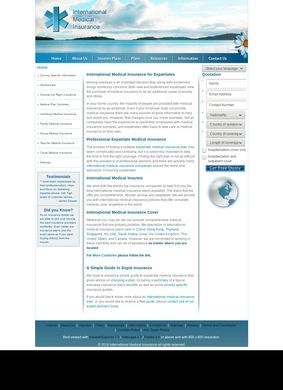
What does an expat need from a health insurance site, and does this one answer the question or just take the lead and run? International Medical Insurance is built around a single, well-defined problem: people who live, work, or move abroad for years at a time need cover that travels with them and does not collapse the moment they cross a border. The site sells annual international health insurance for that exact group, and it positions itself as a broker and advisory service rather than a single carrier pushing one product.
Comparison and advisory services
That distinction shapes everything else on the page. Because International Medical Insurance acts as an intermediary, the pitch is comparison and guidance: free personalised quotes, plus access to advisers who help a client weigh policies against each other. For anyone who has tried to read an international policy schedule cold, the offer to have a human translate the small print into something decision-ready is the part with real pull. A quote engine alone is easy to build. Advisers who will sit with you and explain why one plan suits a family in Bangkok and another suits a contractor in Riyadh are harder to put on a website and mean more.
Products for expat segments
The product range is broader than the expat-individual cliche suggests. International Medical Insurance lists individual plans, family packages, group and corporate cover, a teacher-specific medical product, and travel medical insurance for shorter trips. The teacher line is worth pausing on, because it points to an operator who knows its market: international schools employ a steady stream of staff who relocate on fixed contracts and need cover that fits the academic calendar and the host country at once. A generic broker would lump those people into the standard individual bucket. Carving out a dedicated product for them reads as someone who has fielded that enquiry many times. It is a detail that hints International Medical Insurance has spent real years inside this market, and did not simply buy a list of keywords to rank for.
Global coverage with country specifics
Coverage is described as global and portable, which is the whole point for this audience, and the country guidance backs the claim with specifics. The site singles out China, Hong Kong, Thailand, Singapore, the UAE, Saudi Arabia, Israel, the UK, the US, and Canada. That list is not random. It maps closely onto the places where Western expats, teachers, and corporate transferees actually cluster, and where local healthcare systems and insurance rules differ enough that off-the-shelf advice falls apart. Country-specific pages suggest International Medical Insurance is trying to address the real friction points, things like whether a plan covers treatment in a country with expensive private hospitals, or how cover interacts with a local mandatory scheme.
The way the audience is segmented also tells you who this is and is not for. Individuals, families, groups, and organisations relocating or working abroad long-term are the stated targets, with emphasis on the long-term, annual relationship. Someone wanting a two-week holiday policy would find the travel medical line, but the centre of gravity sits with people whose lives are based overseas for the foreseeable future. That focus is a strength. A site that tried to serve every insurance need at once would dilute the expertise that makes International Medical Insurance useful to the niche it has chosen. The corporate and group lines round out the same logic, since organisations posting staff abroad need one administrator handling many policies at once, and International Medical Insurance treats that as a distinct job, not a bigger version of the individual plan.
From quote process to pricing
Pricing is handled through the quote process rather than published rates, which is normal for this kind of cover since premiums swing wildly with age, destination, family size, and the level of cover chosen. No one can post a single number that would mean anything. The quote-and-advise model fits the product, even if it means a visitor cannot get an instant figure without handing over some details first. International Medical Insurance is asking for a short conversation in exchange for a number that means something, which is a fair trade for cover this variable.
Contact information and reputation gaps
On the credibility side, the picture is mixed and worth stating plainly. A contact route exists: a Contact page is linked from the homepage, so there is a clear way to reach the advisers International Medical Insurance keeps pointing toward. What the landing page does not do is put a phone number or a physical address in front of you immediately. You have to click through to find them, and a broker asking for trust on something as consequential as medical cover would do well to surface a phone number high on the first screen. It is a fixable gap, not a disqualifying one, but it is the kind of thing a cautious buyer notices.
The bigger blank is reputation. A search for independent reviews tied specifically to International Medical Insurance turned up nothing usable. The results that did surface belonged to International Medical Group, a different and unrelated company, which is a genuine trap for anyone trying to vet this site, because the names are close enough to blur together in a hurried search. There is no external chorus of customer ratings to lean on here, positive or negative. That absence does not prove anything bad.
Plenty of sound specialist brokers operate without a pile of public reviews, particularly in a sector where clients tend not to write up their insurance experiences. It does mean a prospective buyer is leaning on the quality of advice from International Medical Insurance and the policy documents themselves, with no verifiable track record from strangers to fall back on.
How should a careful reader treat International Medical Insurance? As a focused starting point for comparison, not the only stop. The specialisation is evident, the product breakdown is thoughtful, and the country coverage matches where the audience lives. The contact presentation on the front page and the lack of findable third-party feedback are the two things to push on. A sensible move is to use the free quote, then put International Medical Insurance side by side with a large named carrier such as Cigna Global, which an expat would plausibly weigh against it. A direct underwriter like Cigna brings name recognition, a long public record, and reviews you can actually read, while the broker model here brings independent comparison across multiple insurers and a person to talk it through.
Running the two against each other, with the same details fed into both, is the way to see whether the tailored advice from International Medical Insurance translates into a better plan or merely a more pleasant conversation. The published evidence points to a broker with real specialisation in its corner; the missing piece is public accountability, and that gap is the honest reason to keep looking in parallel.