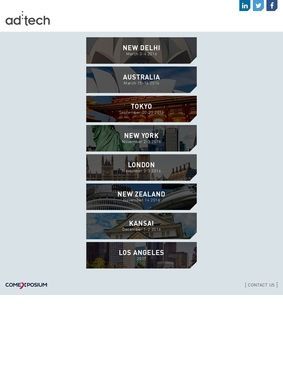
Picture a marketing director in New Delhi who has been told to find out where the real conversations about advertising technology are happening, the ones with actual brand and agency decision-makers in the room and not a webinar reel. That is the search that lands a person on Ad tech, and the first thing the brand does is ask a question back: which city. The landing page at ad-tech.com is a plain selector with two destinations, New Delhi and Tokyo, and nothing else. No hero pitch, no scrolling marketing, just a fork in the road. For a brand that has been running advertising-technology conferences for years, this stripped-down front door from Ad tech is either refreshingly honest or a sign that the central domain has been left to do the bare minimum.
I lean toward the second reading, and the evidence is sitting right next to the gateway. The www version of the address currently shows a Symposia holding page saying the server is not yet ready for that domain. So the primary domain is functioning as a router and not much more, while the substance lives one click deeper. A visitor who types the bare address and expects a homepage gets a choice menu, then has to commit to a region before seeing a single concrete detail. It works, but it asks for patience before it gives anything in return.
Conference structure and speaker transparency
Follow the New Delhi path and the picture fills out fast. The regional portal hosts the annual Ad tech conference built for senior people across marketing, advertising and technology: brands, agencies, publishers and the technology vendors who sell to all three.
The structure is what you would want from an event site that expects scrutiny before anyone books travel. There is a two-day Conference Agenda laid out so attendees can see the shape of the program rather than guess at it. A Speakers section and a separate Advisory Board section tell you who is steering the content and who is on stage, which is the detail that separates a serious industry gathering from a room full of sponsored slots. Plenty of event organisers who run something that appears in a business directory or two stop there; Ad tech goes further by keeping both sections current enough to inspect.
Practical features for attendees
Around that core the site adds the practical scaffolding. Networking Opportunities get their own billing, which is sensible given that the networking is half the reason senior buyers show up to something like this. There is On-Demand video content and a set of Video Testimonials, so a prospective delegate can watch past sessions and hear from people who attended before deciding whether the agenda is worth two days out of the office. A News and More area carries industry news and interviews, giving the portal a reason to be visited between editions instead of going dark for eleven months a year. And a Venue and Travel section handles the logistics that an out-of-town attendee actually needs.
One feature lifts Ad tech above a standard conference page. The portal promotes a second edition of "ad:tech Honours," run in association with the IAA India Chapter, an awards program celebrating industry achievements. Tying an awards property to a recognised industry association is the sort of arrangement that is difficult to set up casually, and it puts the New Delhi edition squarely inside the local marketing establishment rather than merely renting a hall and selling tickets. For a buyer trying to gauge whether Ad tech is an established fixture or a one-off, that affiliation is a genuine data point.
The Tokyo destination is the half of Ad tech I cannot vouch for in the same way, since the documented substance only details the New Delhi side. The selector offers it as an equal option, yet the substance described all sits under the Indian portal. A person clicking through to Tokyo is taking a small leap of faith that the same depth of agenda, speakers and logistics waits on the other side. That asymmetry is worth flagging: a two-city front door implies two comparable events, and only one of them is documented here.
Reaching anyone is where the gateway design costs Ad tech something concrete. The minimal landing page carries no phone number, no email and no physical address. A visitor who wants to reach a human has to first pick a region and then go looking. The route does exist: there is a contact page on the New Delhi sub-site, reachable once you are inside the regional portal. So the information is accessible, just not from the top. For an event that wants to pull in senior decision-makers, placing every contact route behind a regional selection is a small piece of friction that an organiser running a marketing conference of all things ought to notice.
Checking independent reputation
Outside validation is the weakest part of the case, and here the picture has to be stated plainly. There are no notable third-party reviews tied to ad-tech.com as a conference brand. The results that surface point at unrelated companies sharing the word: employee reviews for an "Ad-Tech Industries," an "ADTECH Systems," an "Adtech" or two, plus generic ad-technology software category listings on Gartner Peer Insights and software-review aggregators. None of those refer to this event. The name is common enough in the sector that Ad tech gets lost in the noise, and a buyer doing due diligence will not find an independent rating to lean on. The Video Testimonials on the site are the closest thing to social proof available, and self-hosted testimonials are not the same as an outside score.
So the assessment splits cleanly. The New Delhi edition of Ad tech reads as a real, well-organised industry event with a credible local affiliation, an agenda detailed enough to inspect, and the speaker and advisory transparency that lets a senior attendee judge the lineup. That is more than many event sites bother to put on the page, and the conference content holds enough substance to justify the click past the selector. The structure tells you these are people who have run this before.
Gaps between promise and documented proof
What keeps circling back is the gap between the promise of the front door and what is actually proven behind it. The central domain is a holding pattern with a broken www mirror, the Tokyo half is an unverified equal partner, and the brand carries no independent reputation a careful buyer could check against the common name it shares with a dozen unrelated firms. The New Delhi edition looks worth a senior marketer's time. Whether the rest of what Ad tech presents as a two-city, two-domain operation stands up to the same inspection is the question the site has not yet answered, and until that www mirror and the Tokyo content catch up to the New Delhi portal, the doubt sits there unresolved.