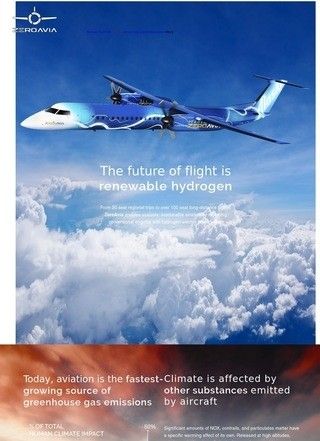
A regional carrier facing tighter emissions rules and a fuel bill that only climbs has a short list of workable answers, and most of them are years or decades out. ZeroAvia builds for the nearer end of that list. The company develops hydrogen-electric propulsion and power systems for aircraft, aiming at what it calls clean, efficient and resilient flight, and its argument is that hydrogen can cut both the emissions and, over time, the running costs that keep an operator awake at night.
In plain terms, ZeroAvia is a company betting that aviation's cleanup can start with regional flight rather than the largest jets.
ZeroAvia's product line splits along two axes. On one side is the Fuel Cell PGS work: hydrogen production and refueling technology, and the broader job of standing up a hydrogen ecosystem at airports so that a fueled aircraft has somewhere to fuel. On the other side are the Powertrains, the hydrogen-electric systems that actually turn the propellers, built in two size classes, one for 10 to 20 seat aircraft and a larger one for 40 to 80 seat regional planes.
Read together, the two halves describe a company trying to solve the aircraft and its fuel at the same time, since neither is much use to a buyer without the other.
The propulsion it is building
The center of gravity is the powertrain. ZeroAvia's hydrogen-electric system uses fuel cells to convert hydrogen into electricity, which drives electric motors turning the propeller, so the only thing leaving the aircraft is water. That is the whole environmental case in one sentence, and it is why ZeroAvia frames the work around clean and quiet flight rather than incremental efficiency gains bolted onto a conventional engine.
Around the powertrain sits a wider portfolio of fuel-cell and electric-propulsion components, plus high-power-density systems for electric aircraft generally. The point of that catalog is that ZeroAvia is trying to supply the pieces as well as the whole aircraft engine, the dense power systems that any electric airframe needs, which is a broader bet than selling a single finished unit. It is also a hedge: if the full powertrain takes longer to certify than hoped, the component business still has customers.
For a supplier chasing a certification path that has never been walked before, that fallback revenue can be the difference between surviving the wait and running out of runway.
Powertrains for regional aircraft
The two-tier powertrain split is the most concrete thing on the site. The smaller class targets 10 to 20 seat aircraft, the commuter and feeder end of aviation, where short hops and frequent turnarounds make fuel and maintenance costs bite hardest. The larger class aims at 40 to 80 seat regional aircraft, the workhorses that connect small airports to hubs.
ZeroAvia is pitching cleaner and quieter versions of exactly those planes, which is a sober choice of target. Regional routes are where the numbers for hydrogen close soonest, well before anyone tries the same trick on a transatlantic jet. A twenty-seat commuter hopping an hour between two small cities has a fuel and turnaround profile a hydrogen system can plausibly match now, and that is the wedge the whole plan rests on.
The fuel-cell and hydrogen side
Propulsion is only half the problem, because a hydrogen aircraft is useless without hydrogen waiting at the gate. The Fuel Cell PGS line addresses that head on, covering hydrogen production and refueling technology and the development of an airport hydrogen ecosystem. It is the least glamorous part of the offering and arguably the most important, since it admits that ZeroAvia has to help build the fueling world its engines depend on.
A propulsion company that ignored the fuel supply would be selling cars with no filling stations. It is also the part least under the company's direct control, since airports, energy suppliers, and regulators all have to move together before the fueling network appears.
Who the systems are for
The stated customers run wider than passenger airlines. ZeroAvia lists commercial aviation, defense platforms, regional aircraft operators, and organizations pursuing aviation decarbonization, which is a deliberately broad net. The common thread is any operator for whom fuel cost, emissions, or noise is a live constraint on the business. That breadth is a strength and a warning at once: it means ZeroAvia has more doors to knock on, but also that its attention is split across markets with very different certification timelines and procurement rules.
The named applications make the range concrete. For fixed-wing transport the pitch is cleaner, quieter commercial aircraft. For trainer aircraft it is lower operating costs and rapid refueling, a real draw for a flight school running the same airframe all day, a market ZeroAvia can chase without waiting on full airline certification. And for uncrewed aircraft the argument shifts to endurance and time aloft.
Defense and unmanned platforms
The defense and UAV angle is the one that reads least like a slide and most like a specific use case.
For unmanned aircraft, ZeroAvia points to extended surveillance and reconnaissance, where a hydrogen system can stretch time aloft beyond what batteries allow. For trainers, the rapid refueling and lower running costs speak to platforms that fly constant hours. These are the missions where the endurance and cost math for hydrogen is easiest to defend, and it is sensible that ZeroAvia leads with them alongside the commercial story instead of resting on green credentials alone.
Where the offices sit
Contact details are open and specific, which counts for a company asking others to bet on infrastructure that does not fully exist yet.
ZeroAvia lists a UK base at Cotswold Airport in Kemble, near Cirencester, and a US office in Everett, Washington. There is a contact page, a separate careers site, and the usual social channels across LinkedIn, YouTube, Instagram, Facebook, and Twitter. Between two real airfield-adjacent addresses and a live hiring portal, ZeroAvia presents as a working operation with staff to bring on, not a paper concept.
How it reads from outside
The outside signals are thinner and more mixed than the polished site suggests. On Glassdoor, ZeroAvia carries an employee rating around 3.4 out of five, drawn from somewhere between 51 and 56 company reviews depending on the page, with between 46 and 57 percent of staff saying they would recommend working there. That is a middling score with a wide band, the sort that reflects a fast-moving company still finding its footing. The gap between the review counts cited on different pages, 51 against 56, is itself a small reminder that these aggregate figures drift and should be read loosely.
The individual reviews sharpen the point. One is titled toxic workplace and incompetent senior leadership; another notes that employee turnover is below average, which cuts the other way; a former senior engineer in San Francisco left a 3.0 out of five. Beyond Glassdoor, Smart.Reviews shows a 4.5 from a single customer review, too small to lean on, and Indeed's UK reviews are mixed with no aggregate score. None of that is unusual for a company at this stage, but it is a real counterweight to the confidence of the marketing.
A reader deciding whether to work at ZeroAvia, or to trust its timelines, has to hold the mixed staff picture and the bold engineering claims next to each other.
The honest comparison for a fleet planner is against sustainable aviation fuel, the other main route to lower-carbon flying. Sustainable aviation fuel drops into existing engines and airport supply with no new airframe and no hydrogen plumbing, which makes it the safer near-term move, while ZeroAvia asks an operator to bet on hydrogen propulsion and a fueling network that is still being built.
The prize if the bet pays off is a genuinely clean aircraft instead of a cleaner fuel burned the old way. Sustainable aviation fuel carries a supply and cost problem of its own, so the real choice is less clean against dirty than near-certain and modest against uncertain and transformative. Which risk a regional carrier can carry is the line ZeroAvia lives on, and the answer turns less on the engineering than on how long that carrier can afford to wait.