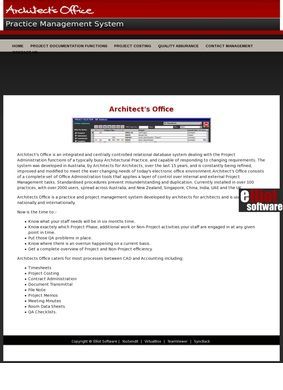
Elliot Software is an Australian developer, and Architect's Office is its practice management package aimed squarely at architectural firms that want their administrative side run from one relational database. The pitch is narrow and that narrowness is the point: this is not generic office software bent to fit architects, but a system written around how an architectural practice actually bills, tracks and documents its projects. The homepage spends its space describing what the program does rather than dressing it up, which suits a product sold to people who already know their own workflow problems.
Features for architectural practices
The feature list is where the product earns attention, because it is detailed and specific. Architect's Office covers timesheets, project costing and contract administration, then keeps going into the paperwork that piles up around a building project: document transmittals, file notes, project memos, meeting minutes, room data sheets and QA checklists. These are the records a firm has to keep anyway, usually scattered across spreadsheets, email folders and someone's filing cabinet. Pulling them into one database that ties each item back to a project is a sensible thing to sell, and the breadth here suggests the software grew out of real practice rather than a feature brainstorm.
It is worth noting what the relational structure buys a user. Because every record sits in the same database, a meeting minute, a transmittal and a costing entry can all be traced to the same project file, and a query about who agreed to what, or when a drawing left the office, has a single place to be answered. Architectural disputes turn on exactly that kind of trail. A practice that has lived through a fee claim or a variation argument understands why a system built to capture room data sheets and QA checklists in the same place as the financials is more than administrative tidiness. The design choices read as the work of someone who has felt the pain they are addressing.
Staff planning and overrun detection
Beyond the document side, the system handles the management questions a principal loses sleep over. It does staff resource planning, tracks which phase each project sits in, and monitors how work is assigned across the team. The overrun detection is the part worth watching: Architect's Office claims to flag projects drifting past their budgeted time, and to produce efficiency metrics that split project work from non-project activity. For a small firm where the owner is also the lead designer, knowing a job is bleeding hours before the invoice gets queried is worth more than any amount of polished reporting after the fact.
That split between billable project work and everything else is a quietly useful idea. Architectural staff spend real time on business development, training, leave and internal admin, and a timesheet system that lumps it all together tells you nothing. By separating the two, Architect's Office can show a firm where its capacity genuinely goes, which feeds back into the resource planning. The pieces are designed to talk to each other, and that integration is the difference between a record-keeping tool and something a practice runs its operations on. Architect's Office presents itself as the latter, and the feature spread supports the claim.
Who buys architect's office?
The intended customer is stated plainly: small to large architectural offices that want integrated, centrally controlled management. Central control is a recurring theme, and it makes sense for a discipline where one missed transmittal or an unrecorded meeting decision can turn into a contractual dispute. A single source of truth for project correspondence is a defensible thing to build a product around, and Architect's Office is unambiguous about wanting to be that source.
The range of firm sizes named is also telling. A package that genuinely serves both a three-person studio and a large multi-office practice has to scale in how it is configured, since a sole practitioner does not need the same resource-planning depth as a firm juggling dozens of concurrent jobs. Whether Architect's Office handles that span as gracefully as the site implies is something only a trial would settle, but the ambition to cover the whole range, instead of carving out one tier, is at least stated openly.
A quarter century of development
On longevity, the numbers are striking if they are accurate. Architect's Office has been in development for more than 25 years and is in use across over 100 architectural practices, with more than 2,000 users in Australia. Software that has survived a quarter century in a niche that small has had to keep paying for itself, because there is no large market to coast on. A firm evaluating Architect's Office is buying into something with a maintenance history, not a launch. That depth of deployment is the strongest argument the site makes, stronger than any individual feature.
A broken contact page
The credibility picture gets harder from there. The homepage carries no phone number, no email, and no physical address. There is a Contact Us link in the navigation, which is the obvious next click for a prospective buyer, but that page returned a 404. So the one route the site offers to reach Elliot Software is broken, and a serious enquiry has nowhere to land. For a product asking a firm to move its entire administrative backbone onto a single system, a dead contact page is not a small blemish. It is the first thing a cautious buyer would test, and Architect's Office fails it.
Absence of independent reviews
Outside opinion does not fill the gap either. A search for reviews of Architect's Office turns up nothing on the usual platforms: no Google entries, no Trustpilot, no Yelp listings for this product or for Elliot Software specifically. The results that do surface belong to unrelated firms sharing a similar name, architects called Elliott in the UK and US, which only muddies a buyer's research. There is no independent voice confirming the 100-practice claim, no user account of how support actually performs, nothing to triangulate against the vendor's own description.
None of that disproves the product. A specialised tool sold to a few hundred professional firms by direct relationship will often have almost no public review trail, and the absence is normal for the category. The deployment figures, if accurate, say more than a handful of star ratings would. But a buyer is left leaning entirely on the vendor's word, which is precisely the situation where a working contact channel matters most. For Architect's Office, that channel is the thing that does not work.
What Architect's Office describes is a coherent, hard-won system, the kind of thing built by people who understand the difference between a meeting minute and a file note and why both need to be searchable. The functional case is genuinely strong, and the longevity claim, taken at face value, backs it up. The practical problem is unavoidable, though: a software firm whose own site cannot tell you how to get in touch, and whose Contact Us page throws a 404, leaves a prospective customer wondering whether the same care that went into the feature set is being paid to the parts a buyer has to use first.