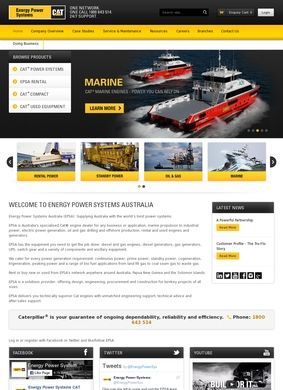
Who do you call in Australia when you need a Caterpillar-branded diesel generator, and you need it sized correctly the first time? For the Australian market, plus Papua New Guinea and the Solomon Islands, the answer runs through Energy Power Systems Australia, the authorized Cat power systems supplier for that whole region. That single fact sets the tone for the rest of the site, because everything Energy Power Systems Australia offers is anchored to one manufacturer and one dealership relationship instead of a grab bag of brands.
Equipment range and inventory
The new equipment range is broad in the way you would expect from a dealer that has to cover both a small standby unit and a mine. Diesel generators span roughly 6 kVA up to 800-plus kVA, sitting alongside industrial engines, marine power systems, and lithium-ion Battery Energy Storage Systems. There are ancillary products too, the bits and pieces that turn a generator into a working installation. The site does not stop at selling iron. Energy Power Systems Australia also lists used and ex-rental stock, plus dealer-certified equipment, which is the kind of inventory a buyer on a tighter budget tends to hunt for and rarely finds spelled out clearly.
Rental fleet options
Rental is treated as its own line of business, not an afterthought. Energy Power Systems Australia rents out generator sets, temperature control equipment, air compressors, and battery storage. That mix matters for anyone running a seasonal load, a construction phase, or an emergency replacement while owned kit is down for service. Pairing temperature control and compressed air with the power gear means a project can source most of its temporary site services from one place, and the practical value of that is hard to overstate when timelines are tight.
Comparing EPC project delivery
Quite a long way, and this is where Energy Power Systems Australia gets more interesting than a typical equipment vendor. There is EPC project delivery, meaning engineering, procurement, and construction handled as one contract, with turnkey power stations as the headline version of that. A buyer who needs a full installation rather than a crate on a pallet has a route here. Remote monitoring is covered through VisionLink, and ongoing upkeep is bundled into Customer Value Agreements, the maintenance contracts Cat dealers use to keep machines serviced on a schedule. Gas parts and service support round out the aftercare side.
Configuring generators online
One detail that caught my attention is the Cat Power Hub, an online configurator that lets a visitor specify a generator to their own requirements. That is a genuinely useful self-service step. Most dealer sites in this space make you phone before you can even guess at what fits, so a tool that narrows the choice before a conversation starts saves time on both sides. It also points to an expectation that technically literate buyers want to do some of the legwork themselves, and Energy Power Systems Australia has built for that.
Industries served and documentation
The industries named cover an unusually wide spread: mining, agriculture, marine, data centers, oil and gas, renewable energy, construction, manufacturing, government and defense, health and education, utilities, and waste management. A list that long can read as filler, but here it lines up with the product range. A data center needs continuous backup, a mine needs heavy prime power, a farm needs something simpler, and the catalog actually stretches to all of them. Supporting that, the site carries case studies, technical brochures, and whitepapers, which is the documentation a buyer or specifying engineer will want before committing budget.
Reaching the company
Reaching Energy Power Systems Australia is straightforward. A toll-free number is shown right on the homepage, so there is no digging through menus to find a way in. Beyond the phone, there is a branch locator page and a contact form, which together suit a company operating across a region as large as Australia and its island neighbours. A buyer in Port Moresby and one in Perth can both find their nearest point of contact without guesswork.
Employee feedback online
The picture here is mixed in a specific way: there is feedback, but it comes from staff, not customers. On Glassdoor, Energy Power Systems Australia holds 18 employee reviews at roughly 3.6 to 3.7 out of five, with somewhere between 73 and 81 percent saying they would recommend it to a friend. SEEK shows similar territory, with 19 employee ratings averaging 3.8 and 19 written reviews averaging 4.3 out of five. A LinkedIn presence is confirmed. None of this is glowing, none of it is alarming, and it points to a workplace that its own people regard as reasonably solid.
What is missing is the other half of the equation. Searches did not surface customer-facing reviews on Google, Trustpilot, or ProductReview. For a consumer brand that absence would be a real worry. For a heavy-industry supplier whose deals are negotiated over the phone and through tender processes, it is far less surprising, because buyers of 800 kVA generators tend not to leave star ratings. Still, it leaves a prospective customer leaning on the Caterpillar dealership status and the documented case studies for proof rather than on a public score.
Taken together, the strongest argument for Energy Power Systems Australia is coherence. The brand, the product range, the rental fleet, the EPC services, and the maintenance contracts all point at the same buyer, the operator who needs reliable power and wants the manufacturer relationship behind it. The configurator and the technical library show a company comfortable letting customers inform themselves before picking up the phone. The thinner spot is the lack of independent customer voices, balanced by an official dealership standing that does a lot of the reassurance work on its own.