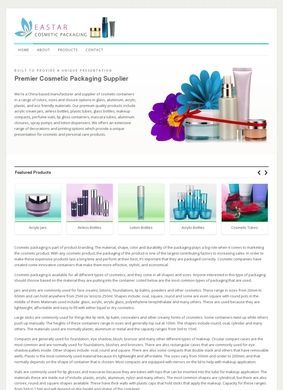
Acrylic cream jars, airless pump bottles, glass droppers and bamboo-topped jars sit side by side in the catalogue at Eastar Cosmetic Packaging, a China-based maker and supplier of containers for the cosmetics trade. The material list is broad: glass, aluminum, acrylic, plastic and a set of eco-friendly options for brands that want to advertise that. This is a components business, the empty vessels a skincare or makeup line fills and labels as its own.
The product spread is the main thing to report, because it is genuinely long. Alongside the cream jars and airless bottles there are plastic tubes, makeup compacts, perfume vials, lip gloss containers, mascara tubes, spray pumps, lotion dispensers, roll-on bottles, lip balm containers, essential-oil bottles, nail-polish bottles, loose-powder pots and tottle bottles, that last one an upside-down tube-bottle hybrid that not every supplier bothers to stock. Aluminum closures and decoration or printing options round it out, so a brand can order the container and the branded finish in one place.
For a company assembling a range, having Eastar Cosmetic Packaging cover all those formats under one catalogue is the practical appeal.
The five material families each pull a different kind of brand. Glass reads premium and recyclable, which is why serum and perfume houses reach for it. Aluminum gives a metallic, refillable feel and shrugs off light. Acrylic imitates the weight of glass at a fraction of the cost and the breakage risk, so it dominates cream jars.
Plastic, in PET and PETG, keeps shipping cheap and lets a tube squeeze. Offering all five means Eastar Cosmetic Packaging can sit a value line and a luxury line under the same purchase order, a genuine convenience for a company running more than one product tier.
What sits on the product shelves
Range like this is the selling point for Eastar Cosmetic Packaging. A small skincare label rarely wants to source a jar from one factory and a pump from another; a single supplier that carries acrylic jars, airless bottles and the caps to match saves a lot of back and forth. The catalogue reads like it was built to be that single stop. That is the pitch Eastar Cosmetic Packaging is making, whether or not it lives up to it.
The intended customer is clear enough: cosmetic and personal-care brands that need vessels and do not run their own moulding. That covers a lot of ground, from a one-person skincare start-up ordering a few thousand jars to an established label refreshing an existing line. The breadth of the catalogue fits that mixed audience, and a supplier that can serve both ends of it is worth a shortlist slot on range alone.
Jars, bottles and the odd tottle
The categories that stand out are the ones aimed at specific formats. Airless bottles matter for serums and anything that oxidises. Roll-on bottles and lip gloss containers are their own small engineering problems. Loose-powder containers with the right sifter, mascara tubes with a wiper that works, a tottle that stands on its cap: these are the details a packaging buyer actually checks. Eastar Cosmetic Packaging lists all of them, which at least signals a supplier that knows the cosmetics shelf, not a generic bottle wholesaler.
The eco-friendly and bamboo lines deserve a note. Bamboo cosmetic jars and PET or PETG bottles give a brand a greener story to tell its own customers, and the fact that Eastar Cosmetic Packaging carries them suggests it is keeping pace with where cosmetic buyers are pushing. Whether the eco claim survives a hard look at the materials is a separate question, and one the site does not answer on the surface.
Decoration is where a bare container becomes a branded product, and the printing options are the part that lets a small label look finished. Silk-screen, hot-stamp, a sprayed color, a foiled cap: these turn a stock jar into something that reads as one specific brand on a shelf. A supplier that keeps decoration in-house spares a brand the trouble of shipping empties out to a separate printer, which adds cost and a week or two every time.
How much to trust the shopfront
Here the picture gets murkier, and honesty demands flagging it. The Eastar Cosmetic Packaging site (cosmeticsbottles.com) has the standard navigation a manufacturer should have: Home, About, Products, Contact and a Blog. But the homepage returned a 403 to a normal fetch, and when the page was scraped another way, one sentence in the middle of the copy was promoting an unrelated online-gambling platform called Basswin, dropped into the text where nothing about it belongs.
That is a red flag, plainly. A stray gambling advert wedged into a cosmetic-packaging page usually points to injected or spun content, a sign the site has been compromised or that the copy is being machine-generated and stuffed instead of written by the company. It does not prove Eastar Cosmetic Packaging is a fake operation; plenty of legitimate factories run neglected websites that get hijacked. It is exactly the sort of thing a buyer about to wire a deposit should notice, though.
The reputation search comes up empty
Looking for outside verdicts does not help. A search for reviews of Eastar Cosmetic Packaging turns up no rating from any recognised platform. There is a ZoomInfo company profile carrying revenue and industry data but no customer scores. The rest of the results are mistaken-identity noise: pages about Eastman's "Eastar" copolyester resin, a ReviewMeta entry for unrelated Eastar-branded tools and mirrors, and Trustpilot pages belonging to two different firms with similar names, Cosmetic Boxes Packaging and The Cosmetic Boxes, neither of which is this supplier. So there is no independent track record to lean on, good or bad.
Contact follows the same pattern. Eastar Cosmetic Packaging keeps a Contact item in the navigation, so a route presumably exists deeper in the site, but no phone number, email or physical address surfaced in the homepage text that could be retrieved. For a manufacturer courting overseas brands, that leaves a gap. Buyers want a verifiable address and a human to email while they are still weighing up a mould or a minimum order, and a front page that hides all of it makes the homework harder.
None of this is a reason to walk away, but it does load the burden of proof onto the buyer. Asking for a business license, a video call to see the factory floor, references from current clients and a small paid sample run are the standard defenses when a supplier's online presence is this quiet. A serious brand would run those checks against any overseas manufacturer; the odd content on the page only makes them more necessary here.
So the verdict lands split. As a product catalogue, Eastar Cosmetic Packaging looks like a capable, wide-ranging cosmetic-container source, the sort a growing brand could plausibly build a line around. As a place to hand over money sight unseen, Eastar Cosmetic Packaging has not earned that trust yet, between the absent reviews, the buried contact details and that planted Basswin line.
A buyer weighing it up would do well to compare it against sourcing the same jars and airless bottles through a marketplace like Alibaba, where a supplier's transaction history, trade-assurance status and buyer ratings are on the table before any deposit changes hands. The catalogue may well survive that comparison, but it should have to.