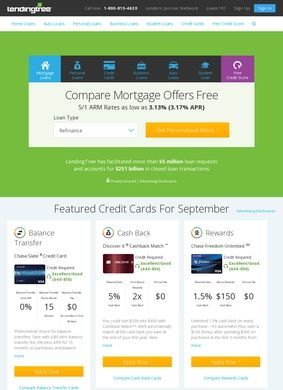
What is the quickest way to see several real loan offers without filling out a separate application at every lender in turn? That is the exact question Lending Tree is built to answer. It is a comparison marketplace, not a lender itself, and its whole pitch, "Compare real offers in minutes," rests on standing between the borrower and a network it describes in one place as more than 300 lenders and in another as over 700 trusted partners.
The mechanics are simple to grasp. A visitor answers a set of questions, Lending Tree passes those details to matching lenders, and the borrower sees multiple offers laid out side by side to pick from with, the site stresses, no obligation to take any of them.
How the marketplace works
The most important distinction sits right at the top: money does not come from Lending Tree. It is an introducer. The offers a borrower compares are underwritten by the partner lenders behind the curtain, and Lending Tree earns its keep by routing qualified shoppers to them. Understanding that shapes how every other feature on the site should be read, because the platform's incentive is to generate matches, and a match means handing a borrower's details to companies that will then compete for the business.
Breadth is the draw. A borrower can shop far more than a mortgage here, and the same three-step flow drives every product on the site. That single mechanism, applied to loans, cards, insurance, and savings alike, is what lets Lending Tree present itself as one destination for almost any consumer-finance decision rather than a mortgage tool that grew extra tabs.
Answer, compare, choose
Lending Tree lays the process out in three plain steps. Answer a short run of questions about what is needed and the borrower's situation. Compare the offers that come back, several at once, in a single view. Choose one, or none. The appeal is obvious to anyone who has ever applied to lenders one at a time, gathering quotes by hand across a week of phone calls and forms.
Collapsing that entire scavenger hunt into one questionnaire is the real product Lending Tree sells, and for a shopper who wants a fast read on the rates they might qualify for, it does the job it promises.
The rate examples on the page
To make the promise concrete, Lending Tree posts sample rate ranges on the site. Mortgage APRs are shown starting around 5.99 percent, home equity around 7.08 percent, personal loans near 6.74 percent, and refinancing about 6.44 percent, each carrying the standard caveat that rates are subject to change. Those figures are illustrative, not a quote, and the borrower's actual number depends on the answers fed into the questionnaire. Still, printing example rates at all gives a visitor a rough yardstick without having to enter any personal information, which is worth something.
Plenty of comparison sites hide every number behind a form; showing a starting APR up front, even a hedged one, lets a shopper decide whether Lending Tree is worth the ten minutes before handing over a phone number and an income figure.
From insurance to RV loans, and the calls that follow
The category list is where the scope of Lending Tree becomes clear, and it runs well past home lending. Insurance covers auto, home, renters, and health. The Home section spans purchase mortgages, refinancing, HELOCs, cash-out refinancing, and home equity. Personal Loans include debt consolidation. There is a Business tier with small business loans, lines of credit, and business credit cards, and a deep Credit Cards section sorted by purpose: best cards overall, balance transfer, low-interest, travel, cash back, and cards aimed at applicants with bad credit.
Each of those tabs is its own doorway into the same matching engine, so the sprawl of options is really one process wearing many labels.
Personal Finance stretches into debt relief, high-yield savings accounts, checking accounts, and CDs, while the Vehicle tab pulls together auto, boat, and RV loans alongside auto insurance. Layered over all of it is an expert-analysis content hub, education pieces spanning auto, business, home, insurance, and personal loans, the kind of guidance a first-time borrower can read before answering a single question.
That library is the part of the site with no catch, since reading an explainer on how a HELOC works costs nothing and shares nothing. Lending Tree also fronts some big self-reported numbers: 149 million people helped, 297 billion dollars in loan funding, and 30 years in business. Those are the company's own tallies, unverified in this search, and they set the scale it wants to be judged at.
Everything under one questionnaire
What ties the catalogue together is that same lead-generation flow, and it cuts two ways. On one hand, a borrower can price a mortgage, a credit card, and car insurance from a single site without re-learning a new interface each time. On the other, contact information is sparse where a curious visitor might look for it.
The homepage surfaces no phone number, email, or street address; it is built around the questionnaire, funneling visitors toward answering questions instead of picking up a phone. A help or contact page very likely lives deeper in the site, but the front door is a form, and a shopper who wants to talk to a human before sharing details will have to hunt for the route.
What reviewers keep flagging
Outside feedback on Lending Tree is heavy in volume and split in tone. Trustpilot shows 16,909 customers who have left feedback, with comments running mixed to positive on customer service. WalletHub carries 1,923 user ratings, also mixed, and a recurring theme surfaces there and grows louder on ConsumerAffairs, whose reviews page is thick with complaints about one specific thing: repeated, unsolicited follow-up calls from partner lenders after using the service. The BBB profile echoes it, with customer complaints centered on information being shared with third-party lenders and vendors.
That pattern is the predictable flip side of a model that sells borrower details to competing lenders, and it is the loudest single note in the outside record for Lending Tree.
One number on the homepage deserves a skeptical eye. Lending Tree displays a "4.5 out of 5, Rated Excellent, 16,287 Reviews" badge, which reads as an embedded review-widget rather than anything independently confirmed in a search. A borrower should weigh that self-served figure against the far larger and messier body of feedback sitting on Trustpilot, WalletHub, and ConsumerAffairs, where the sheer count of reviews is genuine but the sentiment is nowhere near as tidy as a single 4.5 makes it look.
Worth separating from the customer picture entirely is Glassdoor's 338 reviews, since those are employees rating the workplace, not borrowers rating the service, with 76 percent recommending the job, 4.3 out of five for work-life balance, and 4.1 for culture.
The homepage badge announces 4.5 stars and the word Excellent; the follow-up phone calls that fill the review sites are the part that badge leaves out.