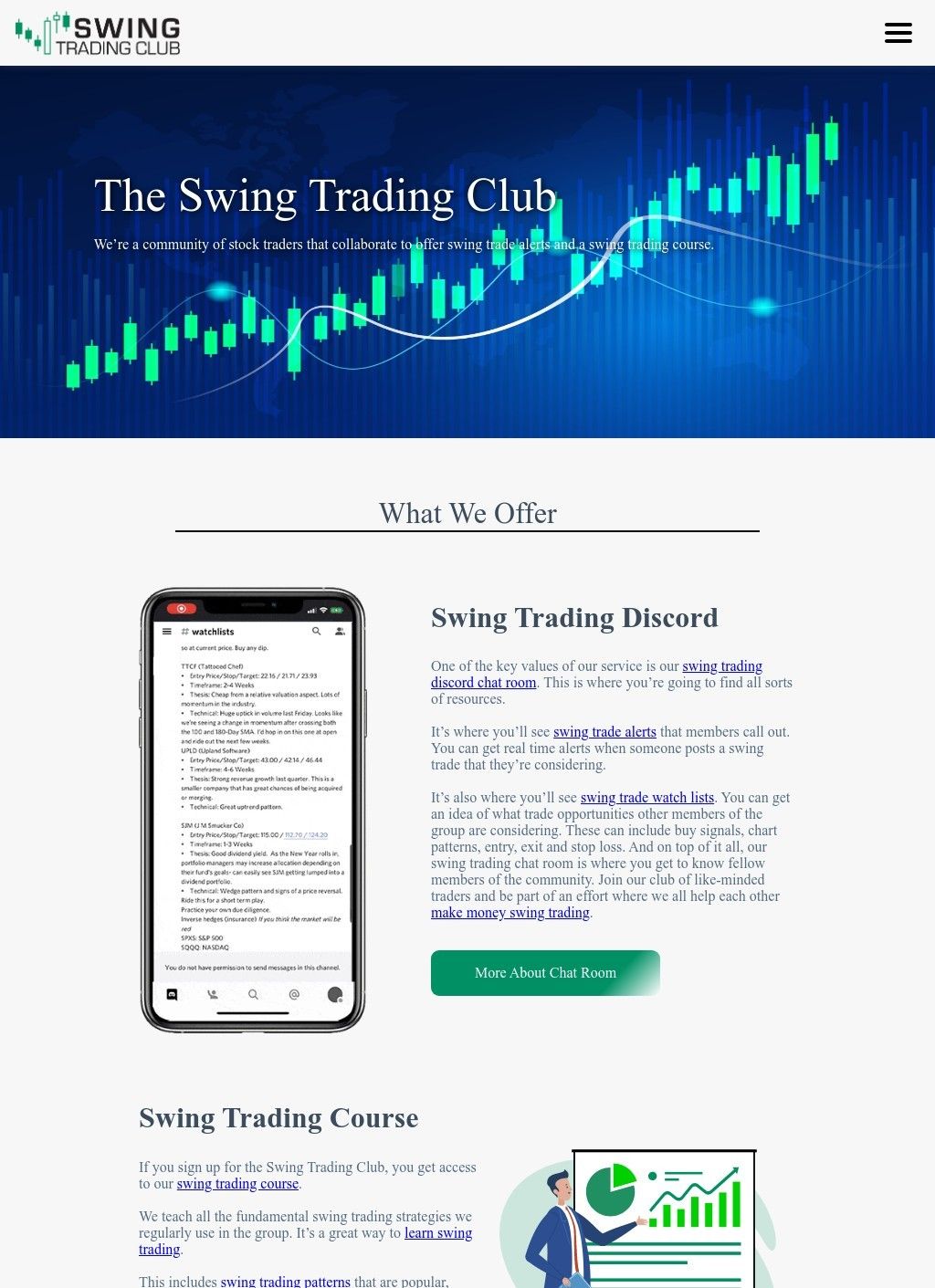
At nineteen dollars a month, Swing Trading Club gives a retail trader access to a Discord room where other members post their own swing trade alerts, watch lists, buy and sell signals, chart patterns, and the entry, exit, and stop-loss points they are working with. That price is the headline. It is cheap enough that a single decent idea pays the Swing Trading Club subscription back, and the site leans on that fact hard: one tier, course access folded in, cancel whenever you want.
A peer group, not a tip service
What you are paying for is closer to a peer group than a tip service. The signals flowing through the chat come from community members, not from a licensed advisor handing down picks, and the site is upfront that this is collaboration rather than managed advice. For some traders that distinction is the whole ballgame. You are buying into a conversation and a feed of other people's reasoning, which is useful if you already know enough to weigh a setup and dangerous if you are looking for someone to tell you exactly what to buy. Swing Trading Club is honest about which of those it is.
Swing trading course and watch lists
Around the live chat sits a fair amount of structured material. There is a swing trading course that walks through strategies, common chart patterns, and the technical indicators a swing trader tends to use. Weekly watch lists arrive with annotated trade setups, so a member sees where someone marked a level or flagged a pattern alongside the ticker symbol. There is a Trading Techniques section with training and tools, plus notifications about upcoming market news and events that might move positions. A free newsletter rounds it out, carrying market commentary and updates on members' actual trading profits.
Profit screenshots in the newsletter
That newsletter detail deserves some attention. Publishing member profit updates cuts both ways. It points to real people trading real money through the community, but profit screenshots are also the oldest marketing instrument in this corner of the internet, and a reader should treat them as encouragement over evidence. Nothing here looks like Swing Trading Club is dressing up returns dishonestly, only that any trading community waving profit figures deserves the same skepticism you would bring to the next one. The framing is more straightforward than the average service in this niche, and the price point keeps the downside contained, but those are not the same as a verifiable track record.
Media mentions and missing reviews
Swing Trading Club has been mentioned by Benzinga and CashBlog as an affordable swing trading resource, which is a respectable pair of name-checks and more than many small services in this space can point to. Benzinga in particular is a known financial-media outlet, so the reference adds real credibility. Past those two, independent member feedback is almost nonexistent. The Facebook page shows exactly one review and no aggregate rating. There is no Trustpilot profile, no Google reviews, no Better Business Bureau entry, nothing on Yelp or any comparable platform tied to theswingtradingclub.com.
For a membership product that asks for a recurring monthly payment, that gap is real. A prospective member cannot read through dozens of accounts of what the chat is actually like day to day, whether the alerts are timely, or how the community handles a trade that goes wrong. The two media mentions confirm Swing Trading Club exists and is inexpensive; they say nothing about whether members stay past the first month, or whether the Swing Trading Club chat is active enough to be worth logging into daily. Adding it to a directory adds discoverability, but does not fill that review gap. Someone considering a subscription is largely working on faith.
Limited contact information
Contact setup is similarly modest. The site offers a web form asking for name, email, subject, and message, and that is the complete public contact route. No phone number, no physical address. An email, sean@theswingtradingclub.com, appears on the Facebook business page, which at least attaches a human name to the operation, but it never appears on the site itself. A form-only setup is workable, and plenty of legitimate small online businesses run exactly this way, yet for something built on trusting other people with your trade ideas, a little more visible accountability would not go amiss.
Social media presence
The social footprint is broader than the review trail. Swing Trading Club maintains accounts on Twitter, Facebook, Instagram, and YouTube, so there is a public face and presumably some ongoing content to sample before paying. A curious visitor can get a feel for tone and activity level through those channels, and that is probably the smartest free research available given how little third-party review material exists. Worth spending thirty minutes there rather than relying on the homepage copy alone.
Stacking it all up, Swing Trading Club reads as a low-cost, no-frills swing trading community with a clear structure: a Discord feed, a course, weekly watch lists, and a newsletter under one inexpensive membership. The peer-collaboration framing is refreshingly honest, and the nineteen-dollar entry keeps the stakes low if it turns out not to fit. The course inclusion sweetens a price that would already be reasonable for the chat alone. The near-total absence of independent reviews is the one real drag, and the bare-bones contact setup does not offset it. The low price is the strongest argument Swing Trading Club has going for it, and whether that argument is enough depends on how comfortable a given trader is making a call with limited outside information.