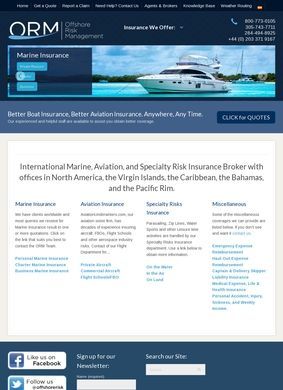
A boat owner lining up a season of paid charter work in the Bahamas calls the carrier that has covered years of weekend cruising, and gets a decline before anyone even orders a survey. A flight school after hull cover on a second trainer hits the same wall, and so does a beach concession about to put its first parasail boat in the water.
These are the callers Offshore Risk Management exists for. The firm brokers marine, aviation, and specialty risk insurance across North America, the Caribbean, the Bahamas, and the Pacific Rim, and nearly everything in its catalogue sits in territory where the standard personal lines market has already said no.
Few insurance shops put parasailing liability and hangarkeeper cover on the same page. Offshore Risk Management does, and the pairing is a fair summary of the whole operation.
The three books: marine, aviation, and specialty risk
Offshore Risk Management splits the work into three lines, each with its own quote request form run on Formstack, so a charter operator and a zip line owner answer different questions from the first screen.
The client list it aims at reads like a harbour and airfield census. It includes boat and aircraft owners, charter operators, maritime and aviation businesses, specialty activity providers, and international customers who need cover that travels with them.
Boats for pleasure, boats for business
The marine book at Offshore Risk Management takes in personal pleasure boats, charter vessels, and commercial marine risks, which includes the awkward middle ground where a privately owned catamaran starts carrying paying guests. Around the hull cover sit two named extras that are easy to picture in use: LifeLine, an emergency expense reimbursement product, and YachtHaul, which pays back haul-out costs when a boat has to come out of the water.
Captain and delivery skipper liability is on the marine menu as well, a sensible line for owners who hire crew to move a boat across the distances Offshore Risk Management works in.
Aircraft cover and a sister firm called Aviation Underwriters
Aviation here spans private and commercial aircraft, flight schools, FBOs, and hangarkeeper liability. That last item is the protection an airfield business carries for other people's aircraft in its care. Hangarkeeper claims arrive when a stored aircraft gets damaged, and the site treats this cover as a standard product.
Offshore Risk Management also points buyers to a sister operation, Aviation Underwriters, which it credits with decades of experience insuring aircraft, FBOs, and flight schools. The decades are the company's own claim, but naming the partner firm gives an aviation shopper something concrete to check before binding anything.
Parasailing, zip lines, and the specialty book
The third line is the odd one. Specialty risk at Offshore Risk Management covers water sports operators, parasailing, zip lines, and other leisure activities run on land or in the air.
Medical, life, and health policies sit on the same shelf. They read strangely next to zip line liability. For an international client already buying hull or hangar cover through this brokerage, though, adding personal insurance in the same conversation has a plain logic.
Getting a quote and checking the record
Contact is the easy part of the homework: a contact page is simple to find, one phone desk covers the US, the Caribbean, and the Pacific Rim, UK callers get a separate number, and Facebook, LinkedIn, and Twitter accounts sit alongside the quote forms.
Phone lines on both sides of the Atlantic square with the international book Offshore Risk Management claims to run.
One catamaran claim and the Progressive question
The public record does not amount to much, and there is no point pretending otherwise. Yelp lists Offshore Risk Management with exactly one review, a strong one: the customer describes prompt, efficient service on a power catamaran claim handled during the pandemic. Claims service under pressure is the thing every insurance buyer most wants evidence of, and that account is the only detailed public version of it.
Facebook adds seven reviews with a 78 percent recommend rate; the sample is small, and the percentage means at least one reviewer walked away unhappy. The only other trace is a thread on Cruisers and Sailing Forums where a user asks whether anyone has dealt with the company and how its claims record looks. That thread is a request for experiences rather than a complaint, and it carries no rating either way. No Google, Trustpilot, BBB, or Glassdoor scores surfaced at all.
None of this is disqualifying for a commercial specialty broker; charter companies and flight schools leave far fewer star ratings than restaurant customers do. It does mean a new client ends up weighing the firm's own materials, one detailed claims account, and seven Facebook votes, so ordinary diligence applies: ask Offshore Risk Management for references in the relevant segment and read the policy wording closely.
Whether to call comes down to where the direct market stops. A trailered runabout that never leaves domestic waters can be quoted online through Progressive in minutes, from a household name, and pushing that simple risk through Offshore Risk Management or any other specialty broker adds a layer without adding much value.
One step past the runabout, the logic flips. A charter income stream in the Bahamas, a parasail concession, a flight school fleet, or a hull that spends its seasons outside the United States is just the kind of risk Progressive and the rest of the direct market turn away, and it is exactly what Offshore Risk Management is built to quote.
Going direct still wins on speed and convenience for the simple boat. Once the risk gets complicated, a catalogue built around LifeLine, YachtHaul, and hangarkeeper cover looks like the product of a firm that underwrites these cases every day, not a broker bolting on a specialty rider.