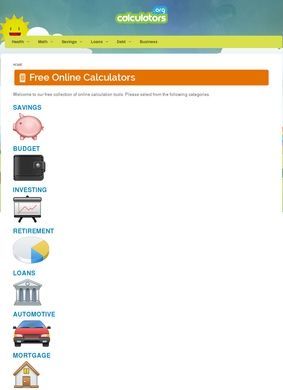
Someone sits down to work out whether they can afford a slightly bigger mortgage, or how much to set aside each month to retire without panic, and they want an answer in the next two minutes without handing over an email address. That is the exact moment Calculators.org is built for. Type the numbers, read the result, close the tab. No login, no paywall, no upsell waiting at the end of the form.
Financial tools for money decisions
The site sorts its tools into three plain buckets: money, math and science, and health. The financial section is the deepest of the three and the most relevant to anyone landing here from a personal-finance angle. There are calculators for savings and budgeting, for investment and retirement projections, for loans, auto financing, and mortgages, plus business, debt-management, and credit-card tools. That spread covers most of the ordinary money questions a household runs into, from "what does this car loan really cost" to "am I saving enough."
Math and science calculators for students
The math and science group leans academic. Scientific, algebra, geometry, trigonometry, calculus, and graphing calculators sit alongside narrower tools for statistical averages, standard deviation, and fractions. A student stuck on homework gets something genuinely useful, and the breadth puts Calculators.org somewhere between a homework aid and an adult finance tool, clearly aimed at more than one kind of visitor.
Health resources and wellness tools
The health tools are the part that makes Calculators.org feel less like a stripped-down finance widget and more like a general reference. Weight-loss and caloric-needs calculators are common enough, but the site also carries pregnancy and due-date tools, a smoking-cessation calculator, and entries for heart health, diabetes, and cancer resources, along with a simple age calculator. None of this replaces a doctor, and a sensible visitor will read it that way, but as a quick orientation it widens the audience well beyond the money crowd.
Free games for younger learners
Then there is the small arcade of free math-learning games, Math Duck, Grocery Cashier, and Dungeon Knight, clearly built with younger students in mind. It is a slightly unexpected addition for a site that otherwise looks utilitarian, and at least one informal blog has spoken warmly about using these games with kids. That is a single positive mention, not a wave of acclaim, so treat it as a small data point and nothing more.
No registration or payment required
The consistent thread across all three sections is that everything is free and nothing asks you to register. For a tool people reach for in a hurry, that no-friction approach pays off in a way the feature list alone does not capture. The value proposition is simple and Calculators.org delivers on it without making you jump through hoops.
Absence of third-party reviews and ratings
Credibility is where the picture gets harder to read. A search for outside opinion on Calculators.org turns up almost nothing tied to this specific domain. The reviews that surface belong to similarly named competitors, calculator-online.net, free-calculator.org, calculators-online.org, which is an easy trap given how crowded and generically named this niche is. No Trustpilot profile, no Google business reviews, no BBB or Yelp entries came back for Calculators.org itself. For a free tool with no transactions, no accounts, and nothing to dispute, that absence is understandable. It does mean a visitor has no outside record to lean on and has to judge the tools on their own merits.
Contact and transparency are a weaker spot. The homepage and navigation show no phone number and no street address, which is normal for a utility site of this kind. More awkward is that an About page link exists but the page behind it did not load on review, so the usual route to learn who runs Calculators.org and how to reach them is effectively closed. For a free calculator that holds no personal data, the missing contact details cost less than they would for a shop or a service firm, yet a working About page would answer the accountability question cheaply.
Calculators.org is a competent, genuinely free toolbox with real range: a deep financial section as the anchor, math and science for students, and a health section that broadens the appeal beyond any single audience. The drawback is quiet but worth naming: no third-party track record and an About page you cannot open. For a quick, no-strings calculation, the site does the job, and the tool quality is what it has to stand on given the near-total absence of published outside opinion. A visitor who needs a fast number and nothing more will get exactly that here. A visitor who wants to know who built the tools, or wants outside confirmation that the formulas are sound, walks away with neither, and the convenience has to outweigh that gap for the verdict to land in the site's favor.