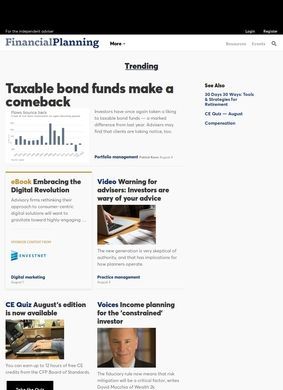
Publishing a dedicated virtual summit on AI in advisory practice is a reasonable indicator of where Financial Planning has pointed its editorial energy lately, and that event sits alongside decades of conventional trade coverage that predates the current technology conversation by a long stretch. Financial Planning is a publication for working advisors, RIAs, and wealth managers, produced by Arizent as part of a B2B financial-services network. Reporting is sorted into five beats: practice management, investing, regulation and compliance, technology, and a rolling industry-news feed. Regular readers will find it less a how-to destination than a desk reference for what is moving through the profession in any given week.
Five reporting beats for advisors
The practice-management vertical is the most distinctive of the five. It covers client management, recruiting, and compensation, which are the unglamorous mechanics of running an advisory firm and the topics that thinner outlets routinely skip. Paired with the regulation-and-compliance beat, which tracks tax changes, policy shifts, fraud, and risk, Financial Planning takes seriously the parts of the job that generate the real liability and headaches. The investing coverage leans toward retirement, estate planning, and ESG questions, so it is written for someone advising clients, not for a retail saver trying to pick a fund.
The technology beat is where the site reads as current. Fintech and the spread of AI into advisory workflows get steady attention, which tracks with the broader anxiety in the industry about software eating tasks that used to justify a fee. The industry-news stream rounds this out with mergers, acquisitions, earnings, and the steady churn of senior advisors changing firms. Read together, the five verticals form a reasonably complete picture of the profession, and Financial Planning does a decent job of keeping them distinct instead of letting everything blur into generic market commentary.
Email newsletters by topic
Three email newsletters carve up the territory by interest: Daybreak for a morning briefing, Portfolio Management for the investing side, and Wall Street Insider for the firm-and-deals angle. Picking by topic instead of receiving one undifferentiated feed is a sensible setup, and it reflects an understanding that a recruiter and a portfolio strategist want different things in their inbox. The newsletters are the most likely entry point for a casual reader who does not want to visit the homepage every day.
Continuing education and credits
The continuing-education quizzes are the feature that gives Financial Planning a practical edge over a plain news site. Advisors carry certification requirements, and being able to earn CE credits by reading and then answering questions turns time on the site into something that counts toward keeping a license current. That is a real reason to bookmark the publication rather than skim it through a search result. Alongside the quizzes sit a print and digital magazine, webinars, whitepapers, and sponsored research reports, so the catalog runs from quick daily reading to longer-form material an advisor might cite in a client conversation.
Sponsored content and events
A fair portion of that deeper material is sponsored. Whitepapers and sponsored research reports carry a commercial backer, and the virtual summits follow the same trade-media economics. None of that is unusual for a B2B title, and Financial Planning is not coy about labeling it, but a reader should weigh a vendor-sponsored whitepaper differently from a staff-reported regulation story. The line between the two is generally clear enough, which is more than some competing outlets manage.
Checking the events calendar
The events program also shapes how the brand operates. Virtual summits like the AI-focused one give the publication a live presence and a way to convene the audience it reports on, and that loop, reporting on the industry and then gathering it in a room, is part of what keeps a trade title relevant past its archive. Whether any single summit is worth blocking out the calendar depends on how close the topic sits to your daily work, and the lineup shifts often enough that checking what is scheduled before any commitment is the sensible move.
News coverage versus technical depth
One honest limitation: this is general professional coverage, not personalized guidance. Financial Planning reports on retirement and estate-planning trends, but it will not tell a specific advisor how to structure a specific client's plan, and the depth on any one technical question varies by article. Someone looking for a textbook treatment of a tax provision may find the coverage useful for spotting the development but short on mechanics. That is the nature of news against reference material, and it is a fair trade for breadth and timeliness.
Outside the site itself, Financial Planning carries minimal public third-party review presence. A general search turns up industry mentions and trade listings but no substantial aggregated reader ratings, which is fairly typical for a professional publication with a narrow specialist audience instead of a consumer product with mass-market reach. The Arizent network backing it gives the brand stability and the staff to cover beats consistently rather than chase trending topics, and the original reporting on M&A and career moves indicates the publication still does its own legwork instead of relying on republished press releases.
For a practicing advisor, RIA, or wealth manager, Financial Planning is a sound regular read. The CE quizzes and the topic-segmented newsletters give it more utility than a passive news feed would offer. For anyone outside the profession, a retail investor or a curious general reader, the value drops off fast, since the writing assumes industry context and the resources are built for license-holders. Financial Planning knows exactly who it is publishing for, and that focus is both its strength and the clearest explanation of why it will not suit everyone equally.