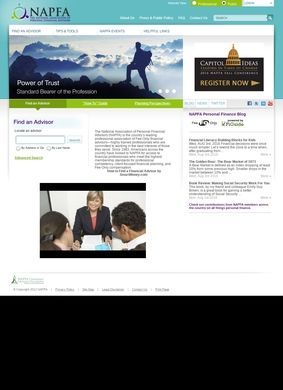
Finding a financial planner who legally cannot pocket a commission for steering you into one product over another is harder than it sounds. The National Association of Personal Financial Advisors has built its entire structure around one membership rule: every advisor it represents is fee-only and bound to a fiduciary standard, paid by the client and no one else. That constraint shapes everything on the site, making it a practical starting point whether you are a consumer hunting for advice or a planner deciding where to hang your professional affiliation.
Finding fee-only advisors
The consumer side is what most people reach first. There is an advisor finder tool covering roughly 4,500 member planners across the United States, and around it sits a layer of plain-language education explaining what fee-only and fiduciary actually mean in practice. A lot of people who call themselves financial advisors are compensated through commissions on the products they sell, and that arrangement quietly bends the advice they give. The National Association of Personal Financial Advisors spends real effort spelling out that difference, with consumer guides aimed at someone who has never had to vet a planner before. The National Association of Personal Financial Advisors also publishes dedicated material on LGBTQ+-informed financial planning, a more specific commitment than the average professional body bothers to state publicly.
Consumer guides and advisor search
For planners themselves, the membership is built around continuing development. A Learning Center carries the continuing education, and the National Association of Personal Financial Advisors runs professional development certifications alongside national and regional conferences, with a Spring 2026 gathering already on the calendar. Webinars fill the gaps between in-person events. What I find more interesting than the headline conferences is the connective tissue underneath: local study groups, a mentoring program, and a community platform where members trade practice questions. Those are the things that keep an association from being a logo on a website and a yearly invoice. The National Association of Personal Financial Advisors also publishes DEI toolkits and training, and maintains member discount directories, so the value proposition for a working advisor is fairly tangible rather than aspirational.
Professional resources for members
The infrastructure is split across a few subdomains. There is members.napfa.org for the membership functions, community.napfa.org for the peer platform, and education.napfa.org for the Learning Center. The National Association of Personal Financial Advisors split the site this way once a single domain could no longer hold everything, and it reads as a sign of a body that has grown past the brochure stage. The NAPFA Nation Podcast adds another channel, aimed at the profession but useful to a curious consumer who wants to understand how fee-only planners think about their work.
Advocacy is the quieter fourth pillar. The National Association of Personal Financial Advisors lobbies on behalf of the fee-only fiduciary model, which puts it in the position of arguing for a standard that not every part of the financial services industry wants to see become universal. That advocacy work is hard to evaluate from the outside, but its presence shows that the National Association of Personal Financial Advisors sees itself as defending a position, not simply servicing dues-paying members. Student membership is offered too, which is a sensible move for a profession that needs to recruit planners into the fiduciary camp early, before they settle into a commission-based shop.
There is a limit to what the site can do for an individual consumer, and it is the one baked into the whole premise. The National Association of Personal Financial Advisors does not give you advice; it gives you a vetted pool and the vocabulary to interview from it. You still have to do the legwork of contacting planners, comparing them, and deciding who fits your situation. People who have been burned by a salesperson dressed as an advisor will find real value in what the membership rule does on their behalf: it removes one entire category of bad incentive before a first conversation even starts. Those who want a single answer handed over will find the National Association of Personal Financial Advisors asks more of them than they hoped.
Comparing fee-only versus commission models
Weighed against the broader alternative most people reach for, the CFP Board's "Let's Make a Plan" directory, the difference is one of strictness. The CFP Board certifies competence and holds its planners to a fiduciary duty when giving advice, and its directory is larger, but it includes professionals who earn commissions. The National Association of Personal Financial Advisors draws a harder line by excluding commission income entirely. Neither is the obvious winner for every situation. If you want the widest selection of credentialed planners and are comfortable asking about compensation yourself, the CFP search casts a wider net.
If you would rather have that question settled in advance, the National Association of Personal Financial Advisors has already done the filtering. Its stricter standard is the reason it exists, and that is what makes it the more focused starting point for anyone who treats advisor independence as non-negotiable.