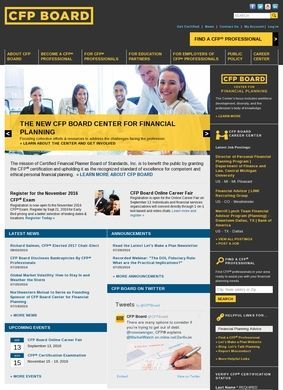
Someone three years into a financial services job decides the letters after a planner's name are worth chasing, and the first question is always the same: what does it take, and who decides whether you measure up. That is the question the Certified Financial Planner Board of Standards, Inc. exists to answer, and it has built an entire infrastructure around that answer. It is the nonprofit body that grants the CFP certification in the United States, sets the bar for who may use it, and enforces what happens when someone falls short of it. The site is built around that single mandate, and it reads like an organization that has thought hard about each group passing through its doors.
Four pillars of certification
The certification path is laid out plainly. A candidate has to finish approved education coursework, sit a comprehensive exam, log real professional experience, and commit to a code of ethics. None of those four pillars is treated as a checkbox. The site walks candidates through registration, points them toward exam preparation material, and breaks the requirements into steps a person can follow without a counselor at their elbow. The experience requirement and the ethics commitment get the same weight as the exam, which is right, because they are the parts most people underestimate when they start.
Plenty of professional bodies pretend everyone arriving at their door wants the same thing. The Certified Financial Planner Board of Standards, Inc. does the opposite, splitting its material across four groups: people pursuing the credential, professionals who already hold it, employers who hire them, and the consumers who eventually sit across the desk. That division shows up in how the content is organized, and it keeps a working advisor from wading through student onboarding to find what they need.
Resources for candidates
For the candidate group, the supporting resources go past instructions. There is a scholarship program that has awarded more than $2.6 million, a mentorship matching service that pairs newcomers with established planners, and a job and internship board aimed at people building toward the credential. A student or a career changer can map out a route that includes paying for the coursework and finding a first role, which is more than most certifying organizations bother to provide. The scholarship figure in particular signals that the Certified Financial Planner Board of Standards, Inc. is not a body content to collect exam fees and step back.
Continuing education tracking
Active certificants get a different toolkit. The site handles continuing education tracking, which matters because CE is the obligation that quietly accumulates and trips people up at renewal. It offers ethics guidance for the situations that are rarely black and white, and it publishes compensation trend research that gives advisors a read on where their pay sits relative to the field. There is also the annual Connections Conference, which draws upward of 900 attendees, a number that tells you the credential carries a working community behind it and something more than a certificate on a wall.
Consumer verification through letsmakeaplan.org
The consumer side runs through letsmakeaplan.org, a finder that lets a member of the public locate a CFP professional. The value is straightforward. A person who has learned the credential means something now has a way to confirm whether the advisor in front of them holds it, and to find one if they do not. Connecting the certification to a public directory of certified planners closes the loop between the standard being set and the standard being used, which is the whole point of a credential meant to protect consumers.
Research reports and industry insights
Beyond the finder, the Certified Financial Planner Board of Standards, Inc. publishes research reports and industry insights. For a working advisor these double as a way to keep current on where the profession is heading, and for an employer they help frame what a CFP designation actually represents when reviewing candidates. The reporting is consistent with an organization that treats itself as a steward of the profession's direction, going well past the role of gatekeeper.
There is also an online account portal where certificants manage their credentials, log CE, and keep their standing in order. It is the kind of administrative backbone that sounds dull until you need it, and its presence means the certification is something a professional maintains over a career, with the upkeep handled in one place.
What ties all of this together is coherence. Looking across the whole site, the Certified Financial Planner Board of Standards, Inc. is not running a grab bag of programs that happen to share a logo. The structure is unusually tight for a nonprofit credentialing body: education leads to an exam, the exam to experience and ethics, the credential to ongoing CE and a public finder, and the whole arc back to the consumer protection that justifies the standard in the first place. Each piece references the others, and the site reflects that rather than burying it.
The one caution worth naming is scope. The Certified Financial Planner Board of Standards, Inc. is a certifying and standards body, so it is the right destination for understanding, earning, or verifying the credential, but it is not a place to get personal financial advice. A consumer comes here to check an advisor or find one, then takes the actual planning conversation elsewhere. That is by design, and the site is honest about its lane, yet it is worth knowing before you arrive expecting something it was never meant to be.
Check your eligibility requirements
For a working financial professional weighing whether to pursue the CFP marks, the Certified Financial Planner Board of Standards, Inc. is the place to start. It is also the right resource for employers trying to understand what the designation means in practice. The Certified Financial Planner Board of Standards, Inc. is the place to begin the process and the only source that defines the requirements with authority. Check whether current coursework counts toward the education requirement, and look into the scholarship program before assuming the cost is out of reach.
A consumer vetting an advisor should head straight to the letsmakeaplan.org finder and confirm the credential there before the first meeting. Either way, the Certified Financial Planner Board of Standards, Inc. is where the standard lives, and going to the source beats taking anyone else's word for what the letters mean.