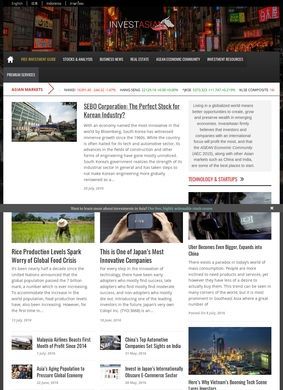
A newsletter claiming more than fifty thousand subscribers sits behind a site that lists exactly one country guide per market and ten markets in total. That gap between the audience figure and the relatively contained published output is the first thing that sticks. InvestAsian positions itself as an information and advisory operation for people putting money into Asian and frontier economies, and the editorial reach is genuinely wide: Cambodia, Hong Kong, Indonesia, Japan, Korea, Malaysia, Philippines, Singapore, Thailand, and Vietnam each get their own investing guide.
Three core investment topics
The substance falls into three working areas. Real estate buying in emerging Asian economies seems to be where InvestAsian has the most to say. Stock trading guidance covers the region's exchanges. And then there is offshore banking, a topic that draws a particular sort of reader and also tends to attract a particular sort of skepticism. Around those pillars the site runs articles on frontier markets, strategies for holding value in a downturn, expat life, and salary comparisons across countries. It is a coherent set of interests, all pointing at the same audience: someone outside Asia, or recently arrived in it, trying to figure out where to park capital and how to do it legally.
Real estate, stock trading, offshore banking
Credibility for a site like this rests almost entirely on who is writing and whether anyone outside the operation takes it seriously. On the first point, InvestAsian describes its contributors as a team that includes analysts and translators with regional knowledge. The translator detail is worth noting, because it implies the content is built partly from local-language sources rather than recycled English-language commentary, and for frontier markets that is the difference between useful and generic. On the second point, there are a few external markers. Asia Property Awards has cited the site for coverage of Cambodian property developers. InvestAsian also contributes pieces to TheFinance.sg, including articles on tax-free countries and capital gains tax jurisdictions, which fits the offshore-and-residency angle of the rest of the catalogue.
Editorial credibility and external recognition
Those citations are more meaningful than they might appear. Anyone can publish an offshore-banking explainer; getting referenced by an established regional property awards body, or invited to contribute to another finance publication, takes a degree of editorial trust that does not come automatically. For InvestAsian, it is a short trail, but it points the right direction.
Contributors with regional knowledge
As a free reading resource, the country guides and the topical articles give a newcomer a structured way into markets that English-language financial media tends to cover lightly or not at all. The salary comparisons and expat-living material round it out into something closer to a relocation-and-investment reference than a pure stock-picking blog. Someone trying to understand how property purchase works for a foreigner in the Philippines, or what the tax position looks like in Singapore, has a starting point here that is organized and apparently sourced with local input.
The picture beyond those references is sparse and a little odd. Scamadviser rates the InvestAsian domain as very likely legitimate, which is reassuring in the narrow sense that the site is not flagged as a fraud, though that tool sets a low bar and clears a great many ordinary websites. Glassdoor lists InvestAsian as a company with a single employee review, confirming it is a small operation and not much else. There are no Google, Trustpilot, Yelp, or BBB ratings to weigh. For a service built on financial guidance, that absence is notable. People who read investing content and act on it tend to leave traces, and the near-total quiet on the mainstream review platforms means a prospective reader has very little independent signal about whether the advice has served anyone well.
Social presence on Facebook, X, and LinkedIn is there, so the operation is reachable and visible across platforms. The homepage itself does not put a phone number or a physical address in front of you, which for an advisory firm dealing with offshore banking and overseas property is a fair thing to flag. None of this reads as evasive on its own; plenty of small content-led firms run lean. The burden of due diligence stays with the visitor.
Free guides and paid advisory services
Where the picture gets harder to read is the step from free content to paid advisory service. InvestAsian is listed on trueoffshore.com as a financial consultancy and advisory provider, which confirms that the operation does more than publish. Yet the public-facing material gives little detail on what that engagement actually involves, what it costs, who delivers it, or what regulatory standing sits behind advice on cross-border banking and overseas property purchase.
Assessing advisory credentials and terms
The reading material can be judged on its own merits. The country guides are organized, the topical range spans property, equities, banking, and expat logistics, and the external citations give a concrete reason to take the editorial work seriously. The advisory side is a different question. A prospective client is being asked to trust a small, lightly-reviewed firm with decisions that carry real legal and financial weight, on the strength of a couple of third-party citations and a clean fraud-checker score, and without a clear line of sight into the credentials standing behind the guidance. That is worth weighing carefully against whatever the engagement actually entails.