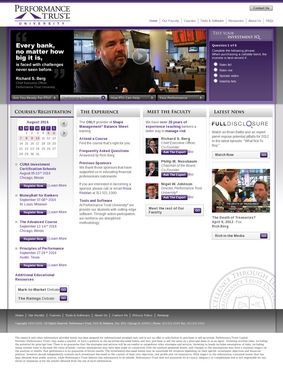
A three-day class on balance sheet management that runs more than ten times a year is the spine of Performance Trust University, and the firm behind it has been doing this since 1994. The wider business, Performance Trust Capital Partners, is a Chicago financial services firm built around community banks and credit unions, so the teaching is no side project. It comes out of a practice that advises the same kinds of institutions it puts in the classroom, and that gives the curriculum a particular slant: Performance Trust University is training for people who run a bank's books, not a general finance survey.
Balance sheet training since 1994
The program sits inside a recognisable house style. The firm pushes a framework it calls the Principles of Performance, and a strategic planning track it labels Survive or Thrive, both of which frame the conventional way community institutions think about their balance sheets as something to be argued with. Whether that reframing holds water is something an attendee would judge in the room, but the consistency of the message across the offering is real, and Performance Trust University is the public face of it.
Strategic planning framework
Performance Trust University covers strategic planning alongside the mechanics of balance sheet management, and it is pitched at decision-makers inside community financial institutions. The multi-day format and the fact that Performance Trust University runs ten-plus times a year tell you it is a steady, repeatable part of the firm's calendar, not an occasional seminar. For a smaller bank or credit union sending a treasurer or a CFO, that cadence matters: there is almost always a session within reach.
PTU Interactive tools
Backing the course is PTU Interactive, hosted on a separate tools subdomain, which gives attendees digital instruments tied to what they learn. The pairing is sensible, because balance sheet work fades fast once you leave a lecture hall unless you have something to practise on afterward. The tools keep the ideas in front of people between sessions, which is a step most training outfits do not bother to build.
Drawing on firm services
Around the education sits the rest of the firm, and it helps explain where the teaching comes from. There is PT Score, a proprietary enterprise risk management platform that scores an institution's risk and regulatory positions. There is Fixed Income Services for bond and investment work, and Enterprise Shape Management, the firm's name for asset liability management advisory. Add investment banking for financial institutions, bond accounting, and regulatory support, and you have a shop that touches most of what a community bank's finance team deals with. Performance Trust University draws on that depth instead of teaching theory in isolation.
Employer and investment ratings
Outside signals are mixed and mostly tied to the firm as an employer or asset manager. Glassdoor carries 38 employee reviews with a 3.5 out of 5 overall satisfaction score, 3.6 for work-life balance, and 56 percent saying they would recommend the place to a friend. That is a middling employer picture, not a damning one, and it says little about the quality of the courses themselves. Morningstar lists Performance Trust Asset Management with an Average Parent rating, which is exactly what it sounds like: neither a red flag nor a selling point. A Yelp listing exists for the Chicago address but shows no visible customer rating, so there is no consumer-side verdict to rely on.
How do peer referrals matter?
What this adds up to is a firm that is easy to verify but hard to grade on the training specifically. The reputation that exists is about the company as a workplace and an investment manager, not about whether a bank treasurer left a Performance Trust University session better equipped. Anyone weighing the program is going to rely on referrals from peer institutions more than on any public score.
Contact and accessibility
On the practical side, the firm is straightforward to reach. A contact page is in place, the Chicago headquarters address is published in plenty of places, and a main phone line is listed. Getting in touch takes no effort, which is the baseline you want from a financial services provider asking institutions to send staff for multiple days.
Weighing credibility against public evidence
The verdict sits somewhere in the middle, and honestly so. Performance Trust University is a credible, long-running program from a firm with real depth in community banking, and the supporting tools and the breadth of the parent company's services give it more substance than a standalone training brand would have. The catch is that public evidence stops short of confirming the courses are good; it only confirms the firm is established and reachable. The worth of Performance Trust University itself comes down to word of mouth, and for a community bank or credit union considering several days and travel, that is a real gap. Institutions that already work with this kind of advisor, or that get a direct recommendation from a peer, have enough to act on. Everyone else is betting on pedigree alone.
Business address
Performance Trust University
445 West Erie, Suite 211,
Chicago,
Illinois
60654
United States
Contact details
Phone: 3122558044