Jewish Accountants exists to narrow a search that most people find overwhelming: finding a CPA or tax preparer who happens to share a religious or linguistic background. The site runs as a matchmaking directory, pairing individuals and businesses with Jewish or Hebrew-speaking financial professionals across the accounting spectrum. That is a specific promise, and it shapes everything else on the Jewish Accountants page.
Coverage stretches wider than the name implies. You get CPAs, bookkeepers, and tax preparers, but also people who handle international tax, startup accounting, and trusts and estates. Alongside the accountants sit financial advisors, wealth managers, retirement planners, insurance companies, investment banks, and credit unions. Someone arriving with a fairly ordinary tax question and someone untangling a cross-border estate would both find categories aimed at them. The spread also nods to how tangled personal finances become once a business, a retirement account, and an insurance policy all sit in the same picture.
Grouping accountants next to advisors and planners lets a user move between related needs without hopping to a different service each time.
Geographically the reach is ambitious. Major US cities anchor the listings, New York, Los Angeles, Chicago, and Miami among them, and Jewish Accountants extends its listings into Canada and Israel. For a user in a smaller market, that breadth is a fair question mark, since a directory is only as useful as the professionals actually listed in a given city.
How the matching is meant to work
The mechanics here deserve close attention, since a directory works only when its tools put a person in front of the right professional.
Search and matching tool
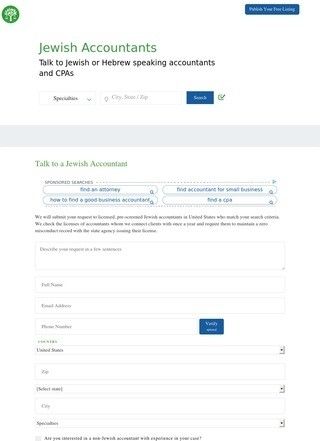
At the center sits a professional search and matching tool, backed by browsing that can be filtered by specialty or by location. Within Jewish Accountants, a person who knows they need a trusts and estates specialist in Chicago can drill down that way; someone less certain can lean on the matching function to surface candidates. Both paths lead toward the same goal, and having them side by side is sensible, since not everyone arrives knowing the exact title of the professional they need.
The location filtering is easy to skim past, but it does real work. Accounting rules and tax filing obligations shift by jurisdiction, so a user in Israel and a user in Miami are looking for genuinely different expertise, and letting the browse narrow by place respects that difference instead of flattening it.
Request form and direct messaging
Two routes exist for making contact once a user has a shortlist. There is a request-submission form, where a person describes what they need and waits for responses, and there is direct messaging to reach listed professionals individually. The form suits someone who wants to cast a line and see who bites. The messaging suits someone who already has a name in mind.
Jewish Accountants states that inquiries get a response within two business days. That is a concrete, checkable commitment, the sort of thing a user can hold the platform to. Whether every listed professional honors it is beyond what the page can promise, but naming a window at all is better than the vague open-endedness many directories settle for.
Verified listing system
Jewish Accountants promotes a verified listing system, which is its main pitch on trust. In a category where a stranger is about to hand over tax documents and financial details, a claim of vetting is not a small thing. The page does not spell out, at least not upfront, what verification involves, whether it confirms credentials, licensing, or merely identity. A user relying on that badge would want to know which of those it means before treating it as a guarantee.
A newsletter signup rounds out the feature set, aimed presumably at people who want to stay in touch without committing to a search right away. It is a minor thing next to the search tools, but it fits the pattern of a site trying to keep a relationship going after the first visit.
One structural detail sits underneath all of this. The contact route points toward a help center at a Heritage Web address, which strongly suggests the platform is built and run on that company's infrastructure. That is common enough for niche directories, and it is not a mark against Jewish Accountants, but it does mean the operator behind Jewish Accountants is a web platform company rather than an accounting firm itself. Users should read the listings as a marketplace, not as endorsements from a professional body.
Reaching an actual person is a different matter. A contact page link sits in the footer, and the form-based inquiry path works as the primary channel, but no phone number or physical address is published for direct contact. The form covers the practical need well enough, and there is nothing wrong with routing questions through it, though a visible phone line would do more to reassure a cautious first-time visitor.
As for outside reputation, a search turns up little that speaks to Jewish Accountants specifically. Other directories occupy the same niche, and a forum thread shares the general topic, but none of that amounts to independent reviews of this particular site. There are no third-party ratings to point to either way, which leaves a visitor to judge the platform on its own presentation and on the professionals it surfaces once a search is run.
That absence cuts both directions. Nobody has flagged a bad experience, but nobody has vouched for a good one either, so the site cannot borrow credibility from a track record of satisfied users. In a field built on trust with money, the quiet is worth noting.
What Jewish Accountants offers is clear and reasonably specific: a filterable directory, two contact methods, a stated response window, and a verification claim, all aimed at a well-defined audience. The gaps sit around proof, the unexplained verification process, the absent direct contact details, the empty outside-review picture. A user in a covered city with a common accounting need gets a straightforward tool to try. The verification badge and the depth of listings in smaller cities stay unproven on the page itself, so a cautious visitor is left weighing concrete gaps against a presentation that no outside review confirms or disputes.