You have a position open, you want to know exactly where it liquidates, and you need the number now. Bitcoinmargin puts a liquidation calculator on the front page precisely for that moment. The tool accepts margin type, entry price, multiplier, and position size, then returns a force-close price calibrated to whichever exchange you specify. That choice to open with calculation is the organizing logic of the entire site.
Liquidation calculator with exchange-specific pricing
A position-sizing calculator runs alongside the liquidation tool. Between the two, Bitcoinmargin covers the pair of pre-trade decisions that determine risk: where a position dies and how large it should be relative to account size. A funding-rate tracker pulls live perpetual data from Binance, Bybit, and Kraken Futures into a single view. For anyone holding overnight perpetual positions, those rates accumulate quietly across sessions, and aggregating three major venues cuts down the tab-switching that basic due diligence otherwise requires. Price tracking across Bitcoin, Ethereum, Solana, and other major assets refreshes on roughly eight-second intervals, fast enough to feel current without crossing into terminal-grade data feeds. The site makes no claim to replace a trading terminal, and the refresh cadence is calibrated to match that scope.
Position sizing, funding rates, price tracking
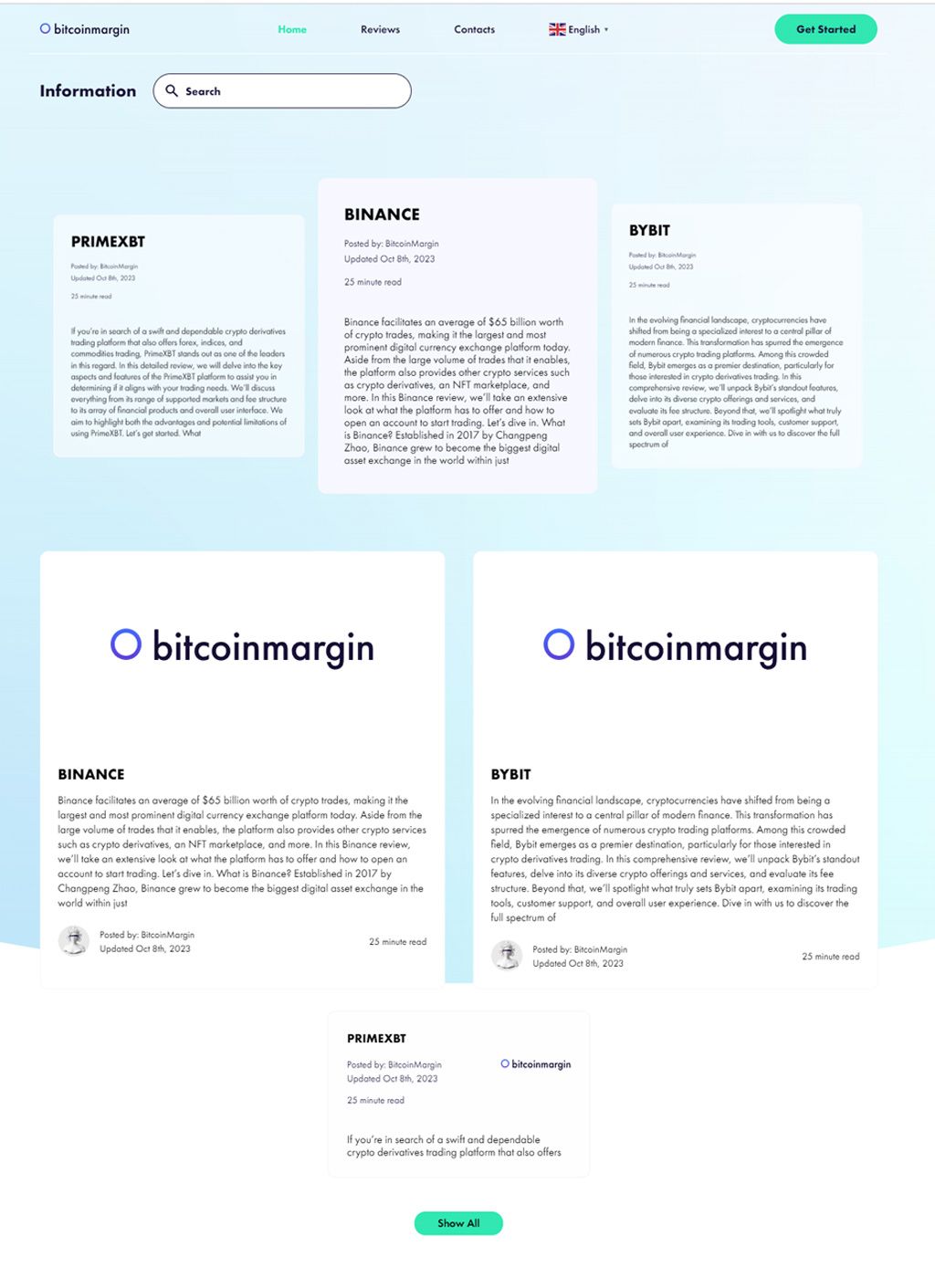
Bitcoinmargin also carries guides on crypto futures mechanics, margin strategy, and risk management aimed at retail traders still building their framework. A Bitcoin futures piece distinguishes linear from inverse contracts, a point that genuinely catches newcomers who assume all perpetuals settle the same way. Review-style pieces cover specific platforms: the PrimeXBT write-up cites 0.05 percent perpetual fees, up to 200x margin multiplier, and Covesting copy-trading. An exchange comparison piece lines up Binance, Coinbase, Kraken, Bybit, Bitvavo, and Crypto.com. The ESMA figure that 74 to 89 percent of retail accounts lose money on margin products appears on the site with attribution. A German-language edition at the /de/ path extends the audience past English-only readers; maintaining a live translation takes ongoing effort, and the presence of one is evidence the site is actively tended.
Educational guides for retail traders
No Trustpilot profile for Bitcoinmargin surfaced. No Google rating either. The only Trustpilot result that appears under a similar search, carrying close to four thousand reviews, belongs to bitcoin.com, an unrelated entity. For a calculation and reference tool, the absence of an external review record is less disqualifying than it would be for a brokerage or custodian: no user funds flow through the site, no accounts exist, and the deliverable is a number produced on-screen. A contact page is accessible from the navigation; no phone number or postal address is listed, which is consistent with an independently operated reference property, not a commercial service with ongoing client relationships.
No external reviews or user accounts
Bitcoinmargin delivers a focused set of pre-trade tools with live data feeds and exchange-specific calibration. The risk disclosure figures it cites are attributable to their named source. What it does not publish is any methodology behind how the liquidation formula handles cross-margin versus isolated-margin edge cases, so traders with non-standard position structures should confirm the output against their exchange's own risk engine before acting on it.
Business address
Malta