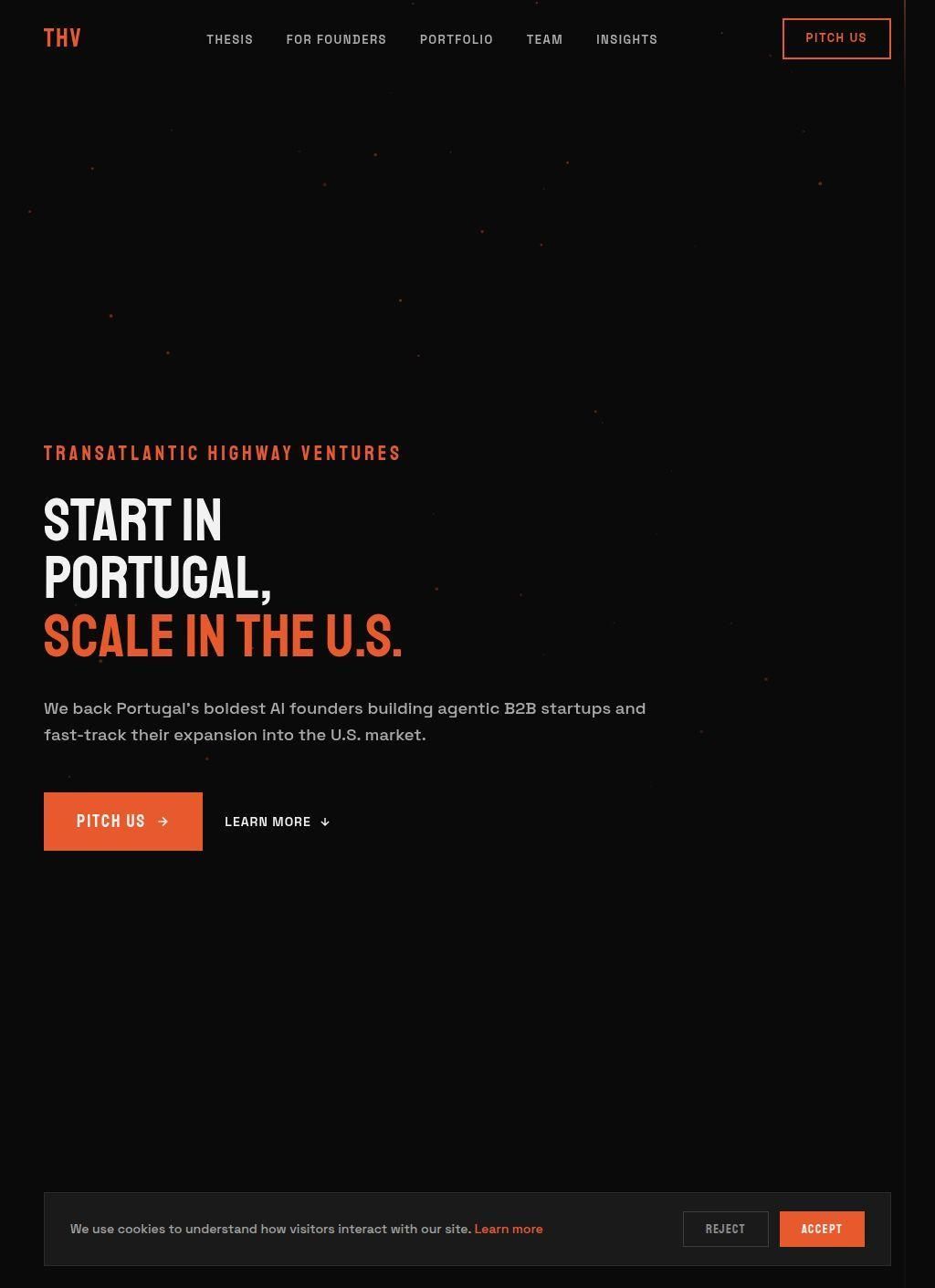
A Portuguese founder building an agentic AI product hits a wall that has nothing to do with the code: the buyers, the follow-on capital and the operator advice they need all sit on the other side of the Atlantic, and a cold pitch from Lisbon to a San Francisco enterprise team rarely lands. That gap is the precise problem Transatlantic Highway Ventures (THV) sets out to close. The firm is a Lisbon-based early-stage venture fund, founded in 2025, that backs Portuguese teams at the pre-seed and seed stages, and almost everything on its site is bent toward moving those companies into the U.S. market quickly. The pitch is plain enough that you grasp it before you finish the first screen.
Investment focus on AI agents
The thesis is tighter than a generalist fund's, and that narrowness is a point in its favour. Transatlantic Highway Ventures (THV) writes checks into three defined lanes: vertical AI that automates a domain expert's full workflow end to end, autonomous agents that run multi-step reasoning, and the infrastructure underneath all of it, meaning APIs, orchestration tools, trust layers and developer platforms. Mapped onto sectors, that comes out as vertical SaaS, AI infrastructure and B2B enterprise software. There is no pretense of chasing consumer apps or whatever happens to be trending this quarter. A founder reading the site can tell quickly whether their company fits the box or sits outside it, which saves both sides a wasted meeting and shows that Transatlantic Highway Ventures (THV) has actually decided what it does and does not fund.
Portfolio companies disclosed
What lifts this above a stated focus is that the portfolio is disclosed outright. Three companies are named. CloudSweep is an AI-powered cloud cost optimization tool that was acquired in 2026. Humanos builds a human-intent verification layer for AI agents. Nixar is an AI-driven influencer marketing platform aimed at e-commerce. An exit already on the board for a fund this young is a concrete data point, not a vanity logo, and it gives the rest of the claims something solid to stand on. The other two names line up cleanly with the agentic and infrastructure themes Transatlantic Highway Ventures (THV) says it cares about, so the money appears to be going where the words say it should. That alignment is more reassuring than any tagline could be.
Support services for founders
The support on offer is spelled out in concrete terms, and it reads like work the team expects to do, not a list of buzzwords. Transatlantic Highway Ventures (THV) frames each item as a job to be done: U.S. go-to-market introductions to enterprise buyers, fundraising strategy paired with access to a U.S. VC network, hands-on product and engineering help for agentic architecture, and an operator network that spans both Portugal and the United States. For a small team trying to sell into American enterprises, warm buyer introductions are usually the hardest thing to source independently. Leading with that says Transatlantic Highway Ventures (THV) knows exactly where its founders bleed, and it is a sharper offer than the generic "we add value" line so many funds settle for.
Team experience in venture
The people behind it carry the kind of background that makes those promises plausible. Managing Partner Pedro Coutinho cites more than twenty years backing over seventy technology companies, which is a long enough record to have built the U.S. relationships the pitch depends on. General Partner Joao Camarate is the agentic-systems specialist, the technical counterweight to Coutinho's investor network, and a third team member, Sam Ghahremanpour, is listed alongside them. It is a compact bench. For a fund this focused, the division of labor between a connector who opens doors and a builder who can read the architecture is a sensible way to split the load, and it matches the dual promise of capital plus engineering help that Transatlantic Highway Ventures (THV) makes elsewhere on the site.
Content resources for prospects
Around the core pitch, the site does more than park a logo and a contact form. There is an Insights blog carrying go-to-market advisory content, which is the same expertise the firm claims to bring to its companies, put on display where a prospective founder can sample it before ever reaching out. That is a smart move: it lets a reader test the quality of the thinking instead of taking it on faith. A Fund Deck section gives institutional readers a path to the formal numbers, the kind of material a limited partner expects. A "Pitch Us" call to action runs throughout, so the route in is never more than a click from wherever a visitor happens to be on the Transatlantic Highway Ventures (THV) site.
Contact methods available
On reachability, the picture is partial and worth flagging honestly. The "Pitch Us" button is the front door, and for a fund that may well be the intended channel, since venture deal flow tends to arrive through warm introductions and structured submissions anyway. An email, info@thv.vc, surfaces on outside investor profiles such as Private Equity International, so a direct line does exist for anyone who digs a little. What the landing page itself does not show is a phone number or a street address. For a venture firm that omission is closer to normal practice than a warning sign, but a founder who wants to verify the office location before sending a full deck will have to look past the homepage, and Transatlantic Highway Ventures (THV) could make that easier than it currently is.
Institutional presence verified
Outside opinion is sparse at this stage, which is exactly what you would expect from a fund launched in 2025. No consumer review platforms carry it, no Google or Trustpilot or BBB footprint, and that absence is unremarkable for an early-stage VC firm that no member of the public would ever rate. Where Transatlantic Highway Ventures (THV) does turn up is the institutional databases that count in its world: PitchBook, Preqin, Private Equity International, OpenVC and Superscout all hold a profile. Those are factual fund listings with no stars attached. Being indexed across that whole set means the firm is documented where limited partners and co-investors actually check, which counts for far more here than any consumer review count would. It places Transatlantic Highway Ventures (THV) inside the plumbing of the venture world rather than at its margins.
Weighing it as a whole, Transatlantic Highway Ventures (THV) reads as a young, sharply scoped fund whose claims are mostly backed by verifiable detail. The thesis is specific, the three portfolio names are disclosed, one of them has already exited, and the partners' experience matches the transatlantic promise being sold. Set against that, the fund is barely past its founding, the team is small, and the public record is necessarily limited, so a founder cannot lean on a long history of how Transatlantic Highway Ventures (THV) behaves once the wire clears and the hard quarters begin.
The honest read is that Transatlantic Highway Ventures (THV) is a credible early bet for the exact founder it describes: a Portuguese team building agentic or B2B AI with U.S. ambitions. Anyone outside that lane will find a weak fit, and the newness of the operation deserves the same weight as its clarity of focus.