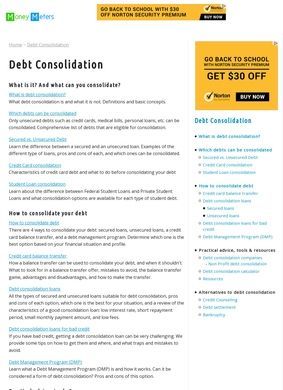
Among personal-finance education sites, Money Meters: Debt Consolidation Guide stands out for having a genuinely useful interactive tool: a debt consolidation calculator that is probably what will hold a visitor's attention longest. Drop in different scenarios and you can watch monthly payments and total interest costs shift across the four consolidation methods the site covers, turning an abstract choice into something you can compare in actual numbers. That tool anchors a site built around one goal: helping people understand debt consolidation when they are trying to get out from under several balances at once.
Interactive calculator for debt consolidation scenarios
The writing starts where a confused borrower usually starts, with what debt consolidation is and what it is not. From there it separates secured debt from unsecured debt, a distinction that quietly determines which options are even on the table for a given person, and then walks through the four methods side by side. I found that framing more honest than the typical debt-advice content online, because it forces the trade-offs into view instead of steering the reader toward one predetermined answer.
Consolidation methods compared with trade-offs visible
Beyond the core explainers, Money Meters: Debt Consolidation Guide branches into the situations people actually arrive with. The breadth of Money Meters: Debt Consolidation Guide is one of the things that sets it apart from narrower how-to pages on the same topic. There are dedicated pages on consolidating credit-card balances and on student-loan consolidation, each with its own quirks, plus a section aimed at consumers with bad credit who assume they have no options. Non-profit debt consolidation gets its own treatment too, and that coverage is useful because the non-profit label gets attached to a lot of things that are not what borrowers expect.
Credit cards, student loans, bad credit situations
What separates this from a simple how-to is the attention paid to picking a provider without getting burned. The site carries company-reliability guides built around red-flag warning lists, the kind of concrete checklist a person can run against a firm that is pressuring them on the phone. That defensive posture runs through the whole resource, reinforced by coverage of the alternatives: credit counseling, debt settlement, and personal bankruptcy each get explained as paths in their own right, so a reader can see that consolidation is one route among several without any contortion needed to make a comparison.
Red-flag checklists for evaluating providers
The intended audience is easy to identify. Money Meters: Debt Consolidation Guide is built for someone juggling multiple debts or wrestling with credit trouble who wants to understand the terrain before talking to anyone or committing to anything. As a resource, Money Meters: Debt Consolidation Guide reads like a self-education layer that comes before the sales pitch, and it largely sticks to that role instead of quietly funneling readers toward a particular lender or service.
Who should use this resource?
Credibility is the weaker side of the operation. The contact path exists but is understated: a /contact/ link sits in the navigation, yet the debt-consolidation landing page itself shows no phone number, no mailing address, and no email out in the open. Social profiles are listed, including a Facebook presence, a Twitter account at MoneyMeters, and a Google+ link, so the operators are reachable in some fashion. For a personal-finance site asking readers to trust its judgement on money, that light touch on direct contact detail is a minor friction point, though the contact page covers the practical gap well enough for most visitors.
Contact information and social media presence
On outside opinion, there is little to lean on. A search turns up the usual debt-consolidation review roundups and a crowd of competitor sites, but no ratings tied specifically to moneymeters.org surfaced on Trustpilot, Google, the BBB, Yelp, or anywhere comparable. That absence does not undermine the content, which is solid on its own terms, but it does mean a reader cannot triangulate the site's reliability against a body of public feedback. You are judging Money Meters: Debt Consolidation Guide on the substance of the pages alone.
No third-party ratings or public reviews available
That substance is the strong part. Money Meters: Debt Consolidation Guide covers the definitions, the method comparisons, the niche cases, the provider warning signs, and the alternatives with enough depth that a careful reader could form a plan before engaging a single company. The calculator gives that reading a place to land in actual figures. Where it falls short is the trust scaffolding around the content, the contact transparency and any track record a visitor could verify from outside. The red-flag checklists alone are worth the visit for anyone about to approach a debt company, because Money Meters: Debt Consolidation Guide arms you with the right questions before you need them. The pages teach; they do not close a sale.