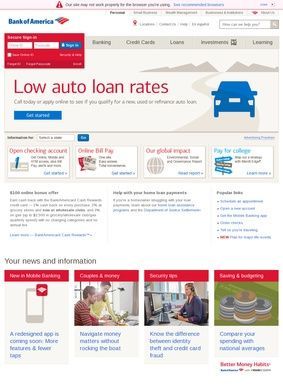
Someone opens a new account and quickly discovers the bank is also where their car loan, their first home, their retirement savings and eventually their kid's college fund all need to live. That sprawl is the problem Bank of America is built to absorb. The site reads less like a product page and more like a control panel for an entire financial life, and the breadth on display is the first thing worth taking seriously. A checking account is the front door, but behind it sit savings accounts, certificates of deposit, and a full deck of credit cards, including travel rewards options for people who want the spend to come back as flights and hotel nights.
Lending across mortgages and personal loans
Lending is where the depth becomes obvious. Home loans and home equity lines of credit cover the big-ticket borrowing most people only do a handful of times in their lives, and the site keeps auto loans and personal loans alongside them so the borrowing tools sit in one place. For a customer who has just been turned down by a smaller lender or is comparing rates across three tabs, having mortgage, HELOC, auto and personal lending under a single login removes a real friction. The same household that uses the bank for daily spending can carry its largest debts there too, and that consolidation is the practical pitch.
Merrill investment and retirement accounts
Investing and wealth management run through Merrill, the old Merrill Lynch name now folded into the Bank of America umbrella. The split between self-directed and guided is sensible: Merrill Edge handles people who want to pick their own stocks and funds through a brokerage account, while the advisory side exists for those who would rather hand the steering wheel to a professional. Retirement accounts sit here too, with traditional and Roth IRAs plus 401k rollovers for anyone leaving a job and dragging an old workplace plan behind them. Parents saving for tuition get 529 education plans in the same ecosystem.
Preferred Rewards program structure
What ties this together is the Preferred Rewards program, which tiers benefits by how much a customer keeps across their accounts. Park more assets, climb a tier, and the perks on cards, savings rates and investment pricing improve. It is a deliberate gravitational pull: the more of your financial life that lives at Bank of America, the more the bank rewards you for keeping it there. Whether that is a good deal depends on how much someone has to consolidate, but the logic is clear and the program is front and center on the site for a reason.
Business banking services
The business side is treated as its own category, not an afterthought bolted onto consumer banking. Owners get business checking, business credit cards, merchant services for taking card payments, and commercial lending for larger financing needs. A small shop and a large corporation are served by the same Bank of America, so a company that expects to grow can keep its banking in place instead of switching every time it crosses a revenue threshold.
Digital tools and Erica assistant
Digital tooling is genuinely a strength here, and it is more than the usual mobile app and online bill pay. Erica, the bank's AI-powered virtual assistant, sits inside the app to answer questions, flag unusual charges and nudge people toward bills coming due. Zelle is wired in for sending money to friends and splitting costs without cash or a check changing hands. None of this is exotic in 2026, but Bank of America was early on the assistant idea and the integration is tight rather than gimmicky. For a customer who manages everything from a phone on a commute, the app handles most of what people once walked into a branch to do.
Scale is the quiet argument running underneath all of it. As one of the largest financial institutions in the United States, Bank of America operates across all fifty states with physical branches and ATMs, so the digital convenience does not come at the cost of ever being able to walk in and talk to a person. Life insurance rounds out the catalog, which means a household can cover protection, spending, borrowing, investing and saving without ever leaving the brand. That completeness is the point, and it is fairly represented on the site instead of buried.
There is a flip side to keeping everything in one house. The breadth that makes Bank of America convenient also makes it a giant, and giants can feel impersonal when something goes wrong or a fee surprises you. The Preferred Rewards math clearly favors customers with substantial balances, so a customer who parks a modest balance will see far less of the upside than the marketing implies. The value scales with how much you bring to the table, and the site does not hide that fact so much as bury it beneath the aspirational tier names.
Comparing Bank of America to Chase
Set against Chase, which competes for almost the same all-in-one customer with a comparable branch network and its own deep rewards lineup, Bank of America holds its own on product range and arguably leads on the assistant front with Erica. The choice between them often comes down to which has more branches nearby and which card rewards match spending patterns. What Bank of America delivers is breadth across checking, lending, mortgages, Merrill investing and business banking, and on that count the site represents the product honestly.