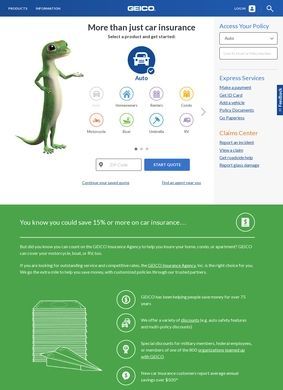
Geico, short for Government Employees Insurance Company, is an American auto insurer owned by Berkshire Hathaway and one of the largest writers of private passenger car coverage in the country. The website is built around a single job: get a driver from a blank quote form to an active policy without a phone call or an agent in the middle. That premise runs through almost everything on the site, and it is the right lens for judging whether the place is worth your time.
Quote tool and policy management
The Geico quote tool sits at the center. You enter vehicle and driver details, see rates, and can buy a policy on the spot. Once you are a customer, the same self-service logic carries into account management, where the Geico mobile app handles digital ID cards, bill payment, claims filing, and roadside assistance requests. There is a separate claims center on the site for opening and tracking a claim through the browser or the app. Other large insurers have done similar things, but the implementation here is thorough, and the pieces connect to each other instead of dead-ending.
Coverage types
Auto is the headline at Geico, and the underlying coverage breakdown is what you would expect from a primary insurer: liability, collision, comprehensive, uninsured and underinsured motorist, medical payments, and personal injury protection. That is a complete spread, and the site explains each piece in language a first-time buyer can follow without a glossary open in another tab.
Beyond auto insurance
What surprised me a little was how far the product list extends past cars. Motorcycle, ATV and off-road, RV, boat, and travel trailer policies are all here, and so are homeowners, renters, condo, and mobile home coverage, plus umbrella, life, pet, and identity protection. Business owners and commercial auto round it out. Some of these are written through partners rather than carried directly, which is worth knowing before you assume one company is standing behind every line, but the breadth means a household can consolidate several policies in one login and pick up bundling discounts in the process.
DriveEasy telematics program
The DriveEasy program is the most interesting wrinkle in the Geico lineup. It is usage-based, using telematics to watch how you actually drive and then setting discounts off that behavior. Drivers who brake hard, drive late, or rack up long commutes may find it cuts both ways, so it rewards careful driving more than it rewards simply signing up. The site is reasonably upfront that the program measures you instead of just tracking miles, which is a meaningful distinction given how many competing telematics programs bury that detail in the fine print.
Local agents and service centers
For all the emphasis on buying online without anyone involved, Geico still runs a network of local agents and physical service centers across the United States. The fully digital path suits people who know what they want and would rather not talk to anyone, while the agent option is there for buyers with a messy situation, a teenage driver, or a commercial fleet who want a human to walk them through it. Keeping both routes open is a sensible hedge, and Geico does not bury the agent locator behind the quote funnel.
Car-buying service
A car-buying service, run through a third-party partner, is folded in as well, aimed at customers shopping for a vehicle who then want to insure it in the same orbit. It is a convenience play more than a core strength, and treating it as a side feature rather than a reason to come here is the honest read.
Government employee heritage
The company's history shows in its marketing. Geico was founded to serve federal government employees and military members, and it still leans into that audience, though coverage is open to anyone. A general consumer will not be turned away or charged a premium for lacking a government badge, but the heritage explains some of the tone and the way certain discounts are framed.
Taken together, Geico does the thing it sets out to do. The quote engine is fast, the coverage catalog is genuinely broad, the app covers the daily chores of owning a policy, and the telematics option gives careful drivers a concrete lever on price. The weaker spots are the partner-dependent lines and the car-buying tie-in, both of which lean on outside firms and deserve a closer read of the fine print. None of that undercuts the core offer for someone who wants to buy auto coverage online in fifteen minutes and manage it without ever picking up a phone.
Where Geico is less useful is when the situation gets complicated: a surplus-lines risk, a fleet, or a household with very specific bundling needs may find the self-service model starts to show its limits, and the agent network, while it does exist, is not as dense as what a traditional carrier can offer in smaller markets.