You bought a portable power station, or you are about to, and you need to know whether it will actually run the thing you bought it for: the CPAP that has to work all night, the well pump that draws a brutal spike when the motor kicks on, the chest freezer full of food you do not want to lose. That gap between what a spec sheet promises and what a device pulls in practice is exactly where GeneratorChecker plants itself. The site treats compatibility as an engineering question and tries to answer it with numbers instead of vibes.
Database of devices and power stations
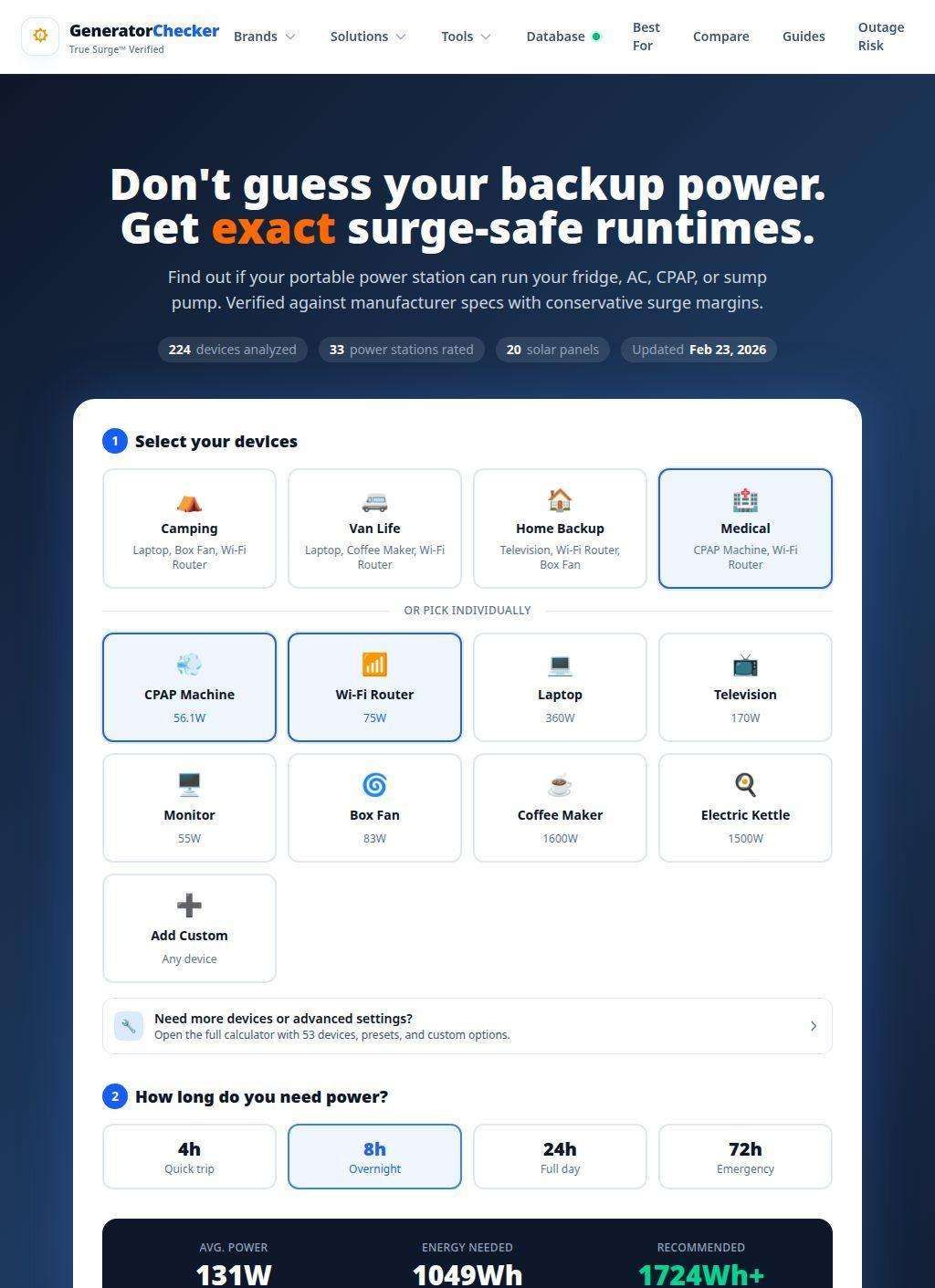
The core of GeneratorChecker is a compatibility database. The figure quoted on the site is 224 household and RV devices checked against 33 portable power stations and 20 solar panels, with the underlying data pulled from manufacturer manuals. Where the OEM paperwork does not exist, estimated values get labeled as estimates, which is a small honesty that a lot of comparison sites skip. That labeling habit is what made me trust the rest of the numbers more than I usually would. Brands in the mix include EcoFlow, Anker SOLIX, Bluetti, Jackery, Goal Zero, and Pecron, so GeneratorChecker is not quietly built around one manufacturer's catalogue.
Runtime and surge calculation tools
Around that database sits a set of calculators that do real arithmetic. There is a runtime calculator that estimates how long a given station will keep your selected devices alive, and a surge calculator that converts locked-rotor amps into the startup wattage a motor demands, which is the number that catches people out with pumps and compressors. A solar charge-time projection tool factors in location and panel configuration, so the answer changes depending on where you actually live and what you bolted to the roof. And there is a real-cost calculator that works out a five-year cost per kilowatt-hour, the kind of total-cost-of-ownership math that turns a cheap sticker price into a less flattering long-term figure.
Recommendations organized by use case
What I find more useful than any single tool is the way GeneratorChecker organizes recommendations by what you are trying to power. Medical equipment gets its own track, CPAP machines and oxygen concentrators, where runtime is a safety margin. Home infrastructure covers well pumps and sump pumps, the high-surge loads that embarrass an undersized unit. Then there is climate control, food storage, and the outdoor and RV bucket. Sorting by use case is the right call, because almost nobody shopping for one of these knows it by wattage; they know it by the appliance sitting in front of them.
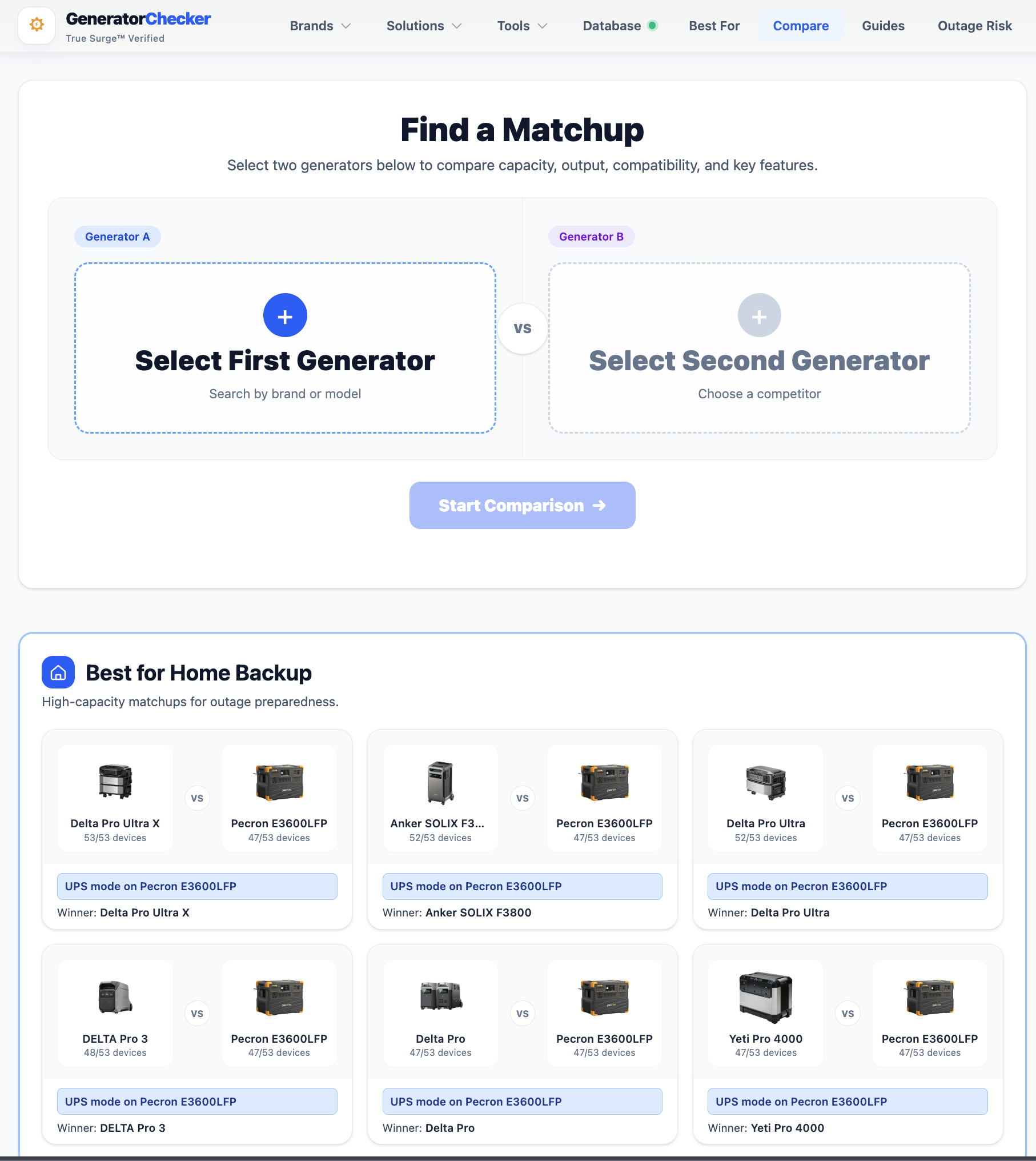
Side-by-side comparison feature
The side-by-side station comparison rounds this out, letting you set two units against each other instead of opening six browser tabs and squinting at PDFs. None of these features are exotic on their own. The value is in having the database, the surge math, the solar projection, and the cost model living in one place and feeding off the same labeled data, so a runtime number and a cost number are at least speaking the same language. GeneratorChecker also makes a point of saying its scoring is formula-based and independent of commercial relationships, which is a meaningful claim in a corner of the web that runs heavily on affiliate links.
Independence from commercial relationships
That independence claim lines up with the visible behavior: the estimate labels, the manual-sourced figures, the lack of flashy brand promotion. It is still something GeneratorChecker says about itself, though, and a reader has no way from the page alone to audit the formula or confirm there is no commercial tilt behind the rankings. This is not a knock, just an open question that comes with any independent-review operation that has not yet built a public track record.
Limitations of manual-sourced data
Which is where my reservations start. The methodology leans on manufacturer manuals, and manuals describe ideal rated draw, not the messy reality of a tired battery, a cold morning, or a motor that has been running for ten years. The surge calculator is only as good as the locked-rotor figure you feed it, and plenty of older appliances do not publish one cleanly. GeneratorChecker is upfront that estimated values are flagged, so it is not hiding the soft spots, but a buyer relying on an oxygen concentrator running through a long outage should treat the runtime output as a planning figure and build in headroom rather than trusting it to the minute.
Lack of public verification
On the question of who is behind all this, the site gives you little to go on. Footer links to Contact and About pages exist, but nothing concrete surfaced about who runs the analysis or where they sit. For a platform whose entire pitch is independent engineering credibility, a named human or organization standing behind the database would do a lot. A search through any business directory or review aggregator came up empty: no Google, Trustpilot, Yelp, or BBB presence for generatorchecker.com that I could find, and no body of user reviews to weigh the formula's accuracy against real-world outcomes. That absence is not damning for a young, niche reference site since this is not the sort of tool people rush to rate, but it does mean the independence claim currently rests entirely on GeneratorChecker's own word.
When to rely on the estimates
For its intended job, though, GeneratorChecker is more substantial than most of what turns up when you search "will this power station run my well pump." The structure is sensible, the use-case sorting matches how real people shop, and the willingness to label estimates is genuinely uncommon. If you are sizing a unit for a freezer or an RV weekend, GeneratorChecker gets you to a defensible answer fast. The harder it gets, the more the limits show: a CPAP user planning around a multi-day outage, or someone trusting the five-year cost figure enough to spend four figures on it, is leaning on a methodology built from manuals and an independence promise that, for now, has no outside voice to back it up.