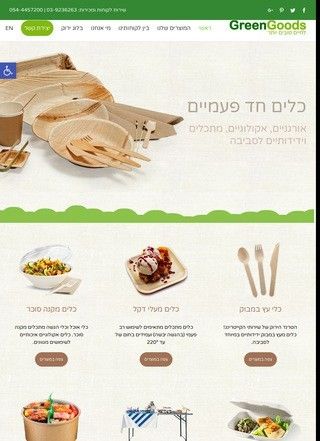
Kraft paper bowls in round, rectangular, square, hexagonal and cone shapes greet you on the homepage, with sample pricing landing around 144 to 210 ILS per unit batch for the rectangular kraft bowls. That level of granularity tells you something useful about Green Goods: Disposable Tableware right away. This is a supplier that has split its single-use product line into material families and shapes, with each shape and size given its own entry. Anyone sourcing food packaging knows the shape of a tray affects a kitchen as much as the material, and the site treats it that way.
Behind the registration wall
Green Goods: Disposable Tableware runs as a B2B wholesaler out of Israel under the legal name Green Goods Ltd, and the registration gate is the thing a buyer hits first. Prices stay hidden until you create an account, with only a handful of sample figures visible on the homepage in ILS excluding VAT. That approach can be mildly annoying to a browser, but for a trade supplier serving restaurants, catering firms and take-away kitchens it is a normal way to keep wholesale pricing out of public view and tied to a registered customer record. The figures that do appear, such as the sugarcane divided trays sitting somewhere between 198 and 537 ILS, at least give a sense of the range before you go through the sign-up.
Sorting 276 products by material
The strongest part of Green Goods: Disposable Tableware is the breadth of 276 products and how clearly they are organised by material. The sugarcane and bagasse line is the deepest: plates, bowls, cups, compartmented trays, hamburger clamshells, oval containers with matching lids, multi-dip trays, and divided bio take-away sets. That last group reads like it was assembled by someone who has packed a meal for delivery, where you need compartments that keep sauce away from something fried. The kraft range runs in parallel with its own two-compartment containers, lids, sushi trays and boxes, so a buyer can pick a material aesthetic and still find the full set of formats inside it.
Expanding into new packaging formats
Beyond those two anchors, the site spreads into wheat-straw serving bowls and plates, palm-leaf serving ware, and a bamboo and wood group covering cones, boats, plates, wooden cutlery and coffee stirrers. The PLA section handles drinks with cold cups, hot paper cups, biodegradable straws and muesli cups, and there is a separate run of compostable cutlery sets in PLA, bamboo and wood. A caterer who wants everything from the serving vessel down to the fork can plausibly fill an order from one place at Green Goods: Disposable Tableware. The catalogue covers genuinely distinct formats here, each with a clear use, instead of repeating one item in slightly different sizes.
Tools built for trade orders
Green Goods: Disposable Tableware includes the parts a trade buyer expects to use: a shopping cart, order tracking, and a price-quote request for buyers who want a custom number rather than the per-batch sticker. There is also an accessibility statement and a set of store terms. Their presence shows Green Goods: Disposable Tableware was built to handle orders online, with a place to track them, instead of pushing every visitor toward a phone call. The quote-request route fits the B2B reality, where volumes vary and a fixed unit price rarely tells the whole story.
Reaching the company for pickup
Contact information is where Green Goods: Disposable Tableware is genuinely strong, which counts for extra when a supplier asks you to register before you can see prices. The footer carries a phone number, an email address, a physical arrival point in the Kfar Qasim Industrial Zone (with a Waze entry under "GreenGoods" so a driver or courier can find the loading area), and a postal box in Petah Tikva. Those details repeat on dedicated location and contact pages. A buyer who needs to confirm a delivery window or arrange a pickup can reach the company through several routes, and that openness offsets some of the friction of the price gate.
Checking customer reviews and reputation
The reputation side for Green Goods: Disposable Tableware is harder to read, and it would be dishonest to dress it up. A search for outside customer reviews of this specific Israeli supplier turned up nothing notable: no Google rating, no Trustpilot presence, no pile of testimonials to lean on. A Facebook business page exists at facebook.com/greengoods.co.il, but it shows no visible review count or star score, so it confirms a social presence without telling you what customers think. For anyone who found this listing through a business directory or other aggregator, that gap is worth noting.
Verifying the business on Crunchbase
The one solid external corroboration is Crunchbase, which lists Green Goods Ltd as an active for-profit company carrying the same phone number and email as the website. That is enough to confirm the legal entity is consistent, even if it says nothing about service quality. The company identity checks out, the contact trail is verifiable, and the product organisation points to people who understand food-service packaging. What is missing is independent customer feedback on shipping, order accuracy and how the company handles a problem.
For the kind of buyer Green Goods: Disposable Tableware is built for, that gap is workable. A restaurant or catering operation can place a small first order, judge the kraft sushi trays or the PLA hot cups on arrival, and scale up from there, using the visible contact details to ask questions along the way. The eco angle runs across every line, from bagasse clamshells to wooden stirrers, so a business trying to drop plastic from its take-away service has a single source for most of what it needs. That positioning is consistent, and the catalogue backs it up rather than merely claiming it.
A few practical notes shape how to approach Green Goods: Disposable Tableware. The prices are VAT-exclusive and quoted in ILS, so an overseas buyer should factor both the tax and the currency before treating the sample figures as final. The registration requirement adds a step before any real comparison shopping. Set against that, the depth of the 276-item range and the easy reachability of the company are concrete reasons a food-service buyer in the region would put Green Goods: Disposable Tableware on a shortlist of disposable-tableware suppliers worth contacting directly.
One detail from the catalogue stays with me: the split between compostable cutlery in three different materials, PLA, bamboo and wood, sitting next to a drinks range that separates cold cups from hot paper cups. That is a supplier paying attention to the small distinctions a busy kitchen trips over.