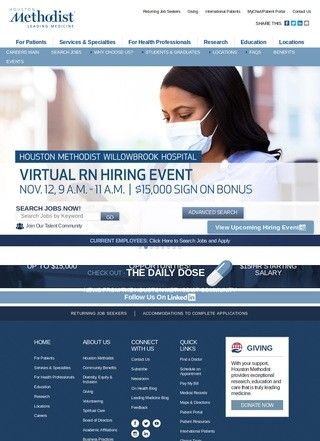
Careers portals attached directly to a hospital system are a different animal from the job boards and recruiting aggregators that dominate healthcare hiring online. Houston Methodist runs its own, and the gap between this and a staffing firm's listing page is immediately obvious. There is no middleman sitting between a candidate's application and the institution that will hire them. A nurse applying here is applying to Houston Methodist directly, routed to the team that will eventually extend an offer. In a field where aggregator sites collect resumes and distribute them to whichever employer pays for the slot, that directness has real value.
Filtering tools for a multi-hospital system
Houston Methodist operates eight hospitals across the Greater Houston area, plus a collection of affiliated facilities and specialty centers. The scale of that system explains a lot of the portal's design choices. Location filtering is not a minor convenience here; it is functionally necessary. A candidate who can only realistically commute to one campus needs to be able to narrow the listing pool to that campus without manually discarding results from facilities forty minutes away. The search tools handle this without asking the visitor to think about the underlying logic, which is how filtering should work. Category filtering adds a second axis, separating clinical, administrative, technical, and support tracks so that a radiologic technologist is not scrolling past finance postings to find anything relevant.
Separate login paths for returning and internal staff
The routing for different types of applicants is more thoughtful than the average employer portal bothers with. Returning applicants get a dedicated login path, so someone who started an application and came back a week later picks up where they left off. Houston Methodist also runs a separate internal transfer pathway for current staff, which keeps employees from competing in the general candidate queue when they want to move within the system.
Signing up for talent network alerts
A Talent Network opt-in lets anyone register for alerts tied to specific roles or departments, a practical feature in nursing and allied health where a desirable posting can close in days. These are not headline features. They are the structural details that tell a job seeker whether Houston Methodist has thought through how people look for jobs, or whether the portal is merely a list of openings with a submit button.
Structured programs for new graduates and early leaders
Beyond the open listings, Houston Methodist publishes a set of defined programs that say something about how the institution approaches its own workforce pipeline. The Nurse Residency Program is aimed at new graduates, which is the group hospitals fight hardest to attract. Hospitals that build genuine residency infrastructure are signaling something about retention strategy, because new-grad nurses are notoriously likely to leave within the first two years of a first job. An Administrative Fellowship Program targets a narrower cohort: early-career people who want to move toward healthcare leadership rather than staying on a clinical track. That the program exists at all tells a prospective candidate that Houston Methodist grows some of its own leadership rather than exclusively hiring it in from outside. Summer internships round out the entry-level approach.
Taken together, these programs make Houston Methodist's recruiting logic legible. The institution is trying to identify people early, train them inside its own culture, and keep them through the transition periods that tend to produce turnover. Whether the execution behind the programs matches the branding is something a candidate only finds out after they are in the pipeline. But the existence of structured pathways for new graduates and early-career administrators is evidence of a deliberate approach, and something different from a careers page that lists whatever roles HR needs filled this quarter.
Browsing the hiring events calendar
The portal also publishes a calendar of hiring events, including both on-site and virtual sessions. This is one of the more practically useful inclusions. A virtual recruiting session, especially in nursing, moves faster than an application review cycle. A candidate who attends can ask about a specific unit, shift structure, or campus in real time, getting answers that no job description will contain. Houston Methodist lists these events in a browsable calendar instead of burying them in social announcements, which makes them findable. The fact that virtual sessions appear alongside in-person ones matters for candidates who are not yet in Houston and are considering a relocation.
Weighing employee testimonials against outside reviews
The editorial content around the job listings includes a staff blog called "The Daily Dose" and a video gallery of employee testimonials. A candidate who reads this material with skepticism is not wrong to do so. No employer publishes its own content to air grievances, and Houston Methodist is not different in that respect. The testimonials show people saying they like working there, which is the expected output of any employer-produced video. The honest use of this material is as texture, not evidence. It fills in some sense of workplace culture that a job posting cannot, and a candidate who triangulates it against what current or former employees say on external platforms gets something closer to a real picture than either source alone provides.
On external reputation, Houston Methodist has a presence on the major employment review platforms. The review counts are modest given the size of the system, which is typical of large healthcare employers where most staff do not post publicly about their experience. What is there does not contradict the culture the Houston Methodist portal presents, though a sample that size is not large enough to draw strong conclusions from. Worth checking against Google and Glassdoor with the system's name plus the specific facility a candidate is targeting, since experience at one Houston Methodist campus can differ notably from another in a multi-site system this large.
Institutional context via Weill Cornell affiliation
The broader Houston Methodist website, linked from the portal, adds institutional depth: a newsroom, affiliation information tied to Weill Cornell Medicine, and general coverage of the system's hospitals and research programs. Candidates with clinical or research backgrounds will find the Weill Cornell connection relevant when weighing where work will have academic reach. The portal links to all of this without forcing the visitor through it, which keeps the job-seeking experience from being swamped by institutional PR.
The portal's scope is its most interesting challenge. Houston Methodist is recruiting across every healthcare discipline simultaneously, plus physicians, advanced practice providers, IT, facilities, administration, and support staff. The structured programs handle the new-graduate and early-leadership pipeline well. Whether the same database and the same set of filters serve a relocating cardiologist or a senior administrator as well as they serve a new nursing graduate is harder to judge from the outside. A new grad benefits from the residency program, the structured onboarding pathway, the entry-level framing. An experienced hire is navigating the same search interface with different expectations about what the process should feel like. That gap is the thing worth probing directly once a candidate is in contact with a recruiter, because the published portal does not resolve it.
Business address
Houston Methodist Hospital
6565 Fannin Street,
Houston,
TX
77030
United States
Contact details
Phone: +1-713-790-3311