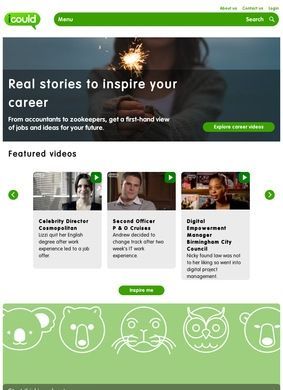
What does a fourteen-year-old picking GCSE subjects actually get out of iCould? A library of short video interviews with people who do real jobs, sorted so a teenager can start from something they already know. The site lets you browse by school subject, so a pupil weighing up whether to keep geography or drop it can see where that choice leads in working life. It also sorts the same videos by job type, grouping related careers into families, and by theme, which gathers stories around the life circumstances that shaped someone's path. The same person appears in more than one route, which is the point: iCould is built to be entered from whatever angle a young person already cares about.
Video interviews organized by subject and career
The videos are the backbone of iCould, and they are the reason to bother. These are not animated explainers or a careers adviser reading from a script. They are working professionals talking about what they do, how they got there, and the turns their path took, including the false starts. A student who has only ever heard about doctors, lawyers and footballers gets a much wider field of view, and the by-subject sorting quietly answers the question every teenager and parent asks: what is a given exam choice good for later? The content lives on a YouTube channel under the handle @icouldstories, hosted where the audience already spends time, with no login required. A pupil can watch on a phone during a free period without an account or a download.
Written guides for school decisions
Around the videos, iCould provides written advice guides covering the practical decision points of school life: how to choose GCSE subjects, what the different post-16 pathways involve, how to prepare for exams. The writing addresses students directly but is plainly useful to a parent trying to help without pretending to know the current system, which has changed a great deal since most parents sat their own exams. For teachers, iCould publishes classroom-ready teaching resources at no cost. A careers lesson is often dropped on a form tutor who has no time to build one from scratch, so free, structured, ready-to-use material is a real saving of preparation hours. The guides on iCould lean toward plain language and short sections, which suits a reader fitting this around schoolwork.
Inspiring the Future connects students with professionals
One part of the iCould offer reaches off the screen. Inspiring the Future is a companion service that connects students with people who actually work in the fields being discussed, for meetings in person or online. That bridges the gap between watching a stranger on video and asking your own questions of someone in the room. A pupil can move from passively browsing job families to a direct conversation, which is the step most careers content never manages to provide. Together the iCould video library and Inspiring the Future give a young person both a wide survey and the close-up, and few free services manage either one well.
Free charity service with partner funding
iCould is a registered charity in the UK, number 1130760, and the service is free to the students, teachers and parents who use it. An "About us" section lays out the organisation, and a "Working with us" area points to partnership or sponsorship opportunities, which is how a free public resource keeps the lights on. There is no upsell to a paid tier, no premium membership gated behind the good videos. The catch, such as it is, sits with the sponsors and partners who support the work, not with the families using it.
Review presence and trustworthiness ratings?
The independent review trail for iCould is almost nonexistent, and it is fairer to say so than to dress it up. Smart.Reviews shows a rating of 4 but with no visible count of people behind it, which makes the number hard to lean on. The Facebook page carries zero ratings and had not been touched in a long while.
A site-safety checker, Scamvoid, puts trustworthiness at 73 out of 100, though that reading is old enough to tell you little. Searches that appear to return Trustpilot scores are a trap here: they belong to icloud.com, Apple's storage service, a different name that is one letter away. None of this points to a problem with iCould. It points to a charity that has spent its energy on content for schools and very little on cultivating a consumer review trail, which is consistent with how the organisation runs. Most users are pupils and teachers who arrive through a school, not customers who would think to leave a star rating, so the empty review pages say more about the audience than about the quality of the work.
Contact options for teachers and parents
There is a contact page on iCould, so a teacher wanting to discuss partnership or a parent with a question has a clear route in. What is not on display is a phone number or postal address, which leaves the form as the practical channel. For a charity working with schools, a published phone line would add some reassurance. The form does cover the realistic reasons someone would reach out, whether a teacher proposing a link-up or a partner exploring sponsorship, and for a free resource the contact options are adequate.
It helps to be clear-eyed about the limits of the format. Video stories age. A profession someone described several years ago may have shifted, and a young viewer cannot always tell how current a clip is. The advice guides are tied to the UK system, so the subject-choice and pathway material maps onto English and devolved qualifications and is less useful to anyone outside that framework. iCould does not pretend otherwise; the whole thing is built around the British secondary school journey, and judged on that basis it is well aimed. Anyone outside the UK can still get value from watching people describe their working lives, but the exam-specific guidance will read as foreign to them.
Set against what a free careers resource usually amounts to, iCould covers more ground than a school careers department could assemble on its own. The breadth of the iCould video library, the three different ways into it, the written guides and the teaching packs, together with the link through to Inspiring the Future, give the whole thing a human endpoint. The gaps are the ones you would expect from a charity-run platform: a quiet social footprint, no independent review trail, and contact reduced to a form. A teacher building a careers lesson can pull resources from here this afternoon without paying anything, and a student can watch a plumber, a researcher and a producer describe their working week in the time it takes to put off homework.