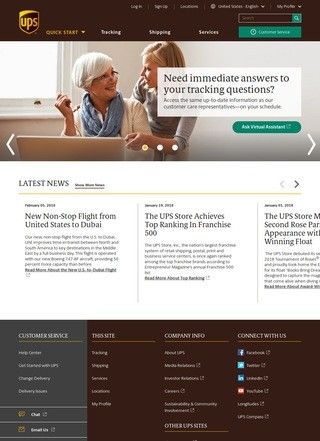
UPS is the website of United Parcel Service, the global package delivery and logistics company, reachable at ups.com. Most people arrive holding a tracking number, and the site is built to answer that need before anything else. What sits around that core turns out to be broader than a single lookup box.
Three audiences share the same front page. There are individual consumers waiting on a parcel, retailers shipping orders out to customers, and enterprise shippers moving freight at scale, and the site quietly routes each one toward a different set of tools without making the others feel in the way.
Tracking, from one number to many
The heart of it is the tracker at ups.com/track, which handles a single shipment or a whole batch of them in one pass. Paste in one number to see where a package is, or line up several to watch a cluster of orders at once. For the everyday visitor this is the entire reason to be here, and it is the piece the rest of the site is organized around.
The single-versus-batch split is more useful than it first looks. A shopper checks one number and leaves; a small online seller shipping a dozen orders a day pastes in the whole list and reads them as a group. UPS folds both jobs into one page instead of splitting casual and business users into separate products, which keeps the tool uncluttered no matter which of the two you happen to be that afternoon.
Where's My Package and the support pages
A raw status line is only useful if you know what it means, and this is where the Tracking Support pages come in. They explain what the various shipment statuses actually signify and walk through common delivery problems, with a dedicated "Where's My Package" help page for the moment a parcel goes quiet or overshoots its window. That turns a cryptic "exception" note into something a worried recipient can act on, which is the difference between a tracking tool and a tracking tool that answers the follow-up question.
Delivery rarely fails quietly. A package can stall at a facility, get flagged for an address problem, or simply miss its scheduled day, and each of those surfaces as terse jargon on the tracking line. The support material exists to translate that jargon, so a recipient can tell the difference between a shipment that is merely running late and one that genuinely needs intervention. Building the explanations right next to the tracker, where the confusion happens, is a small design decision that spares a lot of guesswork.
UPS My Choice for members
For anyone who receives packages often, UPS My Choice reframes the whole exercise. It is a free member dashboard that gathers incoming shipments in one place, lets you view and manage them, and pushes alerts as they move. Instead of hunting down a number every time something is on the way, a member gets the arrivals brought to them. It shifts tracking from a thing you chase to a thing that reports in on its own.
For a household that orders online constantly, that dashboard matters most, because tracking's usual failure is forgetting a shipment exists until it lands unattended on a doorstep. Alerts pull the timeline forward: a heads-up before a delivery window instead of a shrug after it. It is a quiet upgrade over checking numbers one at a time, and switching it on costs nothing.
Shipping and logistics solutions
Past the consumer tools sits the commercial half of the company, and the site gives it real estate to match. The global shipping and logistics solutions pages cover supply-chain services, including customized offerings and retail-store shipping and logistics for businesses that move goods in volume. This is the part a shopper never sees and a warehouse manager lives in.
Supply-chain work is the least visible and probably the heaviest of everything on offer. Those pages speak to businesses that need far more than a shipping label: warehousing, distribution, and the steady movement of stock between locations and out to customers. A retailer deciding whether to run its own fulfillment or hand it to UPS is the reader they are written for, and the material goes deep enough to actually inform that decision.
Housing both under one roof is a deliberate choice, and to my mind it is the most telling thing about how UPS presents itself online. The same domain that tells a nervous customer where a birthday gift is also runs the supply-chain machinery behind a national retailer's inventory. One is a quick answer, the other a standing relationship, and the site carries the two without either swallowing the other. A business directory entry for a company this size mostly just points back to ups.com, since the site itself already covers more ground than any outside listing needs to.
Air cargo and the UPS Store
Freight that flies gets its own lane. UPS Air Cargo tracking lives on a separate subdomain, aircargo.ups.com, and works from air waybill numbers instead of the parcel numbers the main tracker expects. It is a reminder that the parcel on a porch and the pallet in a cargo hold are tracked by different systems, even under one brand. Keeping air freight on its own subdomain is a practical split, since air waybills and parcel numbers are genuinely different identifiers, and pouring both into one box would only confuse the two kinds of user who use them.
There is also The UPS Store, a separately branded arm with its own tools, including a package tracking utility that reaches across multiple carriers. Drop in a number there and it resolves shipments that never touched a brown truck, so a label printed by another company still comes back with a status.