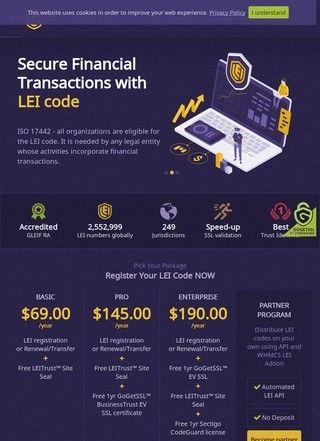
In the LEI market, the dividing line is accreditation. The Global Legal Entity Identifier Foundation maintains the registry that governs the whole system, and only an accredited Registration Agent (or a Local Operating Unit) can put a valid code into it. Plenty of reseller sites sell LEIs without that standing, and a buyer often has no way to confirm the code ever reaches the global database. LEI Code Registration sits on the right side of that line: GLEIF lists LEI Code Registration as a confirmed Registration Agent, and it issues through Ubisecure RapidLEI as its Local Operating Unit. The chain is checkable against the GLEIF registry in a couple of clicks, which is the first thing worth knowing about LEI Code Registration and the thing that separates it from the unaccredited crowd.
GLEIF accreditation and registration scope
The offering spans the full life of an LEI: a fresh registration, a renewal before an existing code lapses, and a transfer for an organisation moving its record off another registrar. Coverage extends across more than 203 countries. Processing time is quoted in jurisdiction bands labelled A through D, ranging from roughly five minutes for the fastest registries to about 78 hours where manual checks apply. That banded estimate is the honest way to do it; a single same-day promise would paper over the fact that national registry response times genuinely differ, and the spread here tracks that reality.
Processing times across jurisdictions
Pricing at LEI Code Registration comes in three tiers, Transfer, Basic, and Pro, each sold across one-to-five year terms. A one-year Basic registration is $69, a one-year Pro is $145, and the longest commitment, a five-year Pro, reaches $601. Because an LEI has to be renewed every year to stay active, the multi-year terms address a concrete failure mode: a code lapsing because a renewal reminder slipped past someone. The reduced transfer rate makes sense too, since an incoming entity has already paid a previous registrar. Publishing the full grid this plainly is not the norm in the niche, and it lets a buyer line the numbers up against rivals without a sales call.
Pricing tiers and multi-year terms
Around the core registrations LEI Code Registration adds a few extras. There is a free LEI lookup and entity-search tool that works without an account, handy for vetting a counterparty. There is a LEITrust Site Seal for client websites, a reseller and API program that the site says runs to 7,560 resellers, and bulk enterprise solutions for registering many entities at once. The 7,560 reseller count and the headline 108,138 customers served are the company's own figures, not independently audited. They are large, and they at least place the operation at meaningful scale, but as self-reported totals they prove activity, not satisfaction.
Additional tools and reseller network
Here the file on LEI Code Registration gets uncomfortable. The company has exactly one Trustpilot review, scoring 3.2 out of 5, and that lone reviewer described a wait stretching past a week, longer than the advertised window. Nothing turned up on BBB, Google, Yelp, or comparable platforms. One review against a claimed six-figure customer base is statistically meaningless, and the problem cuts both ways: there is no broader public record to weigh against that single negative account either. So the service-quality question stays genuinely open. GLEIF accreditation settles whether the issued code is a valid entry in the global database. It says nothing about turnaround when a case stalls, or about what support looks like when a registration goes sideways, and those are separate matters from validity.
Service quality from limited reviews
Contact arrangements at LEI Code Registration are mixed. A contacts page is reachable from site navigation, so a support route exists, yet the registration landing page itself shows no phone number or email. Account management runs through a separate third-party portal at my.gogetssl.com, so a first-time buyer meets two systems before sorting out a billing query. Outsourced account infrastructure is common among compliance vendors, but it adds a step. The corporate trail does resolve cleanly: the parent is DigiCert Ireland Limited, and the site seal points to EnVers Group SIA in Riga, Latvia.
From account management to parent company
Put LEI Code Registration next to LEI Register, a frequently cited competitor in the same segment (GlobalLEI is another). All three hold GLEIF accreditation and publish pricing. The points where LEI Code Registration stands apart are the five-year term, the no-account lookup tool, and the explicit RapidLEI disclosure that lets a buyer verify the issuing LOU on their own. The deficit is the review record.
How LEI Code Registration compares
GlobalLEI, by contrast, carries several hundred Trustpilot entries, which is the kind of evidence a buyer can actually read through. If the only real concern is whether a code will clear regulatory checks worldwide, the credentials LEI Code Registration publishes answer that fully, and no consultation is needed to confirm it. If the concern extends to how the registration experience plays out, the published record here cannot speak to it, and a competitor with a deeper review history gives a buyer more to go on. On credentials, LEI Code Registration is sound; on demonstrated service, LEI Code Registration is asking to be taken on trust, and LEI Register is the easier place to find that second kind of evidence.
Business address
EnVers Group
J.Dikmana street 4 - 26,
Riga,
None
1058
Latvia
Contact details
Phone: 66164222